“MIA is a market of ideas,” says Marco Spagnoli ahead of the event’s 2021 roll-out. It’s also a place that is very much open for business, he adds, especially following a past 18 months of stay-at-home frustration and uncertainty.
“I believe in meeting people,” says the MIA Head of Unscripted, reminding that he was once a journalist whose modus operandi involved face to face engagement, at the same time acknowledging that virtual markets have been somewhat of a ‘headache’. “I don’t think that any industry can progress without the ‘meeting’… When you meet people, you understand if you want to work with this person, you can trust this person and you can learn also, what is the expectation, for example, of the producer wanting to work with you.”
Core to events this week in Rome is the presentation of 14 new unscripted/documentary projects, seven international and seven from Italy, of which 10 are feature-length docs and four are doc series.
These projects cover a smorgasbord of subjects both artistic and potentially crowd-pleasing, from the Hungarian doc series Queen of Chess, that examines the complex relationship between Judit Polgar, the greatest ever female player of the game, and her nemesis Garry Kasparov; to French director Lionel Guedj’s Topper Headon: I Fought the Law, about the complex life of The [eponymous] Clash drummer; to Wanted: Roni Kalderon, the story of the Israeli professional footballer turned international drug lord.
Italian projects include the doc series Re-Making of Love in which eight young people between the ages of 18 and 24 share the dream to create a new form of sex education and present it to their peers. The series Odyssey: Behind the Myth comprises an epic journey in the footsteps of the mythical hero Ulysses, while I Don’t Forgive tells the most unlikely story of reconciliation and friendship between two women after the son of one murdered the husband of the other.
Documentary is currently in the ascendant, Spagnoli acknowledges, adding how the job of him and his colleagues is to support the sector, whether internationally or at home in Italy.
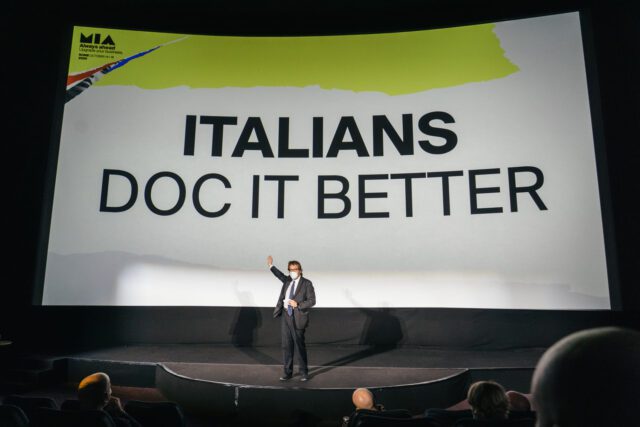
Spagnoli therefore flags up Saturday October 16’s ‘Italians Doc it Better’ showcase of 17 Italian documentaries completed in the last year that are yet to be released internationally. During the event producers are each given five minutes to present their new work to an audience of international buyers, commissioning editors and press.
The Unscripted chief refers to the “new sensibility” of Italian docmakers, which he says derives from their greater sense of “internationalism.” In this, he compares the local doccers to Italian footballers (one of many sporting metaphors he deploys) whose game has improved by playing in, and/or studying the game of, foreign leagues. While their doc output remains recognizably Italian, it is demonstrably better, he argues. “We have a new generation of documentary filmmakers,” says Spagnoli, which he is determined to shout about.
He further points out that the majority of top Italian decision-makers from the broadcast and funding sectors will be in Rome, as well as potential co-producers to back international productions. “We really want to make people meet each other in an environment that offers possibilities, where you can make also discoveries,” Spagnoli says of the “one stop shop” event. “You don’t only get to meet Rai or Mediaset or Italian Netflix at MIA.”
Industry analysis of documentary and unscripted comes via a wide-ranging programme of key-notes and panels. These include an address titled Dispatches from the Golden Age, during which acclaimed producer/director R.J. Cutler will assess the new documentary landscape dominated by streamers, and looks towards what the non-fiction filmmaking community has in store.
Archive is in the frame as German visual researcher Elizabeth Klinck guides us through the world of research, archival imagery and music rights clearances (October 14) while an October 16 panel that includes speakers from Rai and Cinecittà will explain issues such as rights management and the budgeting of footage costs via concrete doc examples.
MIA will also host Cecilia Penati, Creative Content Development Senior Manager at Discovery Italia, who will discuss the approach her company is taking with local content from a creative and strategic perspective, its signature style in real-life entertainment, and its role within the ever-growing and changing audiovisual landscape.
A case study that English delegates may find particularly distressing is the 14 October (Thursday) panel about Sogno Azzurro, the series that follows the Italian national football team’s gilded path to victory (against England) in the final of the 2021 European Championship.
Spagnoli continues with sporting allusion in describing the essence of MIA 2021. “Italy is the home team, but it’s not the team,” he says. “MIA is a place where you can [meet] many Italians, but you also get to meet people from all over Europe and from some parts of the world [he acknowledges current travel restrictions]. It’s in Rome, but it’s a very international market.”
He also underlines that the MIA event is one that he and his colleagues are continually eager to improve. “Rome wasn’t built in a day, of course, but when it was, it took a lot of people from all over the world to build it.”