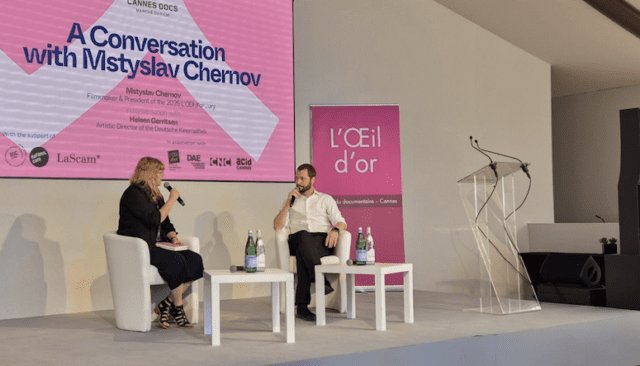
At this year’s Cannes Docs Doc Day (May 19), the opening addresses focused on the increasingly central role of documentary cinema at a time of political instability, disinformation and growing pressure on independent storytelling. But the emphasis quickly shifted to Ukrainian filmmaker and war correspondent Mstyslav Chernov (also President of L’Œil d’or jury) whose discussion with Deutsche Kinemathek Artistic Director Heleen Gerritsen offered highly thoughtful and sensitive reflections on the ethical and artistic dilemmas facing filmmakers working in conflict zones.
Opening the event, CNC president Gaëtan Bruel argued that documentary cinema remained “an art of attention, investigation and complexity” in an era when information is simultaneously omnipresent and increasingly distrusted. He stressed that documentaries “restore context” and “resist simplification,” while warning against separating culture from journalism in moments of geopolitical crisis.
Representing French authors’ society Scam, Anya Unger similarly underlined the fragility of trust between non-fiction filmmakers and audiences, as manipulated or AI-generated images proliferate online. She called on documentary communities to organise collectively, defend artistic freedom and maintain direct dialogue with viewers.
Yet it was Chernov’s contribution that gave the session its emotional and intellectual heft. Best known for the Oscar- and BAFTA-winning documentary 20 Days in Mariupol and recent feature 2000 Meters to Andriivka, the filmmaker repeatedly rejected the idea that documentary practitioners possess definitive answers about how to represent war.
“There’s so much responsibility on the genre right now,” he said, before adding that filmmakers are ultimately “lurking in the dark,” constantly searching for a language capable of responding to a changing world. Chernov emphasised that failure is an integral part of the process, revealing that he had abandoned two earlier documentary projects that he started after 2014 because he lacked “the right team,” resources or timing.
For Chernov, 2000 Meters to Andriivka (2025) emerged directly from that ongoing search. Whereas 20 Days in Mariupol(2023) focused on civilians trapped during Russia’s siege of the city, the newer film follows Ukrainian soldiers in the trenches. He described the project not as a calculated continuation but as another attempt to understand what mattered most “for the country at that moment,” and for a world suddenly focused on Ukraine.
Discussing cinematic form, Chernov acknowledged that his documentary structures are deeply influenced by fiction cinema and literary storytelling. He said he consciously approaches non-fiction filmmaking through the lens of classical dramaturgy because documentaries must compete for theatrical audiences alongside mainstream fiction releases.
“We are balancing on this thin line between being truthful and realistic and honest, and trying to be exciting,” he explained. “Documentaries deserve to be in cinemas.”
Literature also entered the discussion through Ernest Hemingway, whose A Farewell to Arms inspired the opening quotation in 2000 Meters to Andriivka. Chernov recounted how salvaged a copy of the novel from a bombed Mariupol hotel library, and carried it out of the city while passing through Russian checkpoints. He also recalled citing Hemingway while arguing with Associated Press editors who initially resisted publishing his first-person account of the siege. That article would later become the basis for 20 Days in Mariupol.
One of the most compelling parts of the discussion centred on the difficulties of creating documentary cinema during an ongoing war. Chernov argued that urgent filmmaking carries both advantages and risks: immediacy gives films power, but insufficient time for reflection can limit their depth.
“A good film needs time,” he observed, comparing filmmaking to the natural growth of fruit that cannot simply be accelerated.
At the same time, he warned that delaying production risks losing public attention altogether. Drawing parallels with waves of Syrian and now Iranian cinema emerging from conflict, he identified two broad tendencies within contemporary Ukrainian documentary filmmaking. One adopts a more poetic and distanced perspective, allowing audiences to process trauma without becoming overwhelmed; the other seeks maximum proximity to violence and realism, even at the risk of alienating viewers.
“The filmmaker who tries to tell a war story cannot cleanse it,” Chernov insisted. “It has to be terrifying.”
Asked about Ukraine’s cinematic identity and Soviet film heritage, Chernov pushed back against the idea of Ukraine as merely “post-Soviet,” stressing that Ukrainian culture predates the Russian Empire and has historically influenced Russian culture as much as the reverse. He argued that imperial systems routinely appropriate artists and cultural traditions from conquered territories, including filmmakers historically categorised abroad as simply “Russian”.
The conversation later turned to language and identity. Chernov explained that while he grew up speaking both Ukrainian and Russian, Russia’s invasion accelerated his transition towards exclusively using Ukrainian. He described language as both a political weapon and a crucial marker of national identity, criticising long-standing narratives portraying Ukrainian culture as secondary or derivative.
Chernov also reflected candidly on the impact of winning the Academy Award. Far from simplifying his life, he admitted that the Oscar had made his situation “way more dangerous” for himself and his family, increasing security risks while simultaneously forcing him to rebuild his professional identity from scratch as a filmmaker rather than solely as a journalist.
Still, he acknowledged that international recognition has allowed him to collaborate with artists he deeply admires, citing composer Sam Slater among the creative partners now accessible to him.
By the end of the discussion, Chernov repeatedly returned to the same core idea: that storytelling itself remains essential to how societies understand reality, regardless of whether stories take documentary or fictional form.
“We crave for stories,” he said. “We learn listening to stories.”