An inspirational, moving and ultimately uplifting film telling the unlikely story of a compassionate headmaster determined to change fortunes on an inner-city all-boys primary school and who turns to the wisdom of the ancient Greek philosophers, Young Plato is a breezy and powerful documentary that tackles big issues with a gentle touch as young minds learn to embrace challenging ideas.
Kevin McArevey is clearly a maverick. Rather than waiting for explicit permission from the educational boards to implement his ideas, he went ahead and showed what making philosophy a core subject in his school could do. Around him the school staff have tried to create an oasis, where the children – and often their parents – were supported by an dedicated team who were also determined to make a difference.
Holy Cross Boys School is a Catholic state school in one of Belfast’s toughest neighbourhoods, an area still scarred by sectarian struggle. It is still an area that is walled, fenced and gated, which accentuates the notion of turf, dividing and containing people with opposing political loyalties and perceptions. The nationalist Ardoyne area did not benefit from any significant ‘peace money’ that poured into Belfast after the Good Friday agreement in 1998, and as a community they were largely left to fend for themselves. Poverty, drugs, suicide and dissident paramilitarism continued to have an impact on the families in Ardoyne.
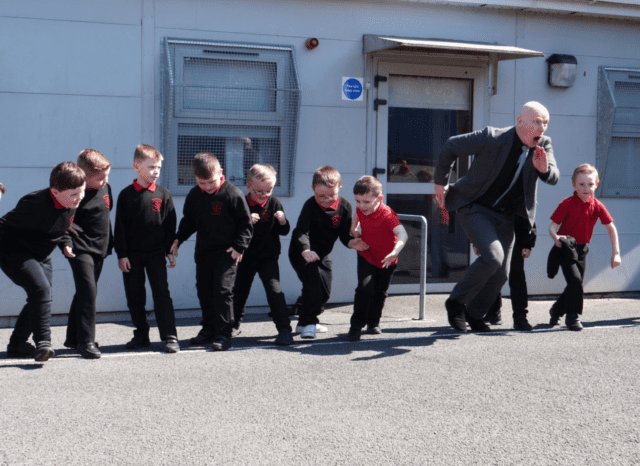
Kevin McArevey may well wear the suit, but his gentle sense of rebellion sets him apart. The film opens with his driving to school with Elvis Presley’s ‘If I Can Dream’ blaring from his radio. McArevey is an Elvis fan and he takes inspiration from the King. He high-fives the youngsters as they arrive in class, knows all of their names and chats to each and every one.
A ‘viable device’ (a bomb) is found close to the school, but he is quick to reassure children and parents that they are safe; a local man – and former student at the school – tells the children what their streets were like in the 1960s and ‘70s when the area was a “war zone,” and with the help of other staff – and in particular head of special needs Jan-Marie Reel – tackles bickering, fights and the worries of the children.
The children at times eagerly respond to their philosophy lessons – when one correctly shouts out the age of Seneca he responds with an enthusiastic “yessss” – and are taught to challenge truths and preconceptions.
In one class he challenges the children to go to their favourite place…but in their minds. Some talk about holiday spots and one about McDonald’s, though McArevey admits his favourite mental place is Graceland, the home of Elvis.
As the academic year comes to an end, so it coincides with the painting of a mural (a great Belfast tradition) on the side of a house close to the school. Using the design of a philosopher deep in thought with the face of one of his young students, the image pulls together the ethos of the school, and though COVID has its impact on the way the school functions, Kevin’s manta of “Think, think, Respond!” still defines the lessons being taught.
Delightfully directed by Neasa Ní Chianáín and Declan McGrath in classic fly-on-the-wall style, the film uses its access perfectly, treating both adults and children alike with respect and compassion. It balances harsh Belfast truth with sage-like philosophy and demonstrates how teaching can make a real difference. It would be easy to see a drama re-make being put into production, but somehow in this instance it feels like it might ruin what is a story of pure educational inspiration.
Ireland-UK-France-Belgium, 2021, 102mins
Dirs Neasa Ní Chianáín, Declan McGrath
Production Soilsiu Films
International sales Autlook Films
Producer David Rane
Cinematography Neasa Ní Chianáín
Editor Philippe Ravoet
Music David Poltrock
With Kevin McArevey, Jan-Marie Reel, the students of Holy Cross Boys School, Belfast