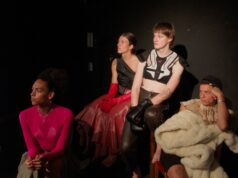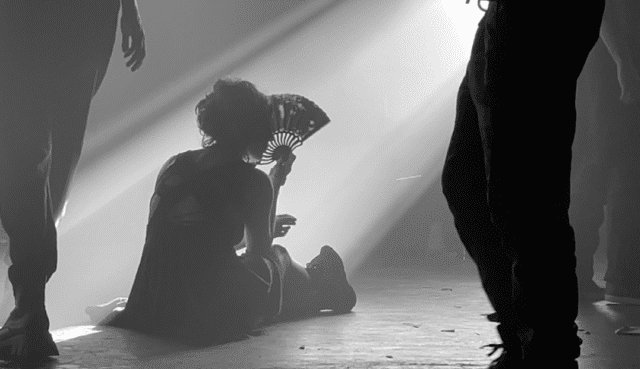
Hugo Pedro’s The Exemplary Tales of the Dancing Beings is a documentary essay constructed from a collection of moments – sometimes idyllic and elegiac, at other times drug-influenced – filmed on a mobile phone over three years. Guided by notes from Sophia de Mello Breyner’s children’s story The Bronze Boy, Pedro portrays a circle of friends, a “constellation,” who are dissatisfied with the values of society and adult life.
“By portraying this intimate space shared among a group of friends, we have this unfiltered and unique look into the lives of a non-conformed youth,” production co-ordinator Vasco Esteves tells Business Doc Europe. “Hoping for a more humane world, their daily experiences are fuelled by the desire to conceive a parallel world, a refuge, a community, where they can play, feel happy and be free.”
“The film shows a particular way of living life and an intimacy that is rarely seen in cinema,” he adds. “This desire for playfulness, happiness and freedom is exactly what interested us the most in Hugo Pedro’s proposal and that we believe will resonate not only with Portuguese audiences, but international as well.”
Director Pedro adds: “This film was born out of the desire to articulate a shapeless set of personal records that I collected for leisure between 2021 and 2024 – a period of my life marked by the enthusiasm of conceiving a parallel world, a refuge, a community.”
Produced by Filipa Reis, the 85-minute film should be ready for March 2026 delivery. In Lisbon, the team is looking to finance the post-production support, and to entice distribution partners. So far, the film was made with no budget, with Pedro investing his own time and effort, together with a couple of like-minded peers and friends who believed in the film’s “power of affection” and connection with an audience. Budget-wise, the main focus is on rights clearance of the music that “punctuates” the film as well as further developing the film’s sound design.
“Hugo Pedro’s delicate and personal approach perfectly encapsulate the context of frustration felt by his generation living in a world deprived of stability, security, compassion and ultimately love,” Esteves says of his director. “Through Hugo’s lens, we are invited into this private and genuine realm where joy and celebration are compatible with adult life, where innocent play and imagination are a reality beyond childhood.”
Divided into fourteen parts, the film articulates the “mosaic of personal archive images” in a fluid storyline, framed with excerpts from Sophia de Mello Breyner’s children’s tale The Bronze Boy, the production co-ordinator adds.
“Placed within a stylistic ambiguity, the film sculpts the rough naturalism of the images with a transparent and smooth grammar derived from fiction. The alternating black and white to colour, the tight close-ups, the dialogues in informal conversations between friends and the constant camera movement lend the film its authentic and raw look. The strong dynamic of the film’s home-made footage perfectly captures the poetry of everyday life, restoring our faith in society’s ability to change its current downward spiral into apathy.”
Pedro adds how he was also “driven by the curiosity to build a long-length discourse out of fragmentary material, embracing the elliptical and fleeting logic that defines the image-consumption model shaped by social networks, in order to restore its lost sense of meaning.”
The production team is looking to secure a premiere at a major international docfest in 2026, “which is without a doubt the most favoured space for a film to start its life, find its audience and promote a discourse around its subject,” Esteves tells BDE. “Afterwards we will privilege theatrical exhibition opportunities where the communion between viewers and the film will be the most forceful, before bringing the film to broadcasting channels and international VOD platforms in search of a broader audience.”
“The most satisfying takeaway from Doclisboa would be to find a viable financing path to make this film come to life and be able to screen it where it should be seen: in movie theatres,” he signs off.