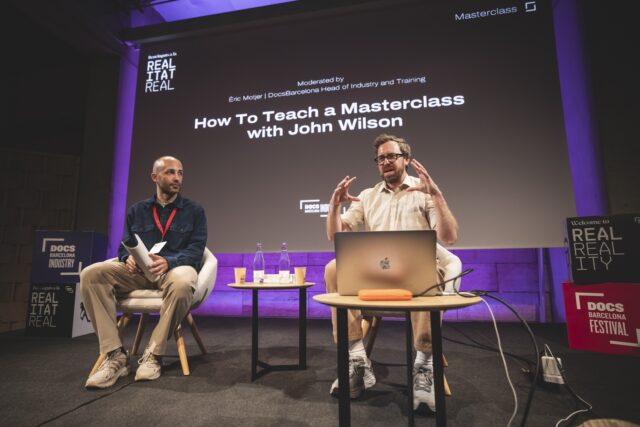
In hilariously ironic and self-reflective fashion, US filmmaker John Wilson explained his working MO to the audience of Docs Barcelona Industry. His Emmy-nominated three-season series How To With John Wilson, about everyday folk and their everyday lives, has achieved enormous worldwide success on HBO Max.
First of all, Wilson explained what he had been doing in Barcelona for the past three days. “It was cool. I did some karaoke. It was just me and a bachelorette party [who] got really weirded out that I was filming. But yeah, it’s been really fun, really beautiful. I really like it here. I really like dense cities with a lot of visual stimuli.”
He then spoke about the process of interviewing on screen, and how he still uses an old analogue Sony microphone from the 1980s which has a “really nice warm sound.”
“So I like to hand people the microphone when I’m interviewing them because then in order to end the interview, they have to give it back to me,” he explained to the amusement of the Barcelona audience. “So you’re kind of tethered to them, which creates a really interesting dynamic…And honestly, the closest thing I can relate it to is just when you’re at a bar and someone’s just talking at you for an hour, that’s the kind of vibe that I feel like I try to recreate in the work where I like to find someone that can just talk without interruption and just doesn’t care what I think, which is I feel, how most conversations historically for me go.”
For him the camera was “this kind of amazing instrument that I feel wasn’t really used in an intelligent way as an extra character in the room in most documentaries.” Whereas many filmmakers try to hide its presence, “for me, I very much wanted to fuse with the instrument and become this self-contained unit that people could just look directly at me and there’s no artifice because they’re looking straight into basically my eyes [via the lens].”
This can have interesting consequences, he conceded. “I would get through an entire interview and then at the end, the person that I was interviewing would be like, okay, so who’s the host? Whose show is this? And I was like, oh, it’s me and I am going to be using my questions in the show. And they’re like, oh, okay. A lot of people just thought that I was a camera person that was about to lose his job because I wouldn’t shut up.”
Wilson has been making films since the age of 13, he said, experimenting with “a bunch of really goofy comedic stuff.”
“And so I think that was always in my blood in a way just because it was just the coolest thing in the world to me that once you run out of things to watch, you can then just make your own entertainment and you can make the stuff that doesn’t exist. And I think that’s been this propelling force for me throughout my whole life.”
When he went to film school in New York, he experienced a ‘what’s the point’ moment. “I just started to actually think about why I was making anything and why even a moving image – why, on a really molecular level, why keep doing this? Because I could be writing essays or try to do something else.”
His response was to take it back to the realm of the personal. “I just tried to take all the stuff that I was really obsessed with and turn it somehow create a container for all of my favourite stuff,”
“So I just got the shittiest camera that I could find, just a little camera the size of a cigarette box and just started to film everything myself. And it was liberating because I didn’t have to ask anyone for favours and I could do everything myself and it was free. And then, the second I was done with it, I would just put it on the internet because I was so worried about my hard drive being corrupted that I was like, once it’s on Vimeo, it’s like, ‘okay, good, now it’s their problem.’”
His shooting style was later influenced by work he undertook for a firm of private investigators. “I did that for a year until I was eventually fired and replaced with a high schooler that they didn’t have to pay, but it really affected the way that I shoot stuff because I became really addicted to viewing people from a certain distance. And you saw these really unfiltered moments with them when they were out at home…or just on their front lawn or something like that. And I just wanted to recreate that energy somehow within my own work.”
After he manufactured a meeting with producer Nathan Fielder, he made a three-minute pitch video to show to HBO, who subsequently ordered a pilot, at which point Wilson had to think hard about what the show was going to be, and what it would consist of.
“I thought that I didn’t have any gas left in the tank at all,” he said. “I thought that I had said everything that I needed to say, and I was terrified of not being able to sustain a single episode, let alone a whole season. But we just talked about it and we figured out what needed to stay the same, what needed to change. We realized that it needed to be broadcast quality, so I got an HD camera, but everything else did pretty much stay the same. We just had to put the production on steroids because it would usually take me a year to make a 10-minute movie. And I realized that we needed to basically clone myself somehow and have people that knew how to shoot what I wanted to shoot.”
He had an intrinsic trust in his team of newly cloned personnel, but nevertheless made a “bible” of do’s and don’ts of what worked for him and what didn’t. Such as to stay stable on a wide shot if the subject isn’t moving, or stay still and follow the action. Or to move towards the object and “be kind of part of the humour or style somehow.” Slow zooms only, and never zoom if using an I-phone. Spend at least 10 seconds filming whatever you land on. “I know it feels really weird, but I need at least 10 seconds for it to be usable at all in the edit,” he said.
“Recognize patterns and images that pair well, somehow these might go together…So I would basically just give them a scavenger hunt list and tell them to go nuts. But also I would say if there’s anything that’s more interesting than just what’s on the scavenger hunt list that you should film that. I don’t care what direction I give you, I trust your instincts.”
He added numerous other do’s and don’ts, during the masterclass, including the absolute necessity to tag and cross-reference everything.
Wilson would initially slave over the editing himself but he was eventually able to hand over that task to others. “I was really anal and the edit is a very personal thing for me. But I eventually got over that and the editors did way funnier stuff than I could have because they could see all the footage that I shot, realize what’s kind of funny and pathetic about me, and then put in jokes from the raw footage that I wouldn’t have even recognized as a vulnerable moment.”
“But there’s this amazing thing that happens with all of this footage, even though there’s thousands of hours of it. Me and the editors, we remember every single clip, every single one, and we would have a shorthand with each other, and if we said ‘oh, you remember the guy who’s screaming on the phone next to the garbage? Then they’d be like, ‘oh yeah.’”
“Those were all in a massive database, that we could just type what we wanted and pick out if we needed a shot of [for example] dog shit. We had a thousand fucking shots by the time the third season was over, and it was just really easy to have this kind of recall.”
Later in the masterclass, Wilson discussed how he deals with releases, ie permissions from the folk whom he had randomly filmed on the streets. “It is different for each shot. Every single shot is its own unique legal calculation, which may seem insane,” he said. “I have four teams of people going out and shooting every day, just random stuff. And there’s a field producer with each of them. So once they get the shot, they’ll signal to the field producer to whoever the [subject] is. They have some series of hand signals and the producer will go up to them, try to explain as quickly as possible what the show is and why we need a release from them. And that usually is fine. A lot of the time people don’t really care because a lot of the people that I hired were really good friends that I think have exceptional social skills. And I think that’s a really big part of it too, just to be able to talk with people in a way that I usually can’t. Like, if I was going out getting releases from everybody, it would be a nightmare…because I get very kind of marble-mouthed when I start to talk about legal stuff.”
Wilson also pointed out that these days he is recognised more and more on the streets of New York. “I feel like I have changed in a way. I feel more visible now and I feel like I can’t be as anonymous, which is the great irony of this project. But I mean, everyone that comes up to me is usually really great. And it’s honestly a dream that they want to tell me weird stories. And I think that’s kind of what I desire a lot.”
At the end of the talk, he told the audience that he is hatching a plan to make something “a little longer and more ambitious, more kind of feature-length vibe, hopefully, if I can convince someone to give me money in this brave new world of documentary financing that we are all in somehow.”
He also expressed his surprise that his show was so popular among the Barcelona professional audience, and widely across Europe. “I mean, I had no idea that anyone watched it here at all. It’s really amazing to be kind of recognized, I think, by the cinematic community because that’s kind of where I always wanted to be,” he signed off.