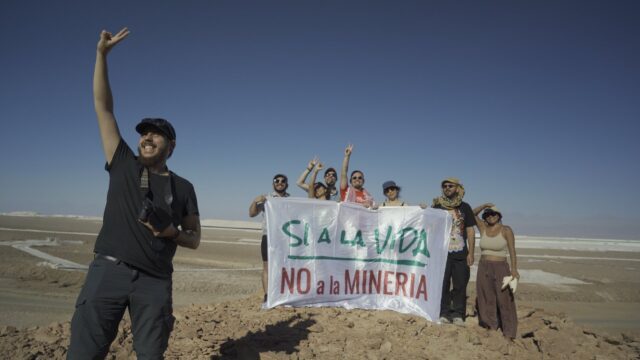
Impact is at the core of Aline Juárez and Juan Francisco Donoso’s doc project All We Have Is Us, which follows socio-environmental movements defending the Atacama Desert (Chile) and the Jadar Valley (Serbia) against increasingly pervasive lithium mining, used in the manufacture of electric cars and renewable energy, as well as weapons manufacture. The film highlights the connections between both struggles.
“The story begins in two places that may never appear in the same sentence: Chile and Serbia. Two different communities, who are defending their lands from mining giant Rio Tinto, which seeks for [this] lithium,” says co-director Juárez.
The film follows an indigenous radio journalist, a rural beekeeper, an academic activist and a US/Serbian actress as they unite to defend their respective environments. Leyla, Vladan, Ramón and Bojana allowed the filmmakers access to their lives shaped both by advocacy and their unyielding commitment to their respective environments. In the process they offer up powerful testimonies that reflect the experiences of the many brave communities within what are referred to as the “sacrifice zones.”
In 2022, Bojana and activists from Europe gathered in the Jadar Valley, joining forces with Chilean Ramón Balcázar. Together, they signed the Jadar Declaration, uniting more and more groups against lithium extraction. Ramón, dedicated to protecting the Andean salt-flats in Chile’s Atacama Desert, collaborates with indigenous journalist Leyla Noriega, who successfully delays company Rio Tinto’s explorations with community support. The film film also gives a voice to a Rio Tinto executive who make a passionate defence of his company’s ongoing modus operandi.
“The impact was clear from the start, especially given that we live in Germany, where the car industry and lithium demand play significant roles,” Donoso underlines to BDE his and partner Juárez’s credentials in delivering both the film and its associated Impact campaign. “[As directors, we] bring a unique combination of strengths to the project. We both have the sensitivity of auteur cinema, which allows us to approach the story with a deep artistic and emotional understanding, while also having extensive experience in climate communication. This makes us an ideal and compelling duo to tell the powerful experiences of communities confronting the exploitation of their land, striving to share these stories not only for awareness but also for tangible impact and action.”
“We want the film to be a toolkit for real change, starting with local screenings and discussions in mining towns, sacrifice zones, and community events like fairs, climate camps, and cultural festivals. These screenings will provide spaces for dialogue, where people can share their struggles, build solidarity, and strengthen their resistance to “green extractivism.”
Right now, the team is looking for sales representation, broadcast and distribution deals and festival interest, as well as close the film’s budget.
“Lithium mining has been in Chile for decades, but now it’s also coming to Europe,” warned Donoso. “Last month, the European Parliament designated 47 mining “strategic projects” in Europe. One of them is in Serbia. What they today call ‘strategic minerals,’ tomorrow will be ‘conflict minerals.’”
Added Juárez in Barcelona: “Yes, of course we must phase out fossil fuels…but really, should Ursula von der Leyen or Elon Musk be deciding on the future of farmers and indigenous communities? The good news? We still have each other, and they are building global movement with more communities. All We Have Is Us is more than a documentary: this film will be a masterclass, a resource to foster dialogue, inspire action, and connect struggles across continents.”