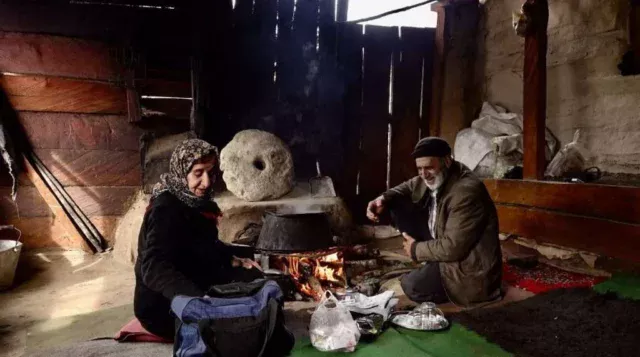
No Friend but the Mountains follows an elderly couple in northern Iran, the last keepers of an ancient nomadic tradition, living in isolation as development, migration, and ecological collapse quietly close in on their land and lives.
“This project captures a vanishing way of life at the precise moment of its possible disappearance,” director Yaser Talebi tells Business Doc Europe. “What makes the project unique is its intimate, long-term access to the characters over multiple years and seasons, combined with a purely observational approach. Rather than constructing conflict externally, the film allows time, landscape, and daily labor to reveal a quiet but profound tension between staying and leaving, continuity and rupture.”
“For audiences, the film offers a deeply human and immersive experience of a disappearing world. For partners, it represents a visually strong, internationally relevant story that intersects ecology, anthropology, and universal questions of belonging and loss.”
Talebi further outlines what she believes to be her creative strengths. “My filmmaking approach is rooted in long-term observation and relationship-building,” she says. “In my previous films, such as Beloved and Destiny, this method has resulted in intimate, character-driven narratives that have resonated strongly with international audiences and festivals. I work closely with my subjects over extended periods, allowing the camera to become part of their lived environment.”
The director is also taking a producer credit on the Iran/Turkey project, together with Yaser Setareh Lundgren and Mahnaz Tafaghi.
“The film is built around compelling, real-life characters whose personal stakes are clear: aging, solitude, and the absence of a next generation willing to continue their way of life. The narrative unfolds organically through seasonal cycles, revealing both emotional and existential layers,” she adds.
The project has been developed over the past three years, with substantial footage captured across different seasons. It has participated in international markets (including Hot Docs Deal Maker) and Talebi is currently in discussion with potential partners such as NHK and Al Jazeera. “We are actively seeking European co-producers and final financing to complete production and post-production. The budget is structured in phases, allowing flexibility while ensuring a high-quality cinematic outcome,” Talebi confirms.
The film promises to be a feast for the eyes, adopting a “patient, observational visual style grounded in duration and presence [relying on] long takes, wide frames, and minimal intervention, allowing the viewer to inhabit the rhythm of the characters’ lives.”
“Nature is not treated as a backdrop but as an active cinematic force,” Talebi adds. “Fog, light, seasonal changes, and the movement of animals shape the emotional and perceptual space of the film. The visual language leans toward an impressionistic sensibility, where perception and atmosphere take precedence over plot-driven narration.”
“The absence of overt exposition allows the film to move toward a more sensory and immersive experience, where time itself becomes a central element.”
Director/producer Talebi stresses how the project carries a strong impact dimension, but will be subtly handled, with broader conversation planned around: environmental preservation and the fragility of ancient ecosystems; the disappearance of embodied ecological knowledge, and rural depopulation and generational shifts.
“We envision impact through festival circulation, partnerships with environmental and cultural organizations, and outreach to audiences concerned with sustainability, heritage, and human–nature relationships,” Talebi tells BDE.
“DocsBarcelona offers an important opportunity to refine the film at a crucial stage,” the director further stresses. “Presenting a rough cut allows us to gain valuable editorial feedback, strengthen the narrative structure, and connect with potential co-producers, broadcasters, and sales agents.”
“Equally important is the dialogue with international peers, which helps position the film more clearly within the global documentary landscape while maintaining its distinct voice,” Talebi signs off.