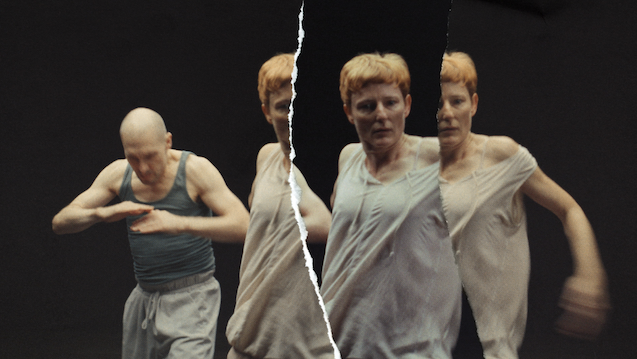
“Domestic violence is a world-wide problem and concerns the entire society. If you look close enough, you will detect a victim or a perpetrator in your own close environment,” German producer/director Alina Cyranek told Business Doc Europe ahead of her presentation of the work-in-progress Curtains at DOK Leipzig’s DOK Preview Germany platform. “But usually life continues and the fewest people take action.” she added.
The project was awarded the D-Facto Motion Works-in-Progress Prize, providing post-production services valued at €10,000.
Cyranek’s film comprises a three-layer approach to the subject, entailing interviews with people who work with victims of domestic, and a second level that tells “an unembellished, authentic life story,” narrated by Sandra Hüller, with staged, highly aesthetic, at times animated, dance sequences. A third dimension is a motif of static shots of numerous building facades
“I hope that the language of highly aesthetic dance elements supported by animation [and] the simple interviews with the experts and the incredible interpretation of the text by Sandra Hüller, will create a unique cinematic experience,” the director tells BDE. “Also, the balance between the personal, very dramatic story and the classifying information by the experts will trigger a thinking process and reflection in the audience.”
Cyranek researched the project for almost two years, speaking to numerous victims of domestic violence and attendant experts.
“I think the ability to listen and to guarantee safety for their very personal and traumatic stories were the key,” she says was a particular strength she brought to the table. “I was always transparent about the project and how their real-life accounts are going to be part of the film. The concept of all elements was clear from the very beginning. I usually pretty exactly know what I am looking for and how everything will add up to a final film.”
“Still, I like to work with people who are inspired by the project and add their ideas to it,” she adds. “There were inspirations coming from all departments, which was extremely rewarding and made the film much, much better. I am confident, though, in taking decisions towards which ideas help my vision to come true, and which are leading away from it. The form of the film is very simple and clear – this was always important to me. Within this structure though, I was able to push creative boundaries.”
The chapters will alternate between the dance sequences and static film shots of various
apartment building facades, such as an apartment building, a row housing estate, a prefabricated building, a detached house, a villa. Cyranek stresses how the images are designed to reflect the open question of how society perceives the subject, ie “what happens behind closed doors is a private matter.”
Cyranek further describes and explains the text, as narrated by Sandra Hüller. “[It] was interwoven and condensed from the experiences of four women, both to preserve their anonymity but also to move away from a TV-typical transposition: concrete faces and certain ‘types of women’ that provide conclusions about social standing, age, religion or origin,” she says. “This lyrical ‘me’ stands for all women affected by domestic violence, because often such relationships follow the same pattern of a spiral of violence, regardless of education level, nationality or religious affiliation.”
“I received a great deal of encouragement from…Sandra Hüller,” she adds. “Working with her was wonderfully uncomplicated, and her interpretation of the text gives the film an incredible pull.”
Nothing in the narration is invented. Everything is sourced from true testimonies, she further underlines of the text.
The film will be ready for early 2025, when Cyranek is looking for a festival premiere, ahead of a theatrical release later in the autumn. In Leipzig the producer/director is also looking to gain feedback and to pique the interest of sales companies.