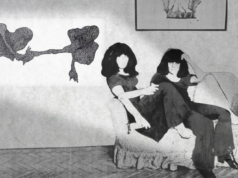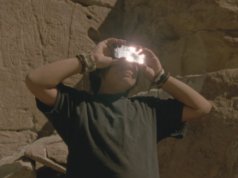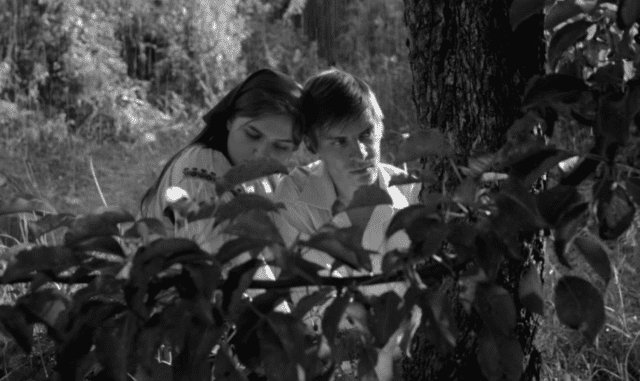
The gentle, respectful underlying sense of humour permeating Russian-born Aleksey Lapin’s playful portrait of a village near the Ukrainian border, where he used to spend every summer as a youngster, helps prevent this hybrid documentary from being cruel or critical. The fact that locals enter into the spirit of the film serves to give it warmth, insight and a helping of generosity.
Shot in a warm monochrome format that helps draw out the best of the summery backdrop of the village, Lapin sets about establishing a casting process for a fake film that allows him to revel in absurdities and play with the boundaries between fact and fiction. How much locals actually buy into the notion of being ‘cast’ for the fake film is never really clear, but many seem to enter into the irony of the production, while others seem happy to have the opportunity to talk about themselves, their lives and aspirations.
While the running time of more than two hours perhaps means that KRAI (which means “the country”) can be a little languid and slowly paced at times, it does allow for a series of memorable vignettes, whether it be the party that the crew sets up to introduce the ‘film’, or a woman methodically papering the wall in a child’s bedroom. It also gives the audience an opportunity to get to know a little about some of the village’s characters.
When the villagers do talk about themselves and their aspirations it is handled in a gentle and non-critical manner. Another filmmaker might have used the opportunity to poke fun at a backwoods village, but Lapin retains a sense of respect and compassion for his subjects.
While the younger villagers talk about dreams and desires for the future, others ruminate about life in years gone by. Especially memorable is an elderly woman who was once a teacher and headmistress at the local school who recalls, almost playfully, stealing paint from a local factory to help finish the decoration of her school.
The fact that staged scenes merge easily with observed sequences helps give the film an often unworldly quality, enhanced by strange rumours about electromagnetism in the area causing cars to break down. It enhances the feeling that this community is caught in a strange time warp.
There are references to classic Russian cinema (enhanced by the black-and-white format) and in a lovely moment a group of labourers – all in vests – sit and discuss their favourite types of films, cinema as an art form and how it is evolving.
Lapin manages to create a gently immersive film that takes the audience on an engagingly oddball journey. The closing scenes see crew members pile into a car (and perch on its roof) and drive through the village while all of the locals wave goodbye along the road. It is another set-up moment, of course, but also one that reinforces the hybrid aspect of the project. At the same time it brings to an end this intriguing delve into a remote village.
Austria, 2021, 123mins
Director Aleksey Lapin
Production Horse & Fruits
International sales sixpackfilm
Producers Florian Bruning, Thomas Herberth
Cinematography Adrian Campean
Editor Sebastian Schreiner
With Elena Nozhenko, Raisa Nozhenko, Vsevolod Nikonov, Arianna Han, Svetlana Gonstein and the local people of Jutanovka, Volokonovka and surroundings.