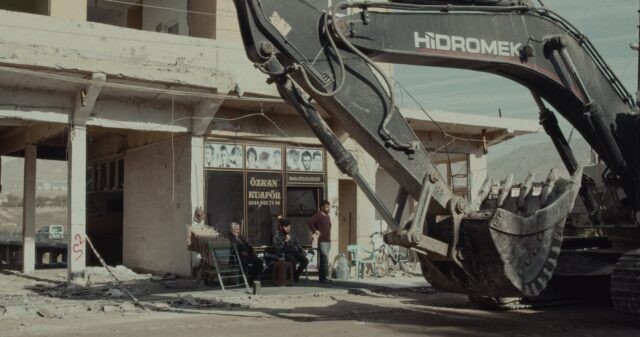
Currently in post-production ahead of an expected January 2025 delivery, Natalia Pietsch and Grzegorz Piekarski’s feature project, produced by Katarzyna Kostecka of LARMO (Poland), tells an alarming tale of forced removal from the place that the film’s subjects have always called home.
In Kurdistan, shepherdess Rengin and Arab barber Burak must deal with situation the Turkish authorities’ irreversible decision to flood the historic town Hasankeyf. Centuries-old traditions and ways of life vanish before their eyes.
“This project is vital because it reveals the hidden impact of geopolitical control on human lives and culture,” says Kostecka.
“Set in Northern Kurdistan (South-eastern Anatolia), it uncovers the Turkish government’s massive dam project, which forced nearly half a million Kurdish and Arab people to relocate. While presented as modernization, it’s a calculated erasure of Kurdish identity, symbolized by the destruction of Hasankeyf, a 12,000-year-old town,” she adds of the project’s sinister undertow.
“International audiences will connect with its universal themes of cultural loss, human resilience, and the consequences of state-driven displacement. The film is not just about Kurdish history but a story of global relevance, showing how power shapes identity and belonging,” she adds.
Kostecka reserves high praise for her directors, who bring their own strengths to the table. “Natalia and Grzegorz are an exceptional, electrifying, and fascinating duo to observe. It’s not a typical director-cinematographer relationship because both of them co-directed the film during its production, and both are also responsible for the unique and beautiful cinematography.”
“Sensitivity to the fate of the individual and the recognition of our characters’ drama is Natalia’s domain, while Grzegorz proved to be an excellent co-director due to the setting of the film’s action – as a man, he was able to gain slightly deeper access to the rather traditional Turkish world,” she adds. “Their patience and curiosity allowed for the creation of a profound portrait of a disappearing city and culture.”
In the film, we eventually see the dam open and the tourist boats arrive, and the epilogue shows underwater shots of flooded houses and streets.
“We aim for a cinematic experience richer than television documentaries,” says Kotecka. “Our observational narrative style immerses the audience in Hasankeyf’s atmosphere by showing ‘how it happens’ rather than ‘what is happening,’ avoiding interviews and focusing on visual storytelling. Static, painting-like frames capture both foreground and background, with camera movement reserved for underwater shots. Sound design leverages off-screen space, creating a spatial atmosphere that conveys events beyond the frame.”
At DOK Leipzig, Kotecka has two core objectives. “The most important thing for us at this moment is to establish relationships with festivals and find a sales agent with whom we can form a great team.”