“When the full-scale invasion [of Ukraine] happened, I realized I needed to create something bigger to remind people about this war not through ruins and suffering, but through life,” Ukrainian-journalist-turned documentarian Mariia Shevchenko tells Business Doc Europe of the genesis of her debut doc feature Keepers of the Ruins. “It’s not about destruction.”
The project, developed as part of the Young Europe program organised by the Fundacja Edukacji Dokumentalnej (Documentary Education Foundation), participated in the Ex Oriente training program in 2023/24 and received the Fine Cut Award that offers the winning project a rough cut consultation worth €1,500.
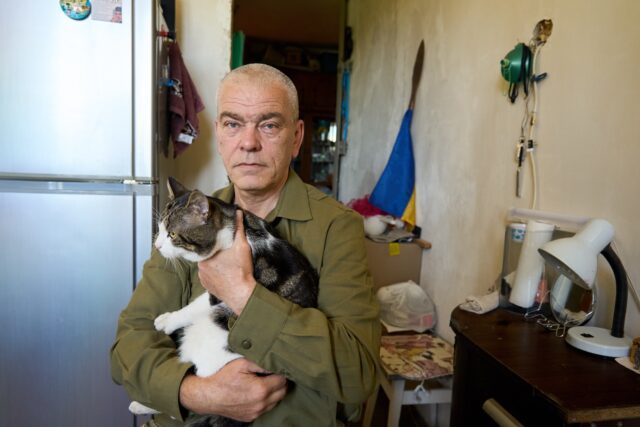
In the film, produced by Ella Shtyka of Indie Media Polis, Shevchenko focuses on the Kharkovian citizens who decided to remain in the city located on the border with Russia and that can be reached by missiles within thirty or forty seconds. These Kharkovians find hope within the ruins and give the war in the city a new meaning. Among them and other supporting characters, is Sashko who unintentionally became a vlogger and uses his phone to film his district, and the apartments of those who left. His own home was destroyed in the fire that followed of one of the numerous shellings the city has endured over the past two years.
Over the course of the film, he adopts a new cat (his previous pet was killed in the fire) and starts from scratch. “Kharkiv has its daily rhythm – ‘shelling-cleaning-reconstruction.’ We breathe in and see a father mourning his son killed by a missile. We see a music teacher who can’t teach an online lesson because notes merge with the air raid sound. We breathe out and observe rescuers clearing debris, and utility workers planting flowers in flowerbeds. People return from abroad and gradually fill a familiar yet slightly changed city. Streets named after Russian figures are being renamed. In the morning, children go to school in underground metro stations so they can continue their studying during air alarms,” explain the project notes.
“I am sure this war has a meaning for a lot of people because it’s civilians, it’s children, it’s soldiers,” says Shevchenko. “But we are still alive and we must build our life now, even under shelling and without water,even without electricity. This story must be about resistance. I know, of course, that no one wants to see sensitive footage and that’s why I’m choosing to deal with civilians because it must be more understandable for people to see daily life, with people like me, like you, but in absolutely different conditions and how thesepeople do not just learn how to survive in this war, but how they learn how to live and how to build a better place”
Shevchenko felt it was her mission to make this film, investing her own money in this project and buying a camera and a cheap car. “But then I was joined by Ella Shtyka, who also supports this project because she understands its importance and we now have a co-producer in Poland,” she shares.
Adds Shtyka: “I produced Mariia’s debut short documentary Birthmark in 2020. I was impressed with the way we collaborated and was eager to work with her again. So, when Mariia started shooting in Kharkiv, we soon agreed to develop the film together.”
The pair pitched their project under the title “Pencil of the Dreadful Reality” at the 2023 edition of ZagrebDox Pro: Dox of War, the industry arm of Zagreb Dox, as well as Millenium Docs Against Gravity, where it won a stay at the SFP House of Creative Work as well as the SMAKJAM Award that entails a colour-correction service worth 15,000 PLN. They are also planning on applying to the Baltic Sea Forum for Documentaries(Baltic Sea Docs) as well as the DOK Co-Pro Market in Leipzig. “Funding-wise, we applied for development support from the European Solidarity Fund for Ukrainian films and plan to pitch it at several international events this autumn,” Shtyka continues.
Over the course of the project’s trajectory, the filmmakers were advised to change the title to the less “depressing” Keepers of the Ruins as the documentary is not only about painful subjects. “In this city, [there is], of course, shelling, destruction, cleaning, reconstruction but, at the same time, [there are] exhibitions, young people going to concerts… In one space, different pieces of life co-exist absolutely and this documentary must be about contrast. For me, it’s very important to tell the truth with truly honest emotions,” claims Shevchenko. “Ex Oriente was the most successful [experience] for me because it was really a great opportunity to talk about my project. It was the perfect audience.”
For Keepers of the Ruins, Shevchenko is opting for an observational style, inspired by Mark Isaacs’ 2009 documentary Men of the City. “It’s an old documentary, but I love this style. How can the director combine different characters? And it’s about a city. It’s about different stories, but combined in one documentary. But,most of all, now, I’m looking for my own voice. And, of course, maybe I’m not unique, but I believe that telling a story honestly can touch everyone,” says Shevchenko.
But shooting in Kharkiv is a challenge in and of itself due to safety reasons. “The decision of whether it’s time to stop the shoot and go to the shelter is not always obvious. To my mind, we are lucky with the cinematographers we are working with [Mykola Dondiuk, Pavlo Dorohoi and Serhii Mukaieliants]. We usually have a common understanding [in terms] of the tone of the film and the approach to the characters,” concludes Shtyka.