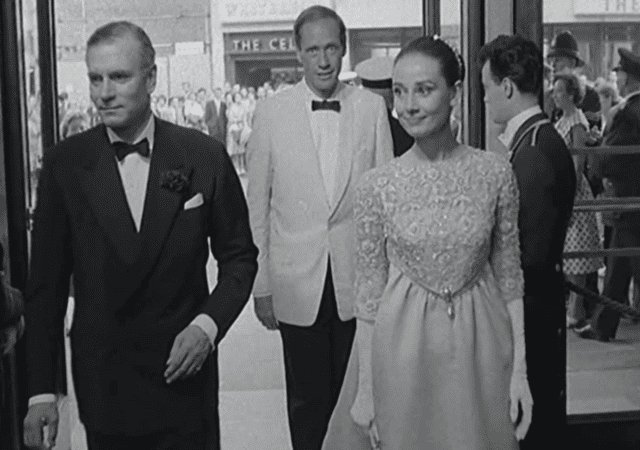
Laurence Olivier and Audrey Hepburn © British Pathé
When asked to look ahead to the February 15 Archive Day, Adelheid Heftberger of the German Bundesarchiv recalls the effectiveness of the last two EFM events, previously presented under the auspices of DocSalon, which is not part of the Berlin market offer this year.
She saw many young producers who had no idea how to approach the imposing “gatekeepers” who were guarding access to the precious archive, and was determined to effect immediate change. “They [could] only see how difficult it is to get archival images, or maybe had not even an idea that there were these archival images. And so it gave me the opportunity to talk a little bit about these aspects and to connect with these young producers and filmmakers and you know, give a face to our archive.”
“If you ask me what I would prefer to do in the future, I would love to have more DocSalons because it’s just a different way of connecting with people and people can ask their questions,” Heftberger adds, “They can talk to me and I can talk to them.”
This year she will again participate in the Archive Day one-on-one consultations both to promote the archive she represents, and advise producers and filmmakers on how best to exploit it for their productions.
As the central German film archive, it holds films made since the earliest days of film production [circa 1895], which number in excess of 350,000 documentaries and features. Key to its offer are the collections dated between 1930 and 1945, movies made within the Weimar era (1919 to 1933), newsreels made after 1945 and films produced in the former GDR, as well as films commissioned by state authorities.
Yes, to some great degree, Heftberger feels that she and colleagues are slowly dragging the archive into the third decade of the 21st Century. “We’re building a virtual presentation which is hopefully online over the next one or two years, so that people can see our material [more easily]… I think that the biggest change we have made is that we now provide viewing files as online files. Previously we had sent out DVDs…now they can have them within a day.”
“And if the database is online, people can research themselves,” she adds of the greater efficiency this enables. “I would probably receive less emails to answer – do you have this film, do you have that film? We want to do good for the people, but we also need to save ourselves time.”
And as this process of greater accessibility develops, so does the wealth of archive available to customers. “What you see now is not everything we have. We have tons more, so keep coming back,” she advises.
Another expert keen to see the return of Doc Salon is archive producer and researcher Monika Preischl, who will also be engaging in consultations during Archive Day. Her bio tells how she has contributed to more than 40 international feature-length documentaries, fiction films and series, and is a freelance lecturer of research methods and seminars on working with archive footage at various art and film schools. She also works as a freelance ‘bildfinderin’, or image finder.
Preischl says that the format of the one-on-ones works well – “it’s like speed consulting” – and that she is keen to advise on myriad archival matters from which archives to contact to which other archive personnel to consult country by country, to the complexities of rights issues.
Prior to EFM she consulted on the EFM Doc Toolbox Programme, which is designed ‘to endow documentary creatives with market intelligence, connections and a kit of transferable business know-how.’
“It’s so funny because these people are from Haiti to Bangladesh, all over the world, and you never think that all of them have the same questions. And so when I make like a case study and tell them how I’m working, it’s really heart-warming,” she says.
But Preischl would like to see Archive Day presented within the context of a fully-fledged DocSalon programme, whose very seriousness and rigour, she argues, is a benefit to the overall festival and market. “We want it back,” she underlines.
She further comments how the past two years have been an extremely busy period for her. “And it’s still going on. I also see that, besides let’s say the local or the German productions, there’s a huge amount of job offers from all over the world. I mean, it’s really becoming more international, which I personally really love. So productions from [such as] UK are searching for German archive producers.”
Preischl’s colleague Elizabeth Klinck, who will also be giving Archive Day consultations, tells a similar story. “We have had the most incredible last two years because archive films were Covid-proof,” she says. “All the work was done remotely. We didn’t have to worry about border crossings because we work from home with international archives, A lot of films that were almost finished that needed interviews, we could be hired to find those interviews. Other things like establishing shots, and a lot of things that people [usually] did but weren’t able to because of travel restrictions or health restrictions, we were able to come through.”
“And because of all the streamers coming on board…there was a huge appetite for archival film,” Klinck adds. “So we’re kind of calling it the Golden Age of archive films right now because of the big interest in music documentaries, in popular cultural documentaries and in historic documentaries as well. And the demographics are skewing quite young, which is also exciting to see.”
Klinck is an archive producer and music clearance specialist on international documentaries and fiction films that have picked up a slew Emmy, BAFTA, CSA, Peabody and Oscar awards. She also leads workshops and producers industry sessions at international markets and film festivals.
“I like putting people together. Sometimes I’ll be approached for a project, but I’ll say, well, I think it’s better if you had someone to work with in Rome [or suchlike] and I can recommend people because I’ve been doing this for a long time,” she says of her collegial approach to archive and her eagerness to recommend fellow practitioners. “I have a good database of contacts and I’ve worked with a lot of people, because working on international co-productions you get to see a lot of other people and the type of work that they can do.”
Simon Witter of British Pathé is eyeing up a busy year ahead, one that is chockful of historical anniversaries, programming that his archive is well equipped to illustrate. There is the Royal Platinum Jubilee (UK monarchy), for which he will be fielding high levels of international interest (as he will for the unfolding Prince Andrew story and impending court case later in the year). 2022 also sees the 75th anniversary of Indian partition, for which Witter has “thousands” of films, he says, plus the 80th anniversary of Stalingrad.
A recent rich seam has been sales to museums, Witter adds, noting how just before our conversation he had concluded another Polish museum deal (the eighth in recent months). “There seems to be a move in museums to need moving visual material to accompany their displays, which is quite a helpful thing for us.”
The early days of the pandemic were particularly profitable for British Pathé. “I think there was a lot of people reaching for archive, not only to finish programs they couldn’t shoot for, but also to win pitches for programs that sounded like they could be made,” Witter comments. “Now we’re back to a more normal market where production isn’t entirely up to what it was pre-pandemic, but our business is good in general and we have a good feeling good about the year ahead with some expansion plans [about which he is tight-lipped]”
Germany is a very important market for British Pathé, he underlines, which together with France “dwarves” the rest of mainland Europe. That said, the two highest yield territories remain the US and UK.
Like all of us, Witter is tired of having to conduct his business almost solely online, although he is sympathetic to the decisions that EFM were forced to make during the run-up to the festival, just as the Omicron variant was wreaking havoc across Europe and beyond.
He illustrates the value of face to face festival engagement. “Take DOK Leipzig, which we’re very keen on [and where he supports Archive Day]. Nadja Tennstedt, (former EFM DocSalon manager) who now runs DOK Industry, I first met her at a meeting for sponsors at Munich. They weren’t introducing us in any official way, it was just a social thing. But you know, we got talking over dinner – and it’s been a good relationship ever since. And that kind of thing doesn’t happen if you are just on Zoom for an hour, and then you wave, and that’s the end of it…”
The archives participating in the 2022 EFM Archive Day consultations are: akg-images, Archiv der Jugendkulturen e.V., British Pathé, Bundesarchiv, CNN Collection, progress.film, ullstein bild.
Archive Producers and Researchers participating at the EFM Archive Day consultations: Elizabeth Klinck, Monika Preischl, Morgane Barrier