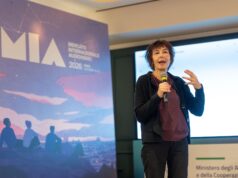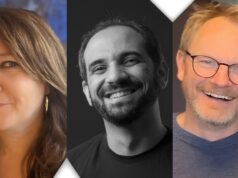
On February 17, the EFM hosted a panel discussion titled Inventive Ambitions – Financing Non-Fiction, moderated by Deadline’s Matt Carey. The session saw the participation of Melanie Adernach (producer, Made in Germany), Emanuel Rotstein (Head of Documentaries, Icon Docs), Mascha Wilke (Head of EVZ Academy and EVZ Foundation), and Sylvia Grass (Senior Commissioning Editor, ARTE/Bayerischer Rundfunk). Together, they explored the challenges and opportunities of financing non-fiction projects in the current media landscape, which has been heavily shaken by geopolitical turmoil and economic hardship.
First, Rotstein described the situation right now as “a watershed moment, with private and political forces dismantling the industry’s fabric while misinformation continues to gain ground.” He stressed the increasing convergence between documentary filmmaking and journalism, arguing that “fostering democratic dialogue should remain the top priority despite financial hardships.”
Grass concurred, stating that her role as a commissioning partner involves investing both creatively and strategically in projects. However, she acknowledged the growing number of obstacles, particularly for channels like ARTE, which must cater to both French and German audiences. She emphasised the need for documentaries that “address multiple needs,” while also allowing filmmakers to sustain a reasonable work-life balance, another increasingly difficult task.
Ahead of the German elections, Adernach pointed out that “right-wing governments often cut funding for the arts, shut down film schools, and impose restrictive broadcasting policies.” She called for a collective effort to ensure that documentary projects continue to be made despite these pressures.
Wilke, drawing from a recent survey conducted by her organisation, highlighted the importance of films as tools for empathy and historical knowledge. Many young respondents saw film as the most effective medium for engaging with history. While her foundation does not always directly fund films, it fosters cross-disciplinary collaborations between films, education, and other art forms, following a holistic approach.
Later, Rotstein explained that while ARTE/ZDF provides a base budget, securing additional funding remains a challenge. Windowing strategies are a critical concern for commissioners, as they must choose between producing smaller projects with ARTE’s budget – reaching only the French-German audience – or spending two or three years seeking international co-production partners to broaden a film’s reach and take on more partners. “For smaller production companies, the latter option is getting increasingly complex,” he added.
Next, Carey asked whether EFM helps with pre-sales. Wilke responded that she is not particularly focused on pre-sales, preferring to sell finished films so that revenues flow directly into her company, facilitating the development of future projects. Meanwhile, Grass underscored the importance of featuring high-profile protagonists in documentaries, as globally recognisable figures facilitate sales to pay-tv networks and co-producers. She cited a Romanian documentary about an elderly woman forced to leave her home near a toxic copper mine built under Ceausescu’s regime as an example of a relatable, high-impact project.
Rotstein, drawing from his experience as an executive at the History Channel, reflected on the balance between public value and entertainment in documentary production. He highlighted fully funded local productions in Germany, backed by partnerships with Telekom and Sky, which faced no financing issues thanks to their budget fully covered by History Channel’s US budget.
The exec also noted that while the panel focused on identifying private funding sources in Germany and Europe, major institutions such as Siemens and Bosch remain hesitant to support documentaries. He argued that these corporations fear the scrutiny that might come with being involved in documentary financing.
Wilke responded that “film funding should not be treated as charity.” That said, she didn’t completely rule out the idea of taking advantage of “multiple funding streams,” particularly where public funds are unavailable, but also encouraged efforts to maintain a public system to ensure universal access and editorial independence.
Grass cautioned that as soon as funding comes from non-public sources, channels like ARTE can no longer engage in co-productions due to contractual obligations. She stressed the importance of maintaining editorial independence and avoiding conflicts of interest.
Rotstein agreed, pointing out that the erosion of platforms such as 3sat has significantly impacted documentary production in German-speaking countries.
The panel concluded with a discussion on billionaire philanthropy, debating whether wealthy individuals should fund documentaries and the potential risks associated with such backing. While all speakers supported initiatives that reinforce democracy, they remained cautious about the ethical implications of private investment.
Carey referenced an episode of the EFM Podcast featuring Film i Väst’s Tomas Eskilsson, who warned of “the growing influence of authoritarian forces threatening freedom of expression.” While the panellists acknowledged these concerns, they admitted that no concrete solutions had yet emerged.
During the Q&A, the discussion turned to the role of media platforms such as The New Yorker, The New York Times and Der Spiegel in producing high-quality documentaries.
Rotstein expressed enthusiasm for these initiatives, praising The Guardian’s documentary work and noted that The New York Times had even won an Oscar for one of its productions. However, he acknowledged that commercial constraints have led several media outlets to shut down or downsize their dedicated units. Despite this, he saw significant potential in these platforms as alternative distribution channels.
The panellists also reflected on the rising importance of impact campaigns in non-fiction filmmaking. While they acknowledged their growing influence, they warned of associated risks. Rotstein advised that “even reputable broadcasters who act as co-financiers might pose challenges.” He cited Chinese state television as an example, urging filmmakers to always consider who is backing their projects. He also warned against the unpredictability of tech billionaires as financial supporters, noting that “figures such as Jeff Bezos—once a champion of democratic media through The Washington Post—had shifted political allegiances siding with Donald Trump and Elon Musk.”
Finally, Rotstein stressed the ethical responsibility filmmakers have towards their protagonists. By exposing real individuals to global audiences, filmmakers must ensure that their projects are handled and distributed with care, as the subjects’ public exposure could have lifelong consequences.