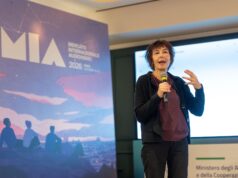
At EFM 2026, a packed Café Connect saw a revealing conversation between German filmmaker Andres Veiel and Deadline’s Matt Carey. The 30-minute discussion, held on 17 February, ranged from Veiel’s latest feature Riefenstahl to questions of archival ethics, documentary responsibility and the renewed relevance of historical material in a tense global political climate.
Veiel arrived in Berlin directly from a series of US screenings of Riefenstahl, including events at Notre Dame University and Columbia University. Asked how American audiences were responding, he described unusually intense debates. “After the Q&As people tell me their stories, and it has a lot to do with the present,” he said, noting that the film is being read not only as a portrait of the controversial Nazi-era filmmaker but also as a warning about contemporary political trends.
Riefenstahl, he added, has become “like a quarry — people take elements: ideology, the longing for a strong hand, easy solutions.”
The German docmaker also spoke of conversations with academics who expressed fear about today’s campus climate. Some tenured professors, he said, had stopped lecturing because they feared legal repercussions. The atmosphere, he suggested, felt emblematic of a broader unease about the free exchange of ideas, a concern that echoes the film’s themes about manipulation and propaganda.
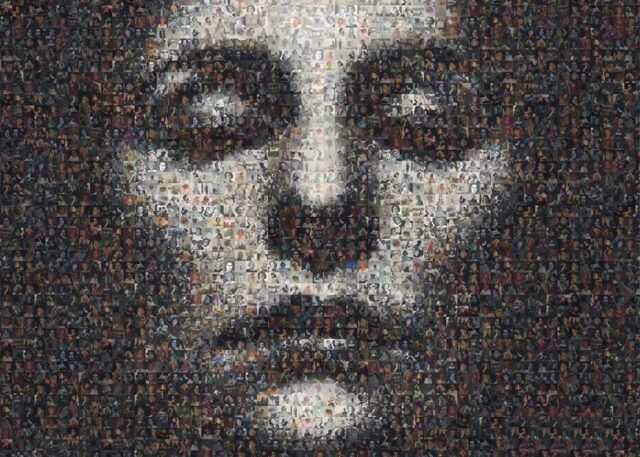
Veiel’s documentary examines the life and legacy of Leni Riefenstahl, whose aesthetic innovations in films such as Triumph of the Will were long celebrated even as her complicity with the Nazi regime was minimised. The director told Carey that dismantling that narrative required painstaking archival work. Riefenstahl, he noted, always insisted she was “just an artist, never interested in politics.” Yet evidence in the archives suggested otherwise. He cited an interview discovered in the Daily Express archive in which she admitted becoming an enthusiastic National Socialist after reading Hitler’s book in 1932.
What mattered most, Veiel explained, were not single revelations but patterns of contradiction. Riefenstahl’s archive comprised around 700 boxes of material. “She was a master of manipulation,” he said, “but not always consistent. You find little holes, contradictions, and you bring them to light.” The process, he described, felt less like building a prosecution case than mapping the mechanisms by which myths are created and sustained.
Carey pointed to the long-standing admiration some filmmakers have expressed for Riefenstahl’s artistry, citing examples such as Quentin Tarantino, and the festival retrospectives of her work. Veiel responded that separating aesthetics from ideology is dangerous. “That’s a very naïve approach,” he said, arguing that the seductive beauty of her imagery cannot be understood in isolation from its political function.
Beyond biography, Veiel stressed that the film asks what Riefenstahl’s story means today. During editing, he said, his team repeatedly encountered contemporary images that echoed her visual language — mass parades, choreographed ceremonies, political rhetoric invoking national purity. He recalled hearing a campaign speech warning that migrants were “spoiling American blood,” a phrase that sounded disturbingly familiar. “The problem is not one leader,” he said. “The problem is the breeding ground — and it still works.”
The conversation also touched on Veiel’s participation in the Berlinale series My Favorite Documentary, in which filmmakers discuss works that shaped them. Veiel chose Shoah by Claude Lanzmann, recalling his first viewing at the Berlinale in 1986. “I came out and felt I looked at the world differently,” he said.
What impressed him most about Lanzmann’s approach was the refusal to rely on archival images of atrocity. Instead, Shoah uses testimony alone, forcing viewers to imagine events through the words and faces of witnesses. Veiel described a scene involving a barber who had cut victims’ hair at Auschwitz. “He doesn’t want to tell the story, and Lanzmann pushes him,” Veiel said. “The images are created without seeing them. It stays in your memory forever.”
That experience influenced his own work. While making his 2006 documentary-theatre hybrid The Kick, about a brutal hate crime, Veiel chose not to show graphic material. Relying on testimony, he found, could be both more ethical and more powerful. The same debate resurfaced on Riefenstahl, where the team ultimately used only footage that confronted the filmmaker with evidence of Nazi crimes. “It remained her story,” he explained, rather than an external accusation.
In fiction projects, he added, preparation dominates; in documentary, a single newly discovered letter can change the narrative. While working on Riefenstahl, he noted, unexpected finds forced the team to rethink the film’s structure again and again.
Asked about other favourite documentaries, Veiel cited Sans Soleil by Chris Marker, praising its poetic narration and the way it reveals what images cannot. Yet he returned to Shoah as the film that most shaped his approach. One question remained central: how should filmmakers handle historical trauma? And, how can non-fiction speak to the present without simplifying the past?
For Veiel, the answer lies in confronting complexity rather than myth. Riefenstahl, he concluded, should not simply be dismissed as a monster. Understanding how she became what she was — and why audiences once admired her — is essential if documentary filmmakers hope to illuminate the forces shaping today’s harsh political realities.