Philippe Béziat’s fest opener Indes galantes
“Finally back in theatres,” is the joyful cry of Fipadoc director Christine Camdessus as she prepares for this Saturday’s very live presentation of her Biarritz-based docfest, the public part of which was postponed from January 2021. She sings even more with Business Doc Europe.
Back in January of 2021 Fipadoc director Christine Camdessus told Business Doc Europe that a founding principle of her festival was the ongoing “encounter between film and the public, and between directors and the public. This is what we value, this is what we want to be part of, and this is what we defend.”
Which meant that even though the professional part of Fipadoc would go ahead online in January, the public component would have to wait until the conditions were right, ie when the cinemas were set to open again.
As director Camdessus explained to the city dignitaries: “If you want to support a festival that takes place in Biarritz, you have to act like Berlin. So we do the digital part online for the professionals. But the festival by itself has to be presented live to the inhabitants of the city.”
So what’s changed? A lot. With the French government’s agreement last month that cinemas could open to 65% seating capacity and, as importantly, the extension of their opening times to 11pm, the time is therefore perfect to throw open festivals doors once again and to allow the great and the good of Biarritz to see the docs on offer.
The public-facing part of the Fipadoc festival will now run 12-17 June, and will include both opening and closing ceremonies.
Of course, any later in the year and life would have been tough again, given the popularity of Biarritz as a tourist town, and summer isn’t the best time to try and block book hotel rooms for festival guests.
“So we will be in the venues starting on Saturday (June 12) for five days,” says Camdessus. “We will present the whole festival selection, which is 155 documentaries, long and short. This is the selection, you know, that what we prepared for earlier in the year.” The winning films within the nine competition sections (which include International, French and Music Documentary), were even chosen back in January, but the names of the winners have been kept a closely guarded secret until the big reveal June 16.
More that 50 directors will be in attendance, mainly French, naturellement, given the ongoing pandemic restrictions.
“Fifteen months later I think people want to go back to cinema – not to watch another film online,” says Camdessus. “It’s obvious that the will, the pleasure to be in a theatre is still alive, which I find very important.”
Yes, the festival will very likely return to its January dates in 2022, and Camdessus concedes that online is very much a factor to be taken into account for the professional market activities. That said, she acknowledges the enormous craving among filmmakers, buyers, sellers, funders and even press for face to face interaction, for serendipitous happenstance or, as she puts it, “the need to meet.”
“I think what do we [professionals] all like in a festival is not only to discover films or new people, but things happening that you didn’t foresee,” Camdessus says. “This is what we like, this is what we remember.”
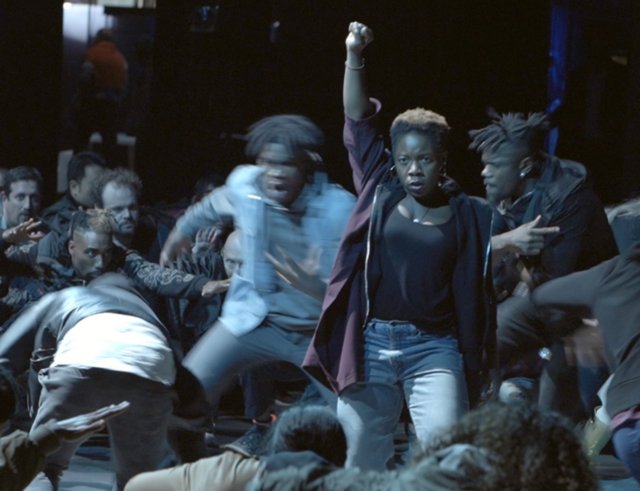
The fest director points to three French films in her programme for 2021, starting with Philippe Béziat’s event opener Indes galantes, in which 30 performers of hip hop, krump, vogue and breakdance move to the baroque music of Jean-Philippe Rameau within the Paris Opera. “It is a very, very impressive film,” says Camdessus.
She also highlights Édouard, mon pote de droite (Édouard, my right wing pal) the third film within leftist Laurent Cibien’s trilogy about his friendship with the conservative French Prime Minister Edouard Philippe. Episode 3 is titled Aux manettes (At the helm) and follows the PM during the peak of the pandemic in 2020.
The third film Camdessus flags up is Dieudo Hamadi’s Downstream to Kinshasa. For two decades, the victims of the Six-Day War in the Democratic Republic of Congo have been fighting in Kisangani for the recognition of this bloody conflict and demanding compensation. Tired of unsuccessful pleas, they have finally decided to voice their claims in Kinshasa, after a long journey down the Congo River.
The Swiss/French co-production, produced by Les films de l’oeil Sauvage and sold by Andana Films will be released in coming weeks within France, Camdessus underlines.