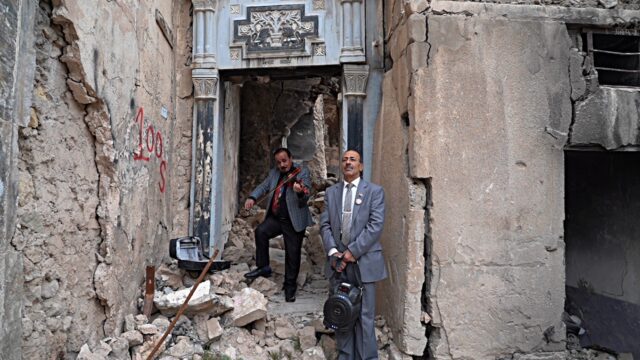
Indie Film Bergen (Norway) has released the trailer for the CPH:DOX HUMAN:RIGHTS Competition selection, The Lions by the River Tigris by Zaradasht Ahmed (see below).
The film’s synopsis reads how, in Mosul, a norther Iraqi city devastated during the battle for liberation from the Islamic State, the fight to heal and preserve its identity, culture and art is far from over. Three men refuse to let Mosul remain in ruins. Bashar, a fisherman, desperately tries to rebuild what was once his family’s home. Fakhri, a passionate collector, salvages remnants of the city’s past, determined to preserve its history. Fadel, a musician once silenced under ISIS rule, now inspires a new generation to embrace art over extremism. As Mosul slowly rebuilds itself, we witness a cultural reawakening—women reclaiming public spaces, theaters reopening, music schools emerging, ancient heritage restored. A city with 8,000 years of history, struggling to reclaim its soul through those who refuse to let it fade into oblivion.
“Even though I am Kurdish, Iraq’s culture is deeply familiar to me,” Zaradasht Ahmed explains in his notes for the film. “We grew up with the same history—Assyria, Mesopotamia, the rivers, the mountains, the deserts. These are embedded in my identity. I understand how people there think and feel. It’s not foreign to me. I don’t experience culture shock. Instead, I carry the pain of seeing my country go through so much change and hardship. That emotional connection shapes my filmmaking. I don’t just observe; I feel. That’s why my approach differs from that of an outsider.”
“When I first started researching in 2020, people thought I was crazy,” Ahmed continues. “Mosul was still considered a minefield. But I found people who helped me—locals who trusted me. That trust made all the difference. They saw I had traveled thousands of kilometers from Norway to Iraq to tell their story. Being a member of the Iraqi Journalist Association also helped.”
“Even so, I was stopped by police and security forces many times,” the director adds. “There were aggressive encounters, questions like, ‘Why are you filming my wife? Why are you filming me?’ And beyond the physical challenges, there was the emotional weight of going to a war zone. Working with people, witnessing their feelings, seeing Bashar’s pain—his tears welling up so often—those were the hardest moments.”
“Yet, no matter how far I go, Iraq is always a part of me. It isn’t a chapter that simply ends.”