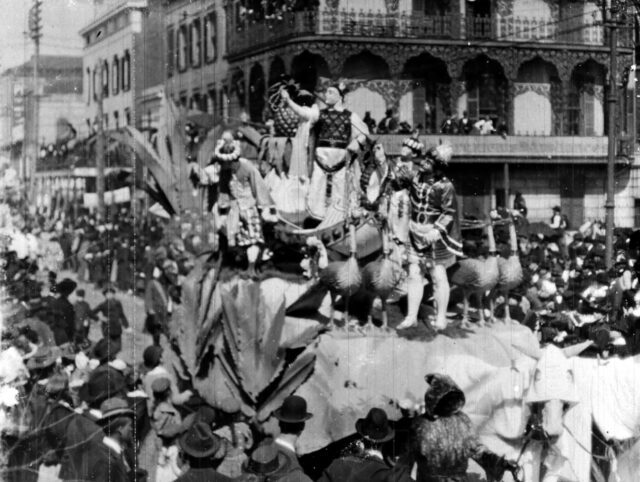
Mardi Gras Carnival (US, 1898, American Mutoscope Company)
The Library of Congress in the United States is adding the short film Mardi Gras Carnival (US, 1898) to the country’s National Film Registry. The Dutch Eye Filmmuseum discovered this year that it had the oldest surviving moving images of the Mardi Gras parade in its collection following an enquiry from the Louisiana State Museum, which is dedicating an exhibition to the history of the Mardi Gras procession.
Another 150 films from Eye Filmmuseum’s renowned Mutoscope and Biograph Collection, which houses Mardi Gras Carnival, are awaiting further restoration, “so there is a large probability of more rare footage from the early days of cinema coming to light,” says Eye Filmmuseum. This rare collection is made up of some 200 films from 1897 to 1902, all preserved on their original 68mm format.
Every year, only 25 American films are added to the National Film Registry, which includes classics such as Sunset Boulevard, Vertigo and The Wizard of Oz, as well as some of the earliest Edison experiments with capturing moving images. This year, Mardi Gras Carnival is among the elected titles. It is the earliest known film of the carnival parades in New Orleans, and shows several spectacular floats. The film became the focus of attention thanks to its inclusion in the “Rex: 150th Anniversary” exhibition curated by the Louisiana State Museum in New Orleans.
Renowned director Martin Scorsese comments: “Over 70% of silent cinema is gone. That’s a fact. Which means that every time a film classified as lost is rediscovered and restored it’s an event to be celebrated. Eye Filmmuseum in the Netherlands has been at the forefront of these efforts. Their latest rediscovery is a priceless record of the 1898 Mardi Gras parade in New Orleans, a window onto a lost moment in time. The entire team at the Eye deserves the recognition and gratitude of every lover of cinema.”
The discovery of Mardi Gras Carnival became global news this year having made the pages of The New York Times and Smithsonian Magazine following a screening of the digitised footage at an exhibition in the Louisiana State Museum. Eye’s collection staff delved into the collection and uncovered the recording of a Mardi Gras parade from 1898. “This soon turned out to be one of Eye’s ‘hidden’ treasures. The Filmmuseum had restored the footage in the late nineties on film, but at that time it was not yet understood that this is the oldest known footage of Mardi Gras and of the city of New Orleans,” says Eye.
Eye’s Mutoscope & Biograph collection contains the earliest films held by Eye. In recent years, a first batch of 50 films with mainly European topics have been restored in high resolution (8K). These films were used in the compilation filmThe Brilliant Biograph, that can be seen on the Eye Film Player. “Another 150 films are currently awaiting additional financing to undergo restoration. It is conceivable that during this process more previously undiscovered or unidentified images from the early days of cinema might get revealed,” says Eye.
Mardi Gras Carnival is still on show at the Louisiana State Museum, but the footage is also available worldwide on Eye’s YouTube channel, where it has already attracted over 40,000 views in the past three months.
Two other films from the Eye collection had already been added to the National Film Registry in 2014: Shoes (1916) restored in 2010, now available through KinoLorber/Milestone Films, and The Dragon Painter (1919) currently under restoration in cooperation with the San Francisco Silent Film Festival (expected to première in May 2023).