Renowned Palestinian filmmaker Rashid Masharawi, born and raised in Gaza’s Al-Shati refugee camp, explored two vital aspects of film and filmmaking in Gaza in his Impact Days keynote on March 9. He articulated the urgent need to bring the works of Palestinian filmmakers to international audiences. At the same time, films from around the world must be delivered to children in Gaza, who have grown up surrounded by blockade, loss, and repeated wars, to offer moments of escape, imagination, and emotional relief.
He opened his keynote by reminding the audience that he was selected for FIFDH in 2014 with Letters from Al Yarmouk. “And now I’m very happy and very glad to be here again,” he said. “I’m making films the last 40 years. I have made many films, but still each film, it’s my first film. It’s exactly like that.”
He then described the essence of film and filmmaking within his country. “For us, the Palestinian cinema, it’s really, really very important. We don’t have a Palestinian state on the ground, but in cinema we have a Palestinian state because cinema can protect the identity, the history, the memory, the culture. We have it all in cinema. Nobody can occupy that. This means nobody can occupy Palestine also because cinema protects us.”
Masharawi spoke about From Ground Zero (2024), a collection of 22 short films made in Gaza, and which he initiated in order to give a voice to Gazan filmmakers to tell the untold stories of the current war.
“I was selecting ideas, selecting filmmakers just to create this window to share these stories with the world. And at the same time to train these filmmakers to make better films,” he said, before underling the need to carry on telling stories even in the face of hunger, loss and homelessness.
“Somehow I managed to influence these filmmakers or these artists, let’s say, to tell them that the priority is cinema now. We need food to stay alive. We need a safe place to be there, but we need cinema also to share these stories with the outside world to stay in our land. We need to work on the opinions of the others because in Gaza during all this war, no journalists can enter. Only Palestinian journalists, and they [the Israeli army] are targeting them one after the other. They kill around 250 until now, a little bit more.”
“For me, personally, I needed this project also as a human being, not only as a Palestinian in Gaza and a filmmaker, because I thought all the times they are not killing only the Palestinians in Gaza. They are killing the humanity in Gaza. So they are killing everybody in Gaza. They are killing you as a human being in Gaza. So [with this project] let’s focus on innocent people. Let’s focus on humanitarian stories, personal stories just to share with the world.”
The From Ground Zero trailer showed the broad range of stories, styles and formats deployed by the Palestinian filmmakers for the project, whether in fiction, doc, animation, video art, experimental, or even with marionette puppets.
“We not only let the filmmakers tell their own personal stories or what they want to say. We were trying also to make them express their own cinema as filmmakers,” Masharawi continued.
“When we started the project, even we didn’t believe that we could make it actually, because…there is no electricity. This means you cannot charge mobiles, you cannot charge batteries of cameras. You cannot charge laptops. You cannot have internet. This means we cannot be in contact also to keep working. So many times we lost contact with all the filmmakers, and many times we needed to stay awake for three or four days because when we have good internet at a certain point then they can upload material.” And when possible they used solar power, Masharawi added.
“I think it’s very important to say that for new filmmakers and for young filmmakers and people who start to protect their own projects – it’s possible, and you can make your film in the end. I learned a lot from this experience on From Ground Zero. I learned that to make cinema, it’s not the big budget. It’s not the big production. It’s not the big equipment also. [With] cinema, okay, you need material, you need money, you need budget, but this is not what makes cinema. If you think cinema, if you have something to say, if you are talented, you can make films. It doesn’t matter which camera you are using or where you are editing, you will show these films.”
From Ground Zero was completed and screened, was highly lauded and selected for numerous film festivals where it picked up many awards. But the war is still going on.
“People who were suffering for six months, they are now suffering for one year. If they lost some people, they lost more people. More and more people lost houses. For me also what to do. Okay, good Rashid, you made it and it’s beautiful and thank you and they clap for me. But my family are in Gaza, my friends are in Gaza. All my filmmakers are in Gaza.”
So Rashid was spurred on to produce a follow-up. From Ground Zero+, to further facilitate the creation of films from Gazan filmmakers, longer works that allowed for the telling of more involved stories, three of which screened during FIDFH 2026.
“It’s very important for me to say you can occupy the land, but you cannot occupy cinema,” he underlined. “Because cinema, it belongs to dreams, to love, to imagination, to ideas. Nobody can occupy these things. Never. This is why it’s very important what we are all doing. On the one hand, we are trying to manage our dreams as filmmakers. We will fight for that. And on the other hand, we are telling our stories, sharing our stories about us as human beings everywhere. It doesn’t matter. If we are Palestinian, or not Palestinian, cinema is cinema and the humans being is a human being.”
Masharawi then addressed the subject of children in Gaza and how to alleviate the pain they are suffering during the bombardment. “They are four, five, six years old. Over the last two years, they didn’t see television because they have no electricity. They only memory is the war. Most of them lost houses and parents.”
“So I decided to make a film festival for one month for children in Gaza.” The effect was mesmerizing, he said, where children saw colours again, listened and danced to music, and felt momentarily secure.
“So then I decided to make a mobile cinema in Gaza for all the year 2026. This means that today, yesterday, tomorrow, they are showing films in Gaza. Each time they are moving to refugee camps, hospitals, schools for refugees. Every day I’m very happy to have these meetings with the team in Gaza, and every day I’m happy to receive these photos and many videos.”
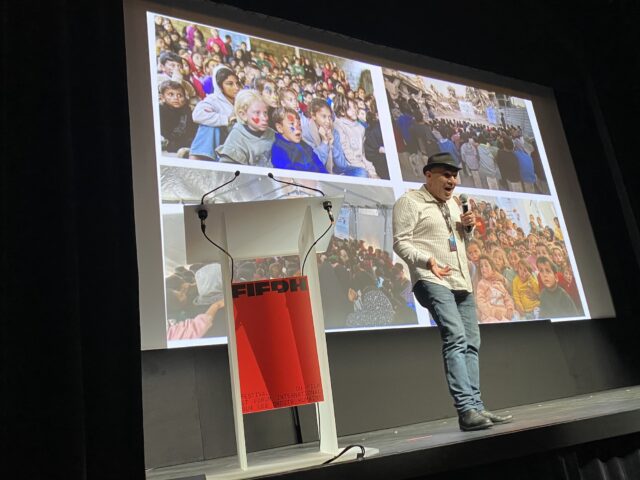
He showed photos of the kids in raptures, watching the screen, their faces illuminated in wonder.
“And the films are not political films. They have nothing to do with what’s going on in Gaza. It’s comics, Charlie Chaplin, Mr. Bean, Popeye, cartoons, all the things that we used to see to watch when we were kids. Really, this project is very dear to me,” Masharawi ended, proving that cinema, art and storytelling can be genuinely transcendent, even in the most dreadful of times.