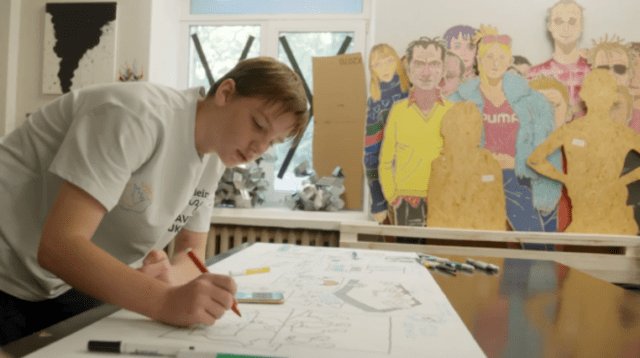
Weaving together animation, observational cinema, and participatory filmmaking, Tetiana Khodakivska’s latest feature doc, The Blue Sweater with a Yellow Hole, is a coming-of-age story questioning the impact of indoctrination and propaganda on children in the modern world.
The subjects of the film are three Ukrainian children who process and illustrate, through drawing, memories of their six months in a Russian ‘re-education’ camp.
The film, produced by Elena Saulich of Pronto Film (Ukraine), is earmarked for delivery in January 2027. “The core importance of Blue Sweater with a Yellow Hole lies in its attempt to raise the question of how propaganda can reshape a child’s identity, instrumentalizing them for cruel purposes, such as becoming a soldier and fighting against their own country,” Saulich tells Business Doc Europe.
“The film also challenges the common belief that propaganda only affects ‘others’ or ‘children of others,’ she adds. “Through a hybrid form combining documentary and animation, we aim to create a shared emotional experience that helps audiences move from thinking about ‘them’ to recognizing ‘all of us’ worldwide in this film.”
Saulich points out that, as of March 2026, only 2032 of 20,000 deported or forcibly relocated Ukrainian children have been returned to their families. Many of the returned children passed through ‘re-education’ camps. She cites research that claims that at least 130 such camps indoctrinate children with pro-Russia narratives. She further claims that at least 39 of the facilities operate militarisation programmes where children as young as eight are put through weapons training, grenade-throwing competitions and tactical medicine courses.
“The film is based on real encounters with Ukrainian children who were rescued from so-called re-education camps,” she continues. “Through drawing sessions and conversations, they share fragments of their memories. Animation created from the children’s drawings allows these memories to appear on screen while protecting them.”
“Our impact campaign aims to create bridges between the academic [and] art worlds, educators, policy makers and NGOs to discuss and research deeper needs of protection of children from identity manipulation with propaganda or indoctrination,” Saulich further underlines. “Screenings and art exhibitions will be followed by discussions and panels with educators, psychologists, researchers, journalists, and human rights experts.”
Saulich and director Tetiana Khodakivska have already begun the process of outreach. In February 2025, for example, children’s drawings from the film were exhibited in Berlin at an event organized with partners Terre des Hommes Germany, in the process reaching more than 15,000 visitors. The same month, Khodakivska participated in the academic roundtable ‘Children in Crisis’ on child rehabilitation at the University of Potsdam and attended the event “Hearing Them Out: Returned Children of Ukraine” at the Václav Havel Library in Prague. The pair are furthermore developing a simple guide-book for working with possibly traumatized children.
“We hope that these events and efforts will encourage audiences not only to reflect on the importance of better practices for protecting children but also how easily our identity can be influenced, and why it is important to recognize the early signs of manipulation,” Saulich stresses to BDE. “Through the impact campaign, the film aims to turn painful stories into knowledge, and awareness. By listening to the voices of children, we hope to help people understand not only what happened to them, but also how societies can better protect the next generation from propaganda and indoctrination.”
The producer describes the qualities of director Khodakivska, who co-directed the Oscar-shortlisted documentary Once Upon a Time in Ukraine (2020). “Tetiana is a director with a rare combination of artistic vision, both journalistic and child-like curiosity, and a strong sense of dramaturgy. One of her greatest strengths is her deep care for the people whose stories she tells, especially children,” she says.
“Another remarkable quality of Tetiana is her ability to attract extraordinary collaborators. She has a charismatic energy that draws exceptional artists to her projects. One example is our art director, Alevtina Kakhidze, an internationally recognized artist whose works are held in the collection of the TATE Modern.”
“But what I admire most about Tetiana is her ability to transform the most ambitious ideas, including changing the world for a better place, into reality. She combines deep artistic sensitivity with an almost mathematical understanding of modern filmmaking tools — including animation, visual techniques, and diverse storytelling methods. Her meticulous thinking, tireless energy, and sharp humour inspire everyone around her and leave a lasting mark on all of us,” Saulich ends.