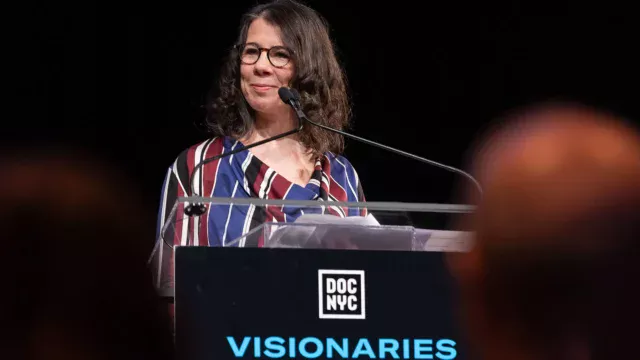
Chicken & Egg Films CEO Jenni Wolfson kicked off her Impact Days keynote with a description of her north-of-the-border upbringing in a tight-knit community of Scottish Jews, where she experienced antisemitism and saw both divisiveness among the Catholic and Protestant communities and hatred born towards Asian minorities.
“But I’m also lucky to have grown up in a family of artists and to have been born in Scotland, which is a country so full of imagination, myths, storytelling and folklore,” she countered. “I mean, the national animal of Scotland is a unicorn…and we believe in the Loch Ness monster! So that’s who I am. On one side, I’m galvanized by experiencing a witnessing prejudice and on the other believing in unicorns.”
But there was another, more impassioned side to her. She was a teenage activist and “a real pain in the ass” to her parents, and after earning a Master’s in human rights, went to Geneva to the work for the UN. The experience was a true eye-opener. “I received a crash course in the huge chasm between theory and practice. I saw some governments that were humble enough to listen and respect the human rights treaties that they’d signed, but I also saw many governments just paying lip service. I learned that just because a meeting or report happens, doesn’t mean that powerful people will take action,” she told the filmmakers, funders, advocates and changemakers gathered at Impact Days.
“That internship was the start of a career dedicated to human rights. During all those years, again and again, I saw three key challenges appear that blocked the power of storytelling. I saw stories depersonalized. I saw stories told at a distance to audiences who were both physically and emotionally far from the stakes, and I saw stories that were packaged into forums that closed off pathways to action, removing agency from both the storyteller and the audience.”
Her posting to post-genocide Rwanda taught her “how to truly listen, because the story shared with me changed me. I experienced how the power of a story can foster deeper understanding of complex issues and nurture connection and empathy between people. I came to appreciate the healing nature of sharing one story in the hope that it might make a difference for others. But where did all the stories I gathered go? Into long reports for the UN?” And these vast reports went, by and large, unread and unheeded.
“The years I spent as a human rights investigator sucked the artist out of me. Writing reports that were triple-check and squeezed into submission by the bureaucracy disconnected me from the emotional necessity and vitality of the stories I heard. It took me years to find my way back to storytelling and to my current vocation at the intersection of storytelling and social justice.”
Her determined journey towards activism and advocacy, as practised through the medium of film, started with her decision to write the one-person play Rash, in which she could portray “what it was like to speak with people who had suffered unspeakable acts and with those who had committed the unspeakable. I wrote about my own life-threatening experiences, putting words to some of my most haunting memories. I wrote about the absurdities of those years from the UN airplane ticket that was printed with the words, ‘we are not responsible for your life’ to the Kafkaesque call with customer service representatives explaining that our militia members had stolen my credit card at gunpoint…but each night as I stood alone on stage I could hear a pin drop.”
“I recognized the visceral power of my story and I reconnected with the power of the arts as a way to draw people in and remind us of our shared humanity. This belief has become the foundation of nearly two decades that I’ve spent working at the intersection of media, art, and justice.”
Wolfson then explained the raison d’être of Chicken and Egg. “[It] is built on the power of stories to advance equity and justice by inspiring empathy, learning, and action. We champion women and gender expansive filmmakers making documentaries around the globe with funding, mentorship, and access to industry decision-makers, so that their stories can ignite change.”
“Films are just one piece of the larger fight for justice, but they are uniquely well suited to moving the needle on urgent and complex issues because they touch our emotions in deep visceral ways – emotions that reports, white papers, news stories, and other forms of media rarely access. That’s why we see so many journalists, activists, artists, writers, teachers, organizers, and others reach for the camera to shed light on urgent issues,” she added. “Films that move us emotionally move us to act through intimacy, proximity, and agency. And when films create Impact campaigns grounded in the same principles, these films can help channel that individual action into real collective movements.”
She then discussed the power and Impact of four films supported by Chicken and Egg; Shiori Ito’s Oscar-nominated Black Box Diaries, in which the director conducts an investigation into her own sexual assault, aiming to bring the prominent perpetrator to justice; Alina Simone’s Black Snow, about a woman’s fight to show how the eponymous substance falling in a remote Russian mining town does so because of extreme pollution; Scott Alexander Ruderman and Rachael Dyer’s Pay Or Die, which tells how nearly 2 million Americans with Type 1 Diabetes are held for ransom in the US by the high cost of insulin; and Contessa Gayles’ Songs from The Hole, about an incarcerated teenage musician who struggles for healing and peace as he comes of age as a creator behind bars.
“Film storytelling and narrative change have a critical role to play in bringing complex issues to light and showing the true impact on the people who are most affected. Films put the ‘human’ into human rights like no other medium,” said Wolfson.
The Chicken and Egg boss then addressed the folk in the room, and offered poignant advice to the core constituencies of filmmakers, partners (in the form of advocated and experts) and funders.
“As traditional investigative journalism has declined, documentary films are often stepping in and doing the long-term, deeply embedded work of exposing corruption with an international spotlight,” she reminded the creatives. “Filmmakers can follow complex stories for months or years, gathering extensive evidence, often at the front lines, and then they present it in these deeply emotional and resonant ways that compel people to take action. They are a vital compliment to journalism, especially in this age of conspiracy theories and misinformation and the emerging complications of AI.”
“Just as importantly, documentary films are beautiful and sometimes fun and artistically exciting, and they’re pushing boundaries in brand new ways. In so many different ways, on so many different issues,” she added. “Documentary films today have the superpowers of storytelling that we need, and there is enormous movement of people, not just filmmakers, but advocates and artists who believe in the power of storytelling to further their work.
“[But] you’re expected not just to be storytellers, but fundraisers, public speakers, impact strategists and distribution experts, and all the while often lacking basic financial security. It costs time and money to show your work in progress at pitch forums, screen your films at festivals go on the awards campaign trail. Our new reality is that filmmakers are struggling to even have their films seen within this severely consolidated distribution model. I wish it wasn’t so hard, and I always admire your tenacity and grit to keep pushing through.”
“I encourage you to collaborate with activists, advocates, organizations, journalists, and others, and my advice for you, shared very generously from the filmmakers I’ve worked with, is to bring the principles that make your film so powerful into your collaborations and partnerships. Forge partnerships with intimacy, proximity, and agency. Start early identifying and building relationships with others who have dedicated their talent to the issues of your story. Time and time again when I ask filmmakers whose films have successfully created impact, what they would do differently, they always say, start earlier. Don’t wait until you finish your film.”
Then she addressed the projects’ [potential] partners. “I have advice for the advocates and experts in the room – to all of us NGOs, international organizations, advocacy groups, scientists, teachers, journalists and media. Our work is also so hard and so important, and I hope that you will consider filmmakers as potential allies for moving your work forward. Filmmakers can help bring alive the tough issues that you work to advocate for. They can help you reach broader and different kinds of audiences worldwide. They lift up the voices of the communities on the front lines. Ayana Pressley [US politician] said, ‘the people closest to the pain should be closest to the power,’ and documentary film can lift these people up so that their stories are heard widely and listened to. And filmmakers need your support in so many ways.”
“And for the funders in the room, I know everyone is always trying to talk to you. Me included. Chicken and Egg films is a funder too, as well as a non-profit organization raising all of the money we give away,” Wolfson continued. “I want to speak about the role of funding as part of this ecosystem. Yes, of course I want to tell you that you need to fund documentary films for all the reasons that I’ve just explained, but I hope that you’re also convinced about the need to fund Impact campaigns and independent distribution strategies. These are incredibly difficult to fundraise for, yet we know that they are so vital to fully realizing a film’s potential.”
“With [Impact] funding, filmmakers can afford to work with Impact producers and focus their audience targeting while also giving filmmakers the space to develop their next project. I hope more funders take it on themselves to help make sure that films can maximize that impact, which means providing filmmakers with the money that they need to run creative distribution campaigns too.”
Wolfson further explained how the flagship Chicken and Egg Award comprises a $25,000 grant towards the film, but it also comes with an unrestricted $50,000 grant designed to offer filmmakers a measure of freedom with living expenses, “from childcare to healthcare, to just having the time to focus on their film so that they can make choices about their work from a place of stability.”
“Funders also have an advantage as hubs of a wheel. You interact with so many experts and organizations. You bring a truly unique bird’s eye view perspective that can help foster these positive collaborations between filmmakers and a broader ecosystem. Whatever stage of filmmaking you support from production to creative distribution, I encourage all funders to approach the funding relationship while respecting the principles of intimacy, proximity, and agency. In our capitalist world, financial freedom is often required for creative freedom.”
“At Chicken and Egg Films, we approach our work with radical tenderness,” Wolfson rounded off about her organisation. “We provide the kind of care to filmmakers that we think everyone in the world deserves. It’s a daily practice that requires humility and intention – but the more we bring our values of our work into our collaborations, the more the world matches our values.”