Yes, Hakuchu Munayta means Hakuna Matata which, as we well know, means ‘no worry.’ The eponymously (and musically) titled feature doc, directed by Augusto Zegarra, won the StoryBoard Impact Award at during FIFDH Impact Days in Geneva.
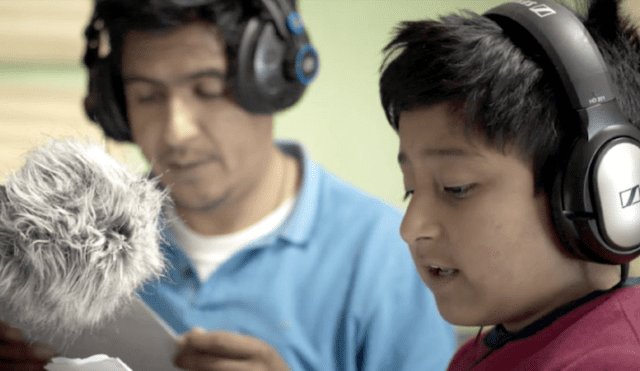
In the film, Fernando, a voice actor from Cusco, Peru, is trying to save his indigenous language from extinction. He dreams of dubbing the animated classic The Lion King into Quechua, the language of the Incas. His journey to achieve this will make him re-examine his role as a father and an activist, with his much-loved 8-year-old son, Dylan, as his essential sidekick.
Director Zegarra describes how he saw a YouTube video of Fernando’s translated Disney offerings and was intrigued. “That’s actually how I met Fernando,” he explains. “I remember watching this and I was in total disbelief. I immediately wrote to the YouTube channel. I wanted to find out more about the group of people behind this project. They answered back. We set up a meeting, and to my surprise, it was only one guy.”
Producer Paloma Iturriaga described the bigger story. “Quechua is an indigenous language and it’s the most spoken indigenous language in South America with over 10 million speakers. But despite this, it’s still considered an endangered language. And the reason behind this is colonialism. Colonialism has a worldwide history of discriminatory and racist practices that repress indigenous people and indigenous languages, and it happens all around the world to this day. What we aim to do through our film, a joyful story of a very proud indigenous man, is to transform Quechua from a language of the oppressed into a language of power.”
Zegarra added: “Through Fernando’s story, we’ll explore things such as the rich culture, parenting, cultural heritage, structural racism in Peru, and the importance of preservation of indigenous languages in modern day,”
The mooted impact campaign for the project is complex and ambitious. “We’ll start…with an eco-friendly mobile cinema around indigenous speaking communities, bringing the magic of cinema to audiences that have never had the choice to enjoy a film in their own language,” Impact Producer Claudia Chávez Lévano told the Geneva audience.
“We plan to have a school screening with the protagonist and with indigenous activists, and also [work] with community leaders to create conversation around language and representation. We will also support Fernando’s initiative to achieve change in public policy, to promote dubbing films into the 53 indigenous languages of Peru. And that’s only the beginning. As Paloma mentioned, we have ambitious visions still in progress to bring this story to other indigenous peoples around the world who are also determined to preserve their culture and language.”
At the end of award-winning presentation, Impact doynenne Ellen Schneider, former executive producer of the PBS series POV (which she explained was the longest running documentary series in the US) joined the fray.
“For the last three decades I’ve been working on impact strategies and I never intended to go back to working with individual films, until I saw that trailer,” she explained why she came on board. “Why? Well, imagine using The Lion King as a way to look at the long tail of colonialism. Imagine the opportunity for crossover audiences for a story like this. And actually I think that the star of this is Dylan, the 8-year-old protagonist with so much charisma and so much promise for this future.”
“So think about how the film can be used?” she implored the audience of change-makers ai FIFDH. “How can the story support your work and how can we bring the joy of this to everyone?”