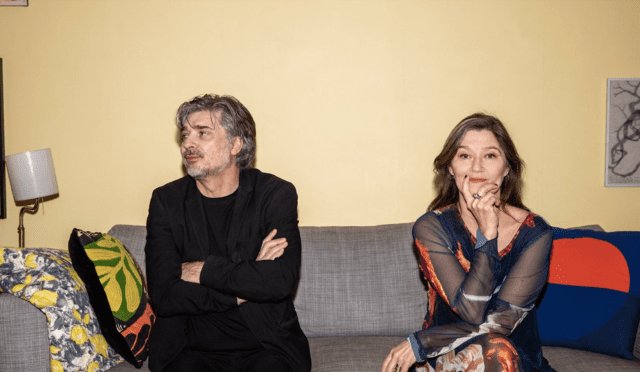
When they first met in the 1990s, Johan was punky, an imbiber of nefarious substances and at a bit of a dead end. Lena was four years older, strikingly beautiful and strangely attracted to theyounger man who invited her back to drink tea in a flat that was meticulously tidy.
But that night they fell in love and were never to be parted, at least not until twenty five years, three daughters, and a lot of rows later. Theirs was, as we see in the documentary, a marriage which slowly ground to a halt, as the spark diminished and as they began to develop independently “on separate branches,” as Lena observes.
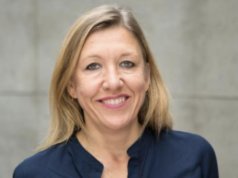
Director Maud Nycander, a family friend with kids the same age as theirs, records the process in her Göteborg film Love and Divorce. “It’s nice to be guided out of a relationship by you,” Johan jokes to her at the beginning of the film.
But this is not the first time that Nycander turned her camera in their direction. Seventeen years ago she made Love and Fish Sticks, a short film for Swedish television (SVT), which featured the younger Johan (at that time a poet) and Lena (then an actress) as new parents of two girls, with another on the way.
Love and Divorce borrows from the older film which shows Johan’s financial fastidiousness and Lena’s disorderly approach to home matters (and home economics). They are caring and they laugh a lot, but we can see the burdens they suffer with little money and three young mouths to feed, and the cracks that inexorably develop.
When we flash forward to the present, they are living in a fabulous Stockholm apartment and their three children are now epicentres of spark and independence. And obviously ready to entertain the inevitable conversation with their parents about divorce? Well, maybe not…
“In Sweden, nearly half of all couples divorce and the other half is thinking about it,” laughs Nycander. “When I have shown the film to people, I think it’s like a mirror…a film to start a discussion from about your life, about your family, about relations. And also, I think it’s a film for youth that have parents that are going to divorce, or are afraid that their parents are going to be divorced.”
The kids in the film start off saying the stuff you’d expect, such as how such indulgent parental talk of divorce is gross, “a completely uninteresting type of conversation.” But we gradually see how the potential separation may really affect them.
“It’s like they’ve broken a promise to us,” says Nadja, the youngest, during a core scene in which the siblings express their feelings away from their parents. Linnea, the eldest, always feared separation, and consequently felt that she needed to protect her younger sisters. Years before, when Lena and Johan were going through a very bad patch, Linnea was at an age when she was “old enough to be included, but too young to be able to handle it.”
“When the kids saw the film, you know, they were like a ball together. They were hugging each other, sitting on each other, laughing and crying and laughing all through the film,” the director says of the youngsters’ response. “And it was very dramatic because Nadja, when she saw she was nearly dying [in footage of her as a newborn baby], it was really emotional for her to see this, because this was something that she had only heard about. Also this idea that the parents in the future will meet someone else, it’s also a hard thing, but it’s a process.”
Nycander had offered Lena and Johan final cut on the film, but it wasn’t a privilege that they needed to exercise, she explains. And that includes the immensely sad scenes when the separation becomes real, tangible and inevitable, as a deeply upset Johan prepares to move out and as his equally teary wife offers him words of loving consolation.
“It’s not a film about something extreme, it’s about everyday life, but in everyday life, things happen,” the director says of the inherent drama that day to day existence throws up. “The most important thing when you do this kind of very sensitive project is that everybody that’s involved feels comfortable with it, and that want people to see it…”
“The thing that is important in this film is how to divorce with dignity,” she adds. “That this 25 years that you live together and grow your family, it’s not like it was a bad time. It’s just that now this part of your life is over and you go to something else…You’ve dared to take this step, but in a good way.”
Nycander also produced the film, which she describes as very low budget and which will go on to screen at the Stockholm Film Festival in March, before a theatrical release across Sweden in April and eventual broadcast. “So that’s make me happy. I hope it will travel internationally, but maybe it’s just a Swedish film for Swedish people. I don’t know.”
Maybe she’s right, but one suspects not, and that festival programmers will soon be looking to fill their slots with this highly poignant, very personal and distinctly universal story.