

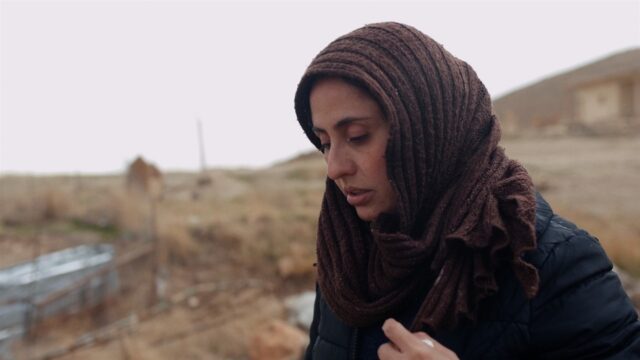
Polish filmmaker Hanna Polak tells Business Doc Europe about her new doc Angels of Sinjar, which tells the harrowing story of the Yazidi community of Northern Iraq that was, on August 13 2014, devastated by ISIS and its unspeakable barbarism. For six years Polak followed two survivors; Hanifa who is determined to reunite all the sisters kidnapped on that day, and Saeed, brother of Nobel Laureate Nadia Murat, who remains in Iraq to try and rebuild his broken community.
In the creation myth of the ethno-religious community of the Yezidi, whose sacred home is Mount Sinjar in Northern Iraq, the world was originally entrusted into the care of seven angels, and there was no concept of Satan. Hanna Polak’s Angels of Sinjar, which won Prix Gilda Vieira de Mello at FIFDH 2022, opens with this fact, but it is not long before we are disabused of any notion of Sinjar as a kind of paradise. On August 14 2014 the place became hell on earth.
Hanifa may have survived the horrendous ISIS massacre of that day, but she witnessed the kidnap of her 5 sisters, the youngest 10, by Daesh attackers. Their fate was appalling, as we hear in the film, one which entailed gang rape. The kidnap of the girls sent their father to the grave after he suffered a severe stroke. Hanifa’s final promise to him before he died was to re-unite the family.
Yezidi compatriot Saeed was left for dead after an attack in the neighbouring city of Kocho, shot five times in the body by a man he used to work with before the descent into evil. Saeed even survived a shot to the head designed to finish him off. He also witnessed how the women of the city, including his own mother, were bulldozed to death or buried alive.
In Polak’s film we watch as Hanifa attempts to locate and gather her sisters, in the company of Mahmood, a rescuer who advises her on logistics; the when, the where and the how and (when necessary) the how much, given that the women and girls have been assigned a market value by their captors. She and her mother also go to the temple, tying new knots on the wall of beautiful silk scarves for the daughters whose liberation they pray.
She also hears the dreadful testimony of her youngest sister Zina who was ordered to convert or be “married,” a terrifying euphemism for rape. As her story descends towards an inevitable conclusion, Zina eventually asks director Polak to stop recording as these are events she cannot bear to put words to.
Equally, we hear a direct eye-witness account from a woman who witnessed women in captivity questioning the provenance of the meat they were being fed, only to be informed that it is the flesh of their own children, which led one woman to commit suicide by hurling herself at a wall. The truth of this story is attested to by director Polak, who sought and gained corroboration from other sources. “It was important for me that if we talked about the genocide we really get the facts right,” she says.
Saeed was a man that Polak met when she was in Sinjar waiting for the arrival of a reluctant Hanifa, for whom, at that point in her life, the return to her home city was particularly traumatic. Polak wasn’t sure how to proceed with her film that day without her main character. “But I just met Saeed on the street. He arrived with someone who I already met and we were introduced to each other. I didn’t know he’s a brother of Nadia Murat [Nobel Peace Prize Laureate]. I didn’t care for this, even if he was or wasn’t. He was just charming.”
The tragedy of Saeed’s life is enormous, having lost many brothers and his mother in the massacre. He breaks down when he sees a wall containing their photos, as he does when attending a conference in Krakow where he talks about the plight of his people, and indeed as he watches his sister Noria on small screen receiving the Nobel Peace Prize in Stockholm.
In her speech Nadia talks of the girls held by ISIS and asks rhetorically of the West’s unwillingness to get animated about their release: “What if they were a commercial deal, an oilfield or a shipment of weapons?”
Polak concedes that she had luck on her side in always seeming to be in Iraq when one of the sisters was released, but she was also immensely resilient and brave. She was the first representative of western media who entered after the liberation of Kocha, and on countless occasions she had to negotiate her way through checkpoints and blockades, continually living off her wits or knowing how best to exploit her network of contacts.
But Polak nevertheless paid a heavy toll for the six-year experience. “I was very much afraid of this project because I knew myself, I will have PTSD. This is not a subject which you are basically making a movie about – this is something which you really have to uptake into your heart.”
“And during the editing process I had really some moments of breakdown,” she adds. “I would close the door and I would just scream and cry because I would be physically affected. Like you listen to the translation and you physically vomit…Then there are moments which you don’t know when they will trigger you, sometimes completely in unexpected moments, like the moments of kindness of these people, the moments when you feel basically ashamed as a human that you are basically witnessing such poverty, such conditions for the people to live in.”
As in previous films such as the remarkable Something Better To Come, which involved following a family for 14 years as they eke out an existence in Europe’s largest rubbish dump, outside of Moscow, Polak is continually seeking another story in her film. “I am always looking for light, for beauty, for humanity. I really try strongly to believe that humanity always wins,” she says.
But the enormity of what she has witnessed over the past years invokes a yet more profound response. She is determined not to be “victimized” by what she has seen, but this, she points out, is demanding a lot. “It is impossible. For example, in the film when Hanifa takes her phone out [and we see her sisters], this is a moment which triggers… I often times start crying. It’s like a Pavlov’s dog [reaction] that you cannot control. Recently we were sitting in Geneva, I was sitting next to Hanifa and watching the film and I heard every little breath [in the theatre] and basically my tears were flowing. Because of course I know everything. I know more than what is on the screen. I’ve been through this.”





