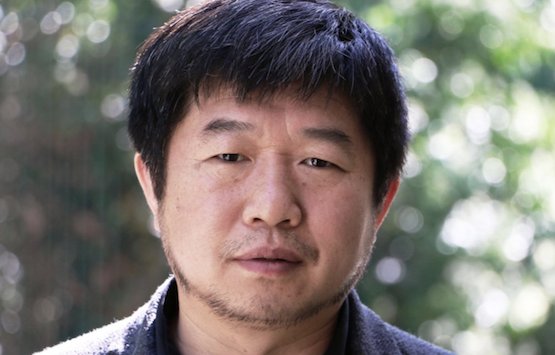
The Guest of Honour at this year’s IDFA was Chinese auteur Wang Bing. In Amsterdam, the director was celebrated with a dedicated retrospective showcasing six of his films including Youth (Spring), Man in Black and Mrs. Fang, a Top 10 programme and a one-on-one conversation with festival director Orwa Nyrabia that zoomed in on his career and body of work.
First, Nyrabia showed a clip of Bing’s debut film, Tie Xi Qu: West of the Tracks (a nine-hour film focusing on the decay of China’s biggest and oldest industrial area). He asked Bing at which point he realised that film was the right path to take.
Bing admitted the thought of embarking on filmmaking had been in his thoughts since the early 1990s, when he was a student. “I was always wondering what kind of movie it would be if I would make one someday. Back in 1999, I thought that was the time that I should make my first movie and that was the beginning of my career,” he explains.
Interestingly, Bing wasn’t particularly attracted by documentaries. Non-fiction, however, wasn’t under the radar of governmental authorities and this gave him relative freedom, and he spent around a year and a half shooting his first feature.
The learning process has been spontaneous and intuitive. Over time, he realised “what documentary is and what is the relationship between the film and the characters, the protagonist, the people and the environment involved.”
Zooming in on the topic of censorship, Bing says that at first “escaping from the commercial and administrative obstacles wasn’t a rational choice.” Despite acknowledging the heaviness of the propaganda machine in China, the Chinese filmmaker also felt that 2000 was a “really hopeful time.”
“I tried to grasp that hopefulness, and to either make a change or enable a change by making my own filmmaking style. And what you saw in West of the Tracks includes all my intuitions, observations, and perspectives about the society back then,” he says.
After the success of this film, Bing ventured into fiction with The Ditch. The picture, based on Yang Xianhui’s book ‘Goodbye, Jiabiangou’ and which premiered at Venice in 2010, centres on the life and toil of inmates sent to the titular prison camp in the 1950s and 1960s.
He considers the making of this film “another attempt” and another learning opportunity, which made him reflect on the fact that all the assets and resources needed for such production are under state control. “You’d have to rely on these resources and assets, which I find really difficult. That’s why all my films since 2010 are documentaries.”
The festival then played a clip of Bing’s Alone (a 2012 shorter version of his Three Sisters), which follows three sisters living in poverty in the province of Yunnan. The director stressed how he wasn’t attracted by the idea of portraying poverty in itself, even though he had realised how he had lost track of how harsh rural life used to be in China.
“The film is more about the connection between children. It was the interaction and the characteristics of the children that I portrayed. It was not begging for sympathy. It was emphasizing the feeling of human beings growing up together,” he insists.
Next, Bing spoke about Youth (Spring), filmed in the rich region of the Yangtze Delta and which world-premiered at Cannes earlier this year. “Talking about the wealthy, beautiful part of China, I speculate that the richer the people get, the more private their lives become. And in society that trust is quite often a missing element. I would not have too many opportunities to show the real side of how things work on the screen,” he explains.
Tackling the unavoidable topic of the relationship between film and politics Bing says: “I’m not particularly interested in politics, and it was definitely not my intention. I don’t want to see my films become tools for political agendas, for criticisms, to act as a weapon. […] The first point is the people: I feel that a person or people must create a desire for me to want to film. Secondly, it is the topic, the place, the story, the uncertainty, the random rendezvous, the newcomers that we came across because we’re telling a story. In the end, I want my films to tell the story of the people rather than making it an implication of anything.”
Opening up about his filmmaking approach, Bing discloses he doesn’t even have a proper crew. Instead, he involves some friends and owing to the little funding he receives, these aren’t paid professionals but basically people who provide him with some support on the ground. Obviously, this makes the production process harder and longer, as is the case of his latest effort Youth (Spring), which was started in 2014 and finalised five years later.
“What we’re seeing here at IDFA is part one of the whole story. Part three is still in the making, and part two is complete. Next year, I expect that everything will be ready to be shared with the world,” Bing reveals.
Towards the end of the talk, Nyrabia returned to why Bing doesn’t want film to be a tool for politics.
“The dilemma is that I live and I film in a politically sensitive society. […] All the people that were involved in my films live in the same society with the same sensitivity. So, we can’t simply unhook ourselves from the context. And that’s why I’ve been thinking how to show this in the way I would like to,” he answered.
“There are many elements in my films that touch upon politics. However, for me these are people’s authentic lives and fates. And it’s our very own emotions, our own fates, our own fortunes and misfortunes that I would like to focus on in my movies.”
Asked what it means to be a free filmmaker, Bing barely touches politics again. He underscores how, when he is making his films, there are always financial and administrative constraints that limit his freedom of choice. These limitations, however, taught him how to inhabit “narrow environments,” pushing him to find new solutions to make his films work.