Less is definitely more in Penny Andrea’s engaging and highly original documentary that chronicles her radically altered state after her diagnosis of a brain tumor. With nothing more than her drawings and her monotone voice-over, she creates a fascinating journey both through time and her magnificent mind within a filmic testimony to resilience, creativity and humour.
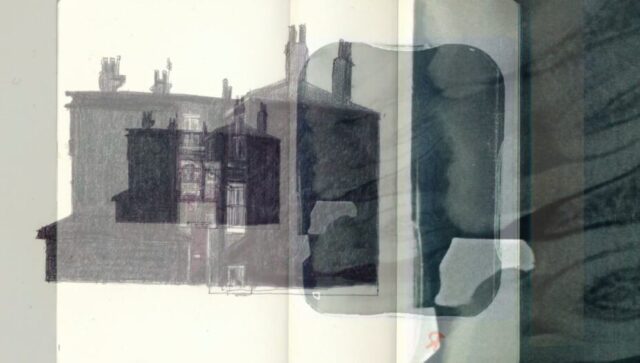
The documentary starts on June 20 2019, the day a doctor in a black suit tells the established artist and filmmaker that they found something in her brain, later diagnosed as a slow growing brain tumour which has probably been there for over a decade. The person in the black suit is captured in a drawing, as are all of Andrea’s experiences, thoughts, doubts, dreams, fears and ponderings.
She continues to draw until the day of her surgery when part of the tumour is removed and sight in one eye is lost. She then takes us on an odyssey into the past, going through her sketchbooks year by year, searching for signs of the benign growth in her brain, “finding a language.” But in all of those endless drawings there is “no big reveal, no exact moment the tumour commenced”, although she “can see over the time a kind of darkness grew around me” and “I could never quite capture it. I stopped growing but it carried on.”
The search continues all the way back to her childhood and her first drawings, already showing the signs of an inquisitive mind and creative skills. In reverse order, we are given an insightful presentation of how she developed those skills and cultivated that sense of curiosity.
After the very earliest drawings the documentary returns to the near present, when the complete removal of the tumour leaves her paralysed on one side and when her “world went dark and quiet for a long time.” Andrea is incontinent, can’t talk or read, let alone draw and write. But with the help or her mother and brother and an impressive amount of perseverance, she manages, very slowly, to start her recovery. First it is just a bunch of illegible scribbles, trying to copy the simple words written by her mother. When she finally manages to write something, she discovers she can’t retain it and has to start all over again the next day.
The road to recuperation is a captivating one, brightened by her surprising observations and subtle self-ridicule. You see the painstaking process – from scribbles to childlike letters, the first attempts at drawings, resembling nothing at all. She tells how she tried to talk: “words melted more than crumbled right out of my mouth.”
She is trying to reclaim the visual language she lost, but as she continues to practise (making minimal progress) she realises she will never gain back what once was. When she tries to draw a horse, she finds its image is erased from her memory: “the recipe for horses was gone.” She has to accept she is “trapped in the cartoon world till further notice.”
It is hard to imagine making a documentary with only shots of black and white drawings in a sketchbook, one mini-animation and a voice-over in a monotonous tone, which clearly shows the impact of the damage done to her brain by both the tumour and the surgeries. But Penny Andrea succeeds in making you want to invest in her search for clarity, recovery and acceptance.
It’s not as much how she draws – although her work from before the surgeries is exquisite – but what she draws and what/where it stems from. By showing her drawings, she lets you into her brain and her mind, which is like an intellectual funfair, a wonderful world of beauty, brightness, humour, but also sadness and melancholy. It is a very direct, moving and insightful way of laying bare a mysterious and mesmeric creative process.
UK, 2021, 99mins
Director Penny Andrea
Production Penny Andrea