Veteran filmmaker Ignacio Agüero takes an intriguing approach in portrait based loosely on Belgian civil engineer Gustave Verniory’s memoirs on when he was hired in 1899 to construct a railroad across the unspoiled natural landscape of Araucanía, a region that had recently become part of Chile.
The style veers between playful and provocative, juggling political anger with relish for the beautiful landscapes and offering up a documentary hybrid that is intriguingly watchable.
Working with actor Alexis Mespreuve (playing Verniory) the film balances material of the crew visiting old sites and re-enacting adventures in modern-day Chile, with Agüero at times inserting himself into the footage as he recounts the story, or as he simply works on dialogue with Mespreuve.
But Agüero and Mespreuve also regularly step out of that narrative as they visit the Mapuche, an oppressed indigenous community still scarred by colonisation from many years earlier, and give time and space for community members to recount the recent brutal past when the conquest of Araucanía saw numerous Mapuches killed or displaced, detailing the deep-rooted anger and resentment still felt.
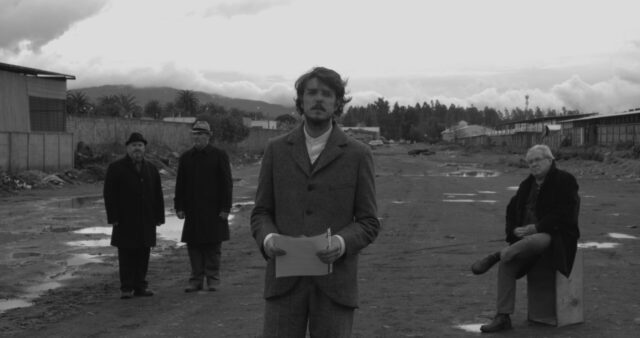
The film opens in playful style (it is largely shot in black and white) with the director standing in the modern-day spot where Verniory first arrived in Chile in 1899. It is where a train station once stood, but the director says: “There is no station. There is no train. There are no railroad ties, rails, nothing!”
Alexis Mespreuve as Verniory wanders into shot and says: “Wednesday, January 23rd, 1899. I hugged for the last time my mother, Marie, (and siblings) George, Blanche and Alfred. My heart is heavy. Who will be there while I return?”
Then from his hotel he looks out of the window and says: “In Collipulli, I met the first Indian. Poor devil… Honestly, he looks like the most harmless person in the world. Is he a worthy representative of this proud and warlike race which, only a few years ago, was the undisputed master of the vast territory of Araucanía?”
The director is soon back with notes in hand and Verniory reads a history of the region suppressed by French, with the filmmaker pacing next to him, hands behind his back. The film continues in this style as Verniory recounts his time working in Araucanía – from his first encounter with his unwelcoming chief engineer Mr Louis Robert de la Mahotiere through to his learning the language and recounting violent encounters with the Mapuche.
All of this is intercut with striking archive footage, often balancing material of old and modern-day locations, presenting the story as (near) adventurous at times and certainly making the most of the dramatic landscapes of the region. But Ignacio Agüero (who made El diario de Agustín and Nunca subí el Provincia) is also keen never to let Verniory’s tale, the images and the landscapes overpower the story of the Mapuche, and works hard to make sure this often playful film nonetheless forces the viewer to face some hard facts as he looks at the radical transformation of the pacified Araucanía territory towards the end of the 19th century.
Chile-France, 2022, 105mins
Dir/scr: Ignacio Agüero
Production: Ignacio Agüero & Asociado Ltda, Fulgurance Films
Producers: Tehani Staiger, Viviana Erpel, Amalric de Pontcharra
Cinematography: David Bravo
Editors: Ignacio Agüero, Claudio Aguilar, Jacques Comets