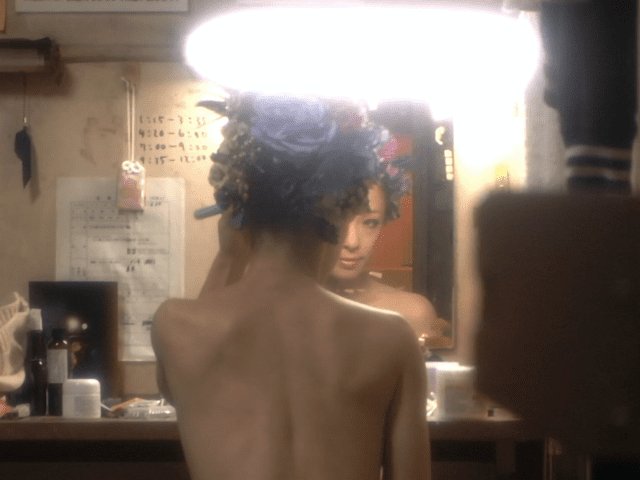
‘People think of strip clubs as seedy places’, an odoriko dancer says in the film. This delicate and understated portrait of a group of odoriko might change their opinion. Or at least it might change their perspective on the fine art of nude dancing.
It takes a moment or two to understand what you’re looking at, when the camera is following a naked young woman down a flight of stairs into a cramped room, where she folds over before she squeezing herself into a skin tight dress. She leaves the last part of her zipper undone but, as we learn a little while later, that won’t matter.
She is an odoriko, a Japanese freelance dancer, part of a group touring a string of striptease theatres. Their performance is less dancing than it is an acrobatic circus act, albeit stark naked. There’s nudity in abundance in this nostalgic and elegiac picture – which was filmed on MiniDV tape. But it can hardly be called sensual, and none of the women being pictured seem to feel the slightest embarrassment – it’s as if the (male!) filmmaker wasn’t even there. But he is, very much so, keeping his camera static, pointed at the mirror the girls are preparing in front of. Or at the door through which the women disappear in their elaborate outfits to return slightly exhausted and totally naked moments later.
It could easily feel like voyeurism but instead, as we spend more time with them, it feels more like being part of a group of friends. Watching the movie you can’t help but wonder how Yoichiro Okutani managed to get full access to this unseen side of the strip club. And how he managed to earn their trust. Maybe it is because they are so used to being seen naked by men. Or maybe they have totally embraced their profession, which earns them an income to maintain their families, their children and parents.
In the dressing rooms the women unveil themselves, talking about their insecurities, their nipples, their families, their future, but also what they’re having for dinner and what the crowd is like that night (maybe the audience is ‘creepy’, or maybe the punters are ‘going for it’).
It is touching how they look out for each other, carefully hanging up the costumes their colleagues throw into the stage wings during their performances. They share the drinks and fancy snacks bought for them by fans. They will even sit and watch the shows. It seems men aren’t part of their lives, even though they are their livelihood.
Okutani has a keen eye for telling scenes. A woman is getting ready offstage, while she listens to the music and the audience cheering the current show. On the re-opening day of a theatre, women arrive at the club in their nondescript clothes, not even noticed by the men finishing the last touches on the refurbishment. At another point, the odoriko are getting dressed while somebody is hoovering up in the background.
The dressing room scenes are interwoven with exteriors of the clubs – indeed, seedy looking buildings which could do with some paint and a little TLC. And of course there are the performances – shot just above the heads of the audience, the camera unmoved by the acrobatics on the turning platform.
So yes, the clubs might be tacky and run down, but the odoriko are strong, independent and proud of their jobs and each other. It is a peep into a very special sisterhood, which you feel honoured to be a part of for almost two hours which, despite the slow pace, seems to fly by.
Director: Yoichiro Okutani
Production: Eric Nyari / Cineric Creative, Asako Fujioka / Documentary Dream Center, Yoichiro Okutani
Co-production: 24images
Cinematography: Yoichiro Okutani
Editing: Keiko Okawa, Yoichiro Okutani
Running length: 114 min