A crusading call for the rights of migrant workers interwoven with the staging of a passion play, this hybrid film from Swiss documentarian and theatre director Milo Rau is a heart-felt and at times profoundly angry film set against the backdrop of workers campaigning for basic living conditions and rights in Italy.
The overt links to Mel Gibson’s The Passion Of The Christ and Pier Paolo Pasolini’s The Gospel According to St Matthew – both of which, like this film, were shot in the southern Italian town of Matera – are central to the film, and director Rau even goes as far as to layer in further links by casting Enrique Irazaqui, who played Jesus in the Pasolini version, and Maia Morgenstern, who played Gibson’s Mary, in small roles.
This time round, Cameroonian political activist Yvan Sagnet takes on the role of Jesus, with the film naturally playing on the notion of Christ portrayed by a man who defends the rights of illegal workers exploited by an agricultural system headed by shady Mafia types. To an extent it is a simple notion, and one that has a real power in certain scenes, though the film’s rather hefty and lumbering structure bogs down that resonance at times.
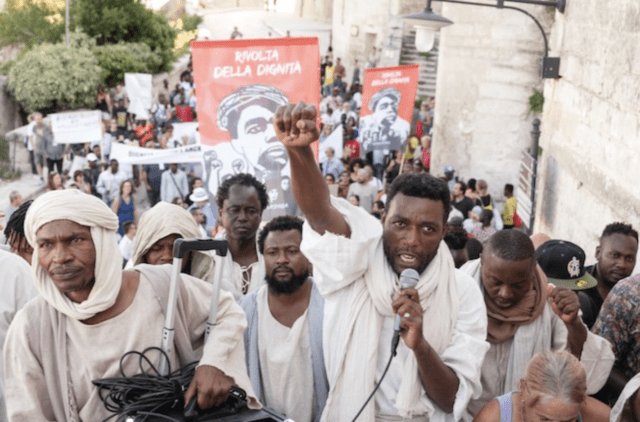
The playful formality of the Passion Play moments – as local dignitaries are cast and costumes are made – sits uneasily at times with the gritty and angry reality of the workers as they set about protesting. This ‘Revolt of Dignity’ campaign against conditions and the policies of the tomato farmers is at times caught up in its own politics, with Rau the unfortunate (and perhaps unnecessary) man in the middle as the concept of the film struggles at times to find its balance.
There are moments when it works very well, such as scenes of the tomatoes being thrown around the streets set to classical music, and followed up with footage of riot police gathering (no music here though). And especially (and disturbingly) when a shirtless male actor thrashes a chair where Jesus would be sitting, shouting brutal racist comments as he beats an empty space. There is no denying that Yvan Sagnet is a charismatic central figure, but when the biblical aspect takes over, the film loses the sense of gritty reality that provided the work’s early powerful edge.
Director Milo Rau, who is also artistic director of the Belgian city theatre NTGent, says he wants his work to “not only portray the world, but change it.” To that extent this project can be viewed as something of a success – and perhaps more than simply a film or a play – because it has led to better housing for the migrants, and the founding of a Fair Trade label for the harvested tomatoes.
Director: Milo Rau
Countries: Germany-Switzerland-Italy, 2020, 147mins
Production: Fruitmarket, Langfilm, IIPM (International Institute for Political Murder)
Producers: Arne Birkenstock, Olivier Zobrist, Sebastian Lemke
Cinematography: Thomas Eirich-Schneider
Editor: Katja Dringenberg
Music: Vinicio Capossela, Elia Rediger
With: Yvan Sagnet, Maia Morgenstern, Enrique Irazaqui, Marcello Fonte
Sales: CAT&Docs