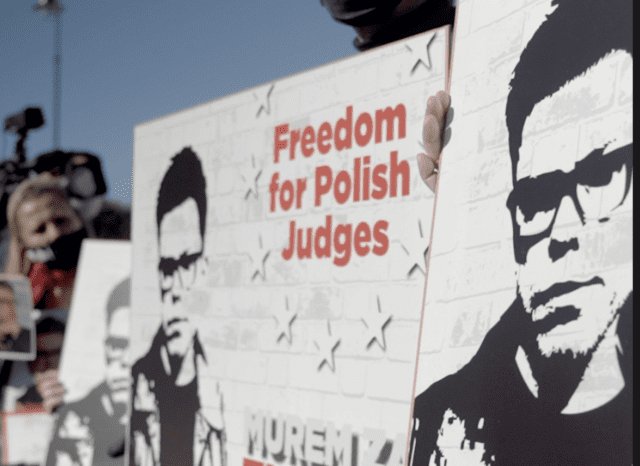
Judges Under Pressure is a film about grass roots protest. It is also a film about the protection of judicial neutrality. Most remarkably, it is a film in which judges are heroes, the ‘armour’ of the people, as director Kacper Lisowski puts it, and one in which those same citizens take to the streets to cry the word ‘Constitution’ in response to their own government’s erosion of that very concept.
What it isn’t is a film that gets bogged down in describing complex legal process, but it does remind us of a core and axiomatic principle of democracy, the independence of the legislative, the executive and the judiciary. These are the foundation stones that support the structure of state, and when one of these is removed, the film tells us, then the whole edifice comes tumbling down. Since the election in 2015 of the aptly/ironically named Law and Justice party, this is exactly what is at stake. As new Polish president Andrzej Duda says in the film, “Our justice system must be fixed. And our judges must know their role in Poland.”
The film focusses on two core protagonists, Igor Tuleya, a judge who lost the right to practise after allowing the media to record the accusation that high-ranking party officials bore false witness after a controversial vote held in Parliament’s Column Room.
The other main character is Waldemar Żurek, a father of two daughters (one of whom needs constant medication because of a heart condition) who has persistently refused to judge alongside others who have been illegally appointed by the politicised National Council of the Judiciary. He is the man who, in the film’s second half, takes the case for the Polish judges to the European Court of Justice.
Tuleya is a fabulous character, a serious and taciturn chain smoker, who looks like a cross between Shostakovitch and one of the Pretenders (Scottish band), who is both fragile and hard as nails. Even when he has doubts about his will to continue the fight, he resolves that he would bear a sense of worthlessness for the rest of his life were he to give up.
So we follow both him and Waldemar as decisions are taken that will determine both their fates, as well as that of their country’s future legal framework and its legitimacy. Of course we see attendant protest against the government and its violent suppression. Then there are those who voice their support at open air rock concerts where, among the folk, house and jazz tents, is to be found the judges’ tent, which is packed to the rafters by serious and politically engaged revellers who are drawn to the cause of protecting democracy. (A horrendous counterpoint to this sees a group of Andrzej Duda supporters singing his name to the tune of “Hallelujah,” which must have had Leonard Cohen turning in his grave.)
As tellingly, we see the stance taken by fellow European judges who undertake the March of a Thousand Robes through the streets of Warsaw in solidarity with their Polish counterparts.
It is, like Aliaksei Paluyan’s Courage, a film that reminds us of the collective imperative to fight and protect the freedoms that were hard won by our forebears, but which can so easily be eradicated by the stroke of a political pen.
“Making a documentary about someone you don’t like would be a horror,” says director Lisowski of judge Tuleya (whom he likes a lot). “I think it would be impossible. So in my approach towards a character it never happens without some sympathy.”
That said, he admits to being initially intimidated by the judge’s intensity and sense of distance, although a strong bond developed subsequently between the pair. “When your protagonist accepts the picture of how he was portrayed [and sees] some truth about himself, it’s a compliment, it’s a relief,” says the filmmaker, who underlines that his partner, producer Iwona Harris, has (at least) equal status in the project. “Igor never complained. He was very, very loyal. We agreed some [personal] borders of, let’s say, his engagement…but this border went far into his life,” which enabled Lisowski to create a very personal and engaging portrait.
He was also impressed by the other judges he met in making the film, who were completely different to what he had imagined, not the fusty old conservatives of popular perception. “I had this picture of someone very distant and cold and emotionless but this was completely the contrary. We met clever, open people who have a lot of solidarity because they know they have to rely on one another, that it’s a strong bond. They just charmed me as a group.”
He further deploys an interesting term to describe the erosion of public liberties in Poland. “We often use the metaphor of cooking a frog, right? Where you change the temperature bit by bit by bit, and the frog doesn’t realised it’s being cooked. And this is the exact process that is happening.”
The film will screen at the Watch Docs festival in Poland in December, but Lisowski admits to uncertainty over what will happen next. He says it will be shown on a “couple of screens” but there is nothing concrete in place yet.
“We don’t have any major television on board, Polish television,” he told BDE. “So we actually thought it would be better for [the film] to have some recognition abroad, and then try and prove that it should be screened in Poland. Because, obviously, screening it is probably going to be some kind of a risk just as shooting [was] a kind of a risk. We did not suffer any consequences so far for doing this movie, but, you know, we don’t know what’s going to happen yet.”