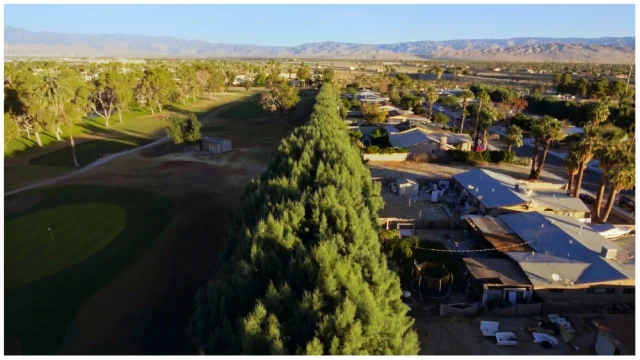
Racist trees. Now that got your attention. And that is exactly what happened in reality. The ‘racist trees’ issue, once it got picked up by the media, went from a local Palm Springs affair to international notoriety. It’s an irresistible hook for a clickbait article, a meme or a political rant. But also for serious historical research and social analysis. It provides the national and international debate about racism with a focal point. A row of sixty-foot tamarisk trees, screening off a poorer Black neighbourhood from the wealthy city centre.
And from there, the subject branches out into many aspects of the debate, while the trees themselves, the era in which they were planted and the way they are perceived today are all rooted in a much larger tradition of racial segregation in America.
Directors Sara Newens and Mina T. Son know how to pull an audience in. Catchy music, entertaining old newsreels and plenty of star power: Palm Springs used to lure big names like Elvis Presley and Frank Sinatra, who owned houses there. During the Depression, it survived by welcoming the movie industry – the one industry which was still thriving. Films like Frank Capra’s Lost Horizon (1937) and James P. Hogan’s Desert Gold (1936) were shot here. It looks, in those old newsreels and even now, when filmed by drones gliding over houses with ‘more pools for the number of residents than anywhere else in the world’ (as one promotional message has it) and surrounded by a mountain range, like the picture-perfect postcard of a western US city. Open and prosperous.
If you’re white. Because there is this one row of trees, on just one side of the golf course, behind which there is a predominantly Black neighbourhood, the Crossley Tract. These residents are not looking at the mountains, they are looking at a dense wall of huge tamarisk trees, which are overgrowing their yards, not being maintained by the municipality, and severely diminishing their property values.
Now, were these trees planted there with racist intent? To keep the Black neighbourhood out of view? It certainly looks and feels that way, but the documentary also presents evidence that this may not have been the case historically. But, as more than one present-day resident argues, even if that’s true – and many Crossley Tract residents don’t believe it is – it still begs the question of how to deal with it today. And there is undeniable racism involved in the arguments against removing the trees, as the documentary shows. And not just at right-wing Fox News, where the ‘racist trees’ soundbite is ridiculed with predictable bias, but also in modern-day Palm Springs, with its politically progressive and liberal reputation.
But not all racism, as we know, is explicit or even self-aware. For what does it say when white LGBTQIA+ politicians argue they can’t be racist because they know what it’s like to be discriminated against? While at the same time they’re not moving on the issue, however often it is raised by the Black community, until a lone white resident of Crossley Tract starts hammering on it. And after an article about it in the local newspaper, written by a white reporter, gets picked up by news outlets from The New York Times and The Guardian to Breitbart. As The Los Angeles Times reporter Tyrone Beason says in the documentary: “We’re not gonna get anywhere if we only talk about whether or not one person is a racist, but [not about] how institutions can be racist. How cities can be racist. How a system can be unjust, even as there are good people operating it.” But while some residents resent the fact ‘white privilege’ gets done what generations of Black activism couldn’t, others pragmatically opt to use it to their advantage.
Newens and Son delve into the history of segregation in the area, including the horrific story of Section 14, where people of colour found their homes destroyed and burnt down without any replacement housing, to make way for expensive real estate, a policy described already in 1968 as a ‘city-engineered holocaust’ by a California State investigation. And they also acknowledge the Agua Caliente Band of Cahuilla Indians whose homeland this had been for thousands of years – although this part of the documentary could have been fleshed out a bit more.
I’m not gonna tell you here how the story ends (if you don’t already know). You will have to see it for yourself. But there is a sadness to it. Because there are many issues dividing communities in the US and elsewhere. Some as functionally similar to this row of trees as a railroad, a street or an actual wall. What if the segregation issue in Palm Springs hadn’t have been as mediagenic as ‘racist trees’? Would anything have happened at all? Would the newspaper article have been written, would national and international media have taken notice, would this documentary have been made? Would I have written about it? Would you have gone to see it?
United States, 2022, 85 minutes
Directors Sara Newens, Mina T. Son
Production Wild Pair Films
Producers Sara Newens, Mina T. Son, Justin Baldoni, Andrew Calof, Joanna Sokolowski
Sales: Deckert Distribution
Script Sara Newens, Joanna Sokolowski
Cinematography Jerry Henry
Editing Sara Newens
Sound design Fancy Film
Sound Ben Chan, Kelin Verrette, Patrick Reilly, Alan Sanchez, Fredie Sanchez
Music William Ryan Fritch
With Charles Metcalf, Jr., Kevin Williams, Trae Daniel, J.R. Roberts, Corinne Kennedy