In Maia Kenworthy and Elena Sanchez Bellot’s smartly constructed film the ultimate achievement – and one which is at the heart of the film – is the very real impact that Extinction Rebellion has had on tackling climate change.
Love them or loathe them, there is no denying the striking impact Extinction Rebellion had on the debate around climate change when the group first engaged in a campaign of non-violent civil disobedience in April 2019, a process that blocked strategic traffic points in London for days, leading to hundreds of arrests and an against-the-odds change in UK government’s stance on climate change.
Maia Kenworthy and Elena Sanchez Bellot’s smartly constructed film tracks the origin, intentions and successes of Extinction Rebellion as well as detailing its internal issues and personality clashes. It is a story of passion, frustrations and ambition and displays how non-violent civil disobedience can have a massive impact, but also how organising such a body can offer as many challenges as successes.
The film focusses on the events of 2019, but also takes a step back to recount how Extinction Rebellion was formed with interviews with two of the co-founders, Gail Bradbrook and Roger Hallam. As Hallam comments: “It was like being strapped into a funfair ride that lasted for years.”
Organisers came up with a plan to head to London and essentially close down the city. As Hallam added: “The challenge was to go there and stay there!”
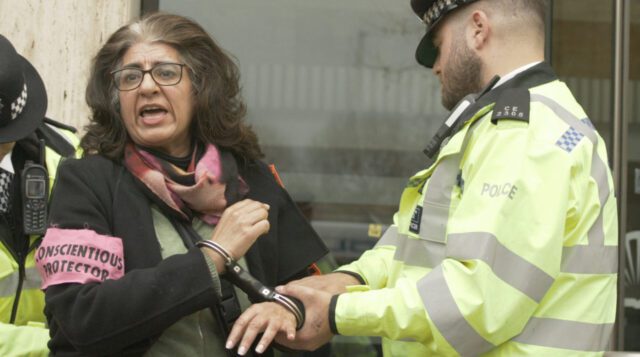
Also interviewed is international climate lawyer Farhana Yamin who for decades has been at the heart of the UN debate on climate change. She finally decided to join Extinction Rebellion out of frustration about politics, but admitted to worries about making the next steps to civil disobedience. But in the end, her perception was that there was a need for urgent radical intervention, and so along with scores of others she joined the April event, which saw five prominent sites in central London occupied – Piccadilly Circus, Oxford Circus, Marble Arch, Waterloo Bridge and the area around Parliament Square.
The protest surprised the government, with the police taking a gently gently approach, even as the days wore on and more arrests we made. There was dancing and cooking; speeches and marches; there was a pink painted yacht parked at the centre of Oxford Circus and even Greta Thunberg paid a visit to speak. To everyone’s surprise the Tory government agreed to a meeting, and out of that meeting Britain became the first country to declare a formal climate emergency.
But while Roger Hallam advocated further action – “If you are not in prison you are not in resistance,” he says – others in the group grew unhappy that certain voices within the group were not being heard. This included Hallam’s activist daughter Savannah, who in one meeting makes a statement asking for younger voices – and in particular hers – to be heard when the group is debating whether to disrupt Heathrow airport by flying a drone into airspace. When he essentially dismisses her views she is in tears and storms out while swearing at him.
Roger Hallam is eventually voted out of the group, but goes on to campaign with other groups (and is arrested and ends up sporting a ankle monitor) and the film sees Savannah warmly engaging with her father, while he admits he should have handled things better between them.
But the ultimate pride – and one which is at the heart of the film – is the very real impact that Extinction Rebellion has had. It spurred further campaigns of non-violent civil disobedience around the world, and despite the UK government targeting protestors by limiting their ability to protest, the ethos and impact of this essentially caring and compassionate group of people remains striking. Climate justice has emerged as a cornerstone of movements that either sprung out of, or were influenced by, Extinction Rebellion, and this film does an impressive job of charting a remarkable period of time when ordinary people took a stand and demanded to be heard.
UK, 2021, 83mins
Dirs Maia Kenworthy, Elena Sanchez Bellot
Production Halcyon Pictures, BFI, Doc Society, Bertha Foundation
Producer Kat Mansoor
Cinematography Elena Sanchez Bellot, Maia Kenworthy, Amy Newstead
Editor Michael Nollet
Music Wayne Roberts