Huang Pang-Chuan and Chunni Lin’s homage to revered sculptor Huang Tu-Shui is a palimpsestic study of the passing of time, the changing of culture and the enduring power of art. The film follows the careful restoration of Kam-lōo-tsuí, Tu-Shui’s marble sculpture of a female nude, and the family who sheltered her from harm throughout the White Terror period.
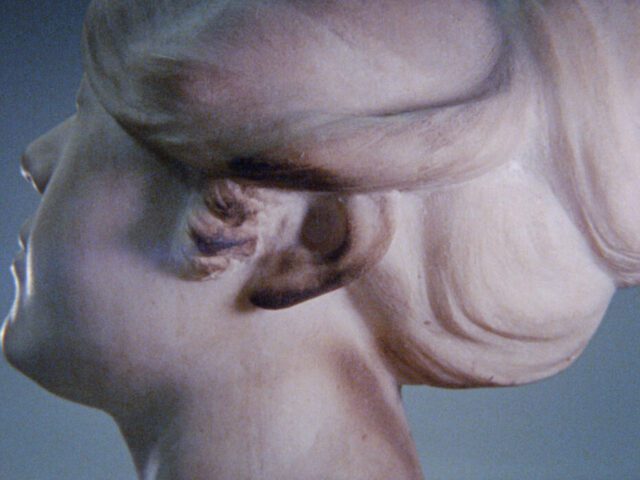
The first clear shot we’re given of Kam-lōo-tsuí (after its brutal deboxing that opens the documentary) is a slow zoom into the innards of her ear, a circular well that fades to a rounded window of rock, framing a calm sea. It’s as though we’re being drawn into the internal world of the sculpture herself, her memories. “The sculpture has lived through 100 years. Experiencing her years, just like a living person,” we are told.
The story of the past century unfolds through the (now elderly) children of a medical doctor, Chang Hung-Piao, who saved the ‘treasure of Taiwanese culture’ from destruction, after it/she was discarded by the provincial government. They gather around family photographs (and dumplings), piecing together the past, her origins, their university days and the subsequent fifty years that saw the sculpture left languishing in the corner of a warehouse.
The Kam-lōo-tsuí statue is presented as a core element from their childhood, constantly personified, the camera zooming in on the landscape of her marble skin, veined with streams of blue ink from a previous act of vandalism, and so close that the fractures and flaws are presented almost as human cells.
We hear how she stood at the end of the dining table, overseeing the family and the lives of the children, who remember her with total fondness – a watchful presence with half-closed but all-seeing eyes.
“Half-closed eyes come from the eyes of Gautama Buddha … they don’t have specific focus, but instead they see everything. Watching everyone in the world,” we hear. This idea feels subversive – traditional symbolism as part of a radical act – and in many ways, that’s what she was. The documentary explains the social attitude towards nudity at the time – and the threat it posed to both the sculpture and family.
“People back then were even less used to it,” we are told. The inclusion of ‘even’ stands out as significant – the implication being that perhaps our liberalism has not evolved to the extent we believe. And is this not the case? In a cultural and political climate that still sees conservatism dictating women’s decisions over their own bodies, does the concept of a world in which even the depiction of the female nude is considered criminally taboo, really feel that far away?
The changing societal role of women is, inevitably, placed under the microscope, but the magnification process is a gentle one. Dr Chang’s daughter recounts being made to help her mother in the kitchen while her four brothers ‘didn’t have to do anything … this was so unfair.’ The discussion is, of course, a crucial one, and yet it does not dominate – refreshing in a film with a female nude at its centre.
However, it is sufficiently present to pose a question – are we returning to a similar state? The cinematography sways the viewer to consider this circular world – life, nature, human nature (both positive and negative) – with the constant employment of cyclical imagery; the bright moon obscured by blackened clouds, the circular doorway that divides a destitute warehouse, the split-circle of the camera lens, like a target around her tarnished genitalia.
In fact, the documentary manages to explore all of its themes with this same elegant subtlety – the slow binding of her mouth in clingfilm that appears both as an act of silent reverence and an illustration of the suffocation of the Taiwanese people under the KMT (Chinese National Party) – made starker still by the lack of soundtrack, just a static soundscape, the squeak of the pulling plastic and muffled hands pressing it down.
“Nobody dared speak, everyone had become silent,” the sons recall, almost in passing, the secret police watching their family house both day and night. Space is left for reflection.
Huang and Lin resume their beautifully balanced partnership – which gave us Before The Dawn (2020) – to create this work, seemingly without agenda, and as quietly observational as Kam-lōo-tsuí herself.
The documentary really feels like a work of art – as though I should be standing under the glare of a projected screen in some dark room at the Tate – the celebration and culmination of a series of creations inspired by this one living sculpture and all the lives she touched. The restorer calls it a ‘swaying’. The ‘order in the process of creation’ is presented as a simple fact of life, the passing of time. The certainty of this fact is as certain as the lapping tides in their recurring cinematic interludes – the rounding off of one century, rolling into another, with Kam-lōo-tsuí as witness.
“Huang Tu-Shui’s sculpture appears immobile, but it is actually in a constant state of flux … Even though time cannot be seen or touched, you can still perceive it somehow,” we are told. One hundred years on, Kam- lōo-tsuí maintains the same power and relevance that we learn she always had – maybe more so – a distilled image of a tumultuous time in serene sculptural form. The documentary very much shares this meditative timelessness and, I have no doubt, will continue the chain of inspiration.
I can’t say I finished the documentary having learned a great deal – yet still, I left feeling my life was richer for having seen it. It felt as though the process had provided an opportunity for reflection and togetherness for the Chang family that was a joy to share in for these forty minutes; their own childlike joy and nostalgia, the warmth of the past even through adversity, a hankering for a simpler time, for which I too was left longing.
A living incarnation of Kam-lōo-tsuí shifts her weight from one foot to the other, stretching and flexing her toes, ‘this moment of condensation contains two moments, before and after, making her seem like she wants to move forward.’ This film is a hopeful step forward, a peaceful acceptance of the past and a lesson in how we carry on – a celebration of beauty and survival.
2022 /40 mins /Taiwan
Production Kiki Kunio Production
Directors Huang Pang-Chuan / Lin Chunni
Producer Lin Chunni / Ishiguro Miwa
Cinematographer Huang Pang-Chuan / Lin Chunni
Sound Chou Chen / Lin Chunni / Huang Pang-Chuan
Edit Lin Chunni / Huang Pang-Chuan
Edit Sound Huang Pang-Chuan / Lin Chunni
Mixing Chou Chen
Music Wang Yujun