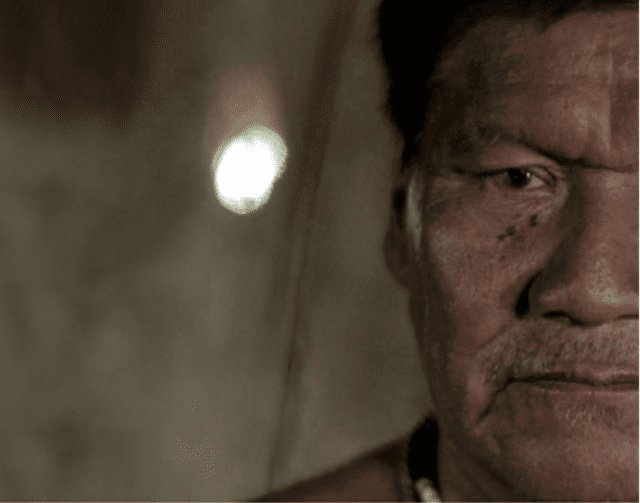
A powerful, enthralling and deeply beautiful delve into language, ancestry and how remote communities have been forced from their land, Arami Ullón’s absorbing film Nothing But the Sun (Apenas el sol), which opened this year’s IDFA may not have a campaigning voiceover or on-screen statistics to make its case but is actually all the more striking because it is a story seen through the eyes (and battered audio cassettes) of one man gently fighting for a way of life facing extinction.
Mateo Sobode Chiqueno (who was given the ‘Mateo’ part of his name when he was baptised by missionaries who took him away from his ancestral lands) has spent years – as well as what little money he has – on a battered tape recorder and increasingly dusty and cracked cassettes, travelling around regions of Paraguay where the Ayoreo community were herded into isolated settlements by missionaries who took their land and forcibly converted them to Christianity.
His sad and sombre voice carries the story. As he says at the start of the film: “White missionaries took us out of our paradise,” followed by a stark scene of animal carcasses by the side of a dusty road as trucks thunder by. He adds: “I wonder….what was our sin?”
His Ayoreo ancestors worshipped the sun, which they saw as a generous being called Yoquimamito. They would climb the trees to pray to the sun to hear the response better. The stolen lands are now surrounded by fences, and often cut down so there is more room for animal stock. Now, as he says to one old woman: “The wind blows harder with no trees.” But for him and his generation, the sun has become something of a threat, turning deforested areas into dry, dusty plains.
Mateo started recording Ayoreo stories, songs and reminiscences in the 1970s, and still travels with his now-antique cassette recorder to collect voices for his archive. Sure, this battered machine sometimes mangles the tape – which involves patient re-winding to make it better – but he is determined to protect a culture and identity in danger of being lost. Some Ayoreo still live in seclusion in the forests of the Chaco in Paraguay, but he is worried they may be contacted by outsiders.
For Mateo and his generation who were forced from their forests, that is a dreadful thought. As he sadly says, “We must not disturb them.” He goes about his recording with sad resignation, and it is left to Arami Ullón’s impressively structured film, which is rich in terms of beautifully composed filming, to bring an understated anger about what has happened to Mateo and his fellow Ayoreo. The film astutely refrains from outright campaigning…instead it lets impressively composed sound and vision do their work and leave audiences in no doubt about the sad circumstances of people whose balanced life is long gone.
Director: Arami Ullón
Switzerland-Paraguay, 2020, 75mins
Production: Cineworx Filmproduktion, Arami Ullón Cine, Nevada Cine
International sales: Film Republic
Producer: Pascal Traechslin
Cinematography: Gabriel Lobos
Editor: Valeria Racioppi, Rebecca Troesch