In 2021, evidence of unmarked graves was discovered on the grounds of an Indian residential school run by the Catholic Church in Canada. After years of silence, the forced separation, assimilation and abuse many children experienced at these segregated boarding schools was brought to light, sparking a national outcry against a system designed to destroy Indigenous communities.
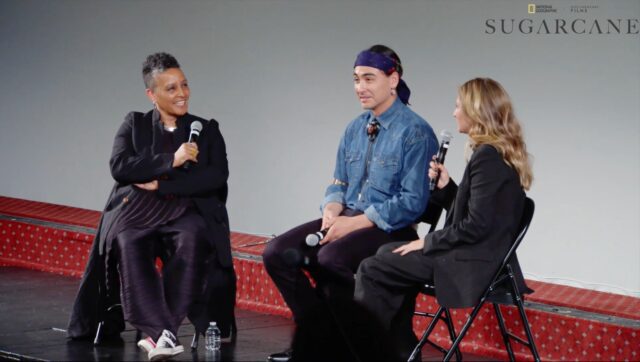
During a Q&A at the Natural History Museum in New York during the Margaret Mead Film Festival, where Sugarcane was the opener, filmmakers Julian Brave NoiseCat and Emily Kassie discussed the Sundance US Doc Director-winning film with Tabitha Jackson.
Jackson kicked off by asking co-director Kassie about the origin of the story.
“Julian and I actually met right here in New York City at our first reporting jobs almost a decade ago, and Julian was randomly sat at the desk next to me and in the year since I’d been desperately trying to work with him,” Kassie responded. “He’s a brilliant writer and storyteller and thinker. Meanwhile, I’m an investigative journalist and have spent time documenting atrocity and telling visual stories around the world.”
“I’m also Canadian,” she continues. “And the last year of the residential schools was my first year of kindergarten, and yet I wasn’t taught anything about the atrocities that my own country perpetrated against its First People. So when the news of unmarked graves broke in May, 2021, I just felt this kind of gut pull to the story. And the first thing I did was text Julian – and Julian sometimes wants to take a little bit of time…”
“And I found an article in the Williams Lake Tribune about Chief Willie Sellars, and I wrote him this long cold email,” Kassie adds. “He called me back that afternoon and said, ‘the creator has always had great timing. Just yesterday, our council said, we need someone to follow and document the search.’ Two weeks later, I had booked flights. I had already brought on Chris LaMarca [Nuclear Family (2021), The Me You Can’t See (2021) and Baby God (20200] to come shoot with me. And then I got a call from Julian…”
NoiseCat takes up the story: “When I finally called Em [Kassie] back (and it was actually two weeks later, I didn’t take that long) I told her that I’d be open to collaborating with her on a documentary. She told me that she had, as she says, identified a First Nation that was leading a search, and that First Nation was the Williams Lake First Nation. And that search was happening at St. Joseph’s mission. And there was a long pause on the phone, and then I said, ‘Wow, that’s really crazy. Did you know that’s the school where my family was sent and where my father was born? So out of 139 schools in Canada, Em chose the one school where my family was taken away and where my father’s life began. So what are the odds?”
And so the collaboration began.
Click below to see the whole conversation between Julian Brave NoiseCat & Emily Kassie and Tabitha Jackson.