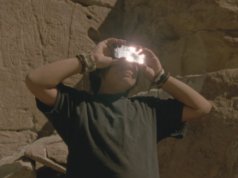
Dutch documentary master Leonard Retel Helmrich, who passed away last month, was one of the most important filmmakers in the Netherlands, with his three-part magnum opus The Eye of the Day (De stand van de zon, 2001), Shape of the Moon (Stand van de maan, 2004) and Position Among the Stars (Stand van de sterren, 2010) one of the genre’s great longitudinal projects.
With the second and third parts of his trilogy, Retel Helmrich became the first, and so far only, documentary filmmaker to win the main prize at the International Documentary Film Festival Amsterdam (IDFA) twice, both films also winning awards at Sundance.
The ambitious trilogy follows an Indonesian family living in Jakarta through the turbulent period beginning with the Reformasi, with dramatic political changes inevitably affecting everyday life. The Sjamsuddin family that Retel Helmrich cast at the centre of the trilogy represents not only three successive generations (and the classic conflict between tradition and modernity), but also the pressures of globalisation, the religious tensions between Muslims and Christians in the predominantly Muslim country, and the growing consumerism and online identities of the youngest generation of Indonesians. “Their microcosm contains the macrocosm of the entire archipelago,” Retel Helmrich described it to IDFA’s festival daily.
Single Shot Cinema
By staying for months at a time, earning the family’s trust, Retel Helmrich was able to gain an unprecedented insight not only into Indonesia’s shifting societal tides, but also into the pragmatic coping strategies of its inhabitants on a day-to-day basis.
Key to Retel Helmrich’s portrayal is his famous camera style, which he called ‘Single Shot Cinema’ (lauded by The New York Times as ‘seemingly impossible shots’) and which he taught at universities and film festivals around the world. It is a lyrical style of intuitively moving the camera in long, fluid takes without commentary, guided as much by chance and beauty as by narrative considerations (often using cheap, improvised camera supports). ‘I try to keep the camera moving at all times. Very slow or very fast but always moving, even if it is less noticeable e.g. when a person is speaking. Just like the surface of water, which is never completely motionless,’ is how Retel Helmrich writes about his Single Shot Cinema style on its dedicated website.
It makes him more or less unique within Dutch cinema, and even internationally his style has few equals. Shots where the camera starts following the path of a wandering cockroach, for example, might recall Terrence Mallick’s love of such digressions. But while their approaches are related in their lyricism, Mallick’s larger-than-life, romanticised universality is a far cry from Retel Helmrich’s down-and-dirty, in-your-face documentary directness.
Fly in the air
Retel Helmrich never uses his subjects as pawns in a premeditated play, but allows broader themes to emerge naturally through careful observation and superior editing. And he combines his lyrical camera – gliding, turning and running with and in between his subjects, fearlessly entering a riot, the chaos surrounding a city fire or confronting a cobra – with a Direct Cinema sense of observational intimacy, turning the well-known ‘fly on the wall’ approach into something like a ‘fly in the air’. Indeed, Retel Helmrich once claimed his subjects got so used to the camera that he could pass in front of their faces in close-up without them even blinking. “You could say I enter people’s aura. To me, that’s a question of honesty,” Retel Helmrich told the IDFA Daily. “As a documentary filmmaker you inevitably manipulate the situations you’re recording. But you do it less when you’re openly participating, than when you’re pretending not to be.”
Retel Helmrich made other films (and worked on films by others), including one of my personal favourites Flight from Heaven (Vlucht uit de hemel, 2003), and his final feature, The Long Season (2017), which won the Best Dutch Documentary Award at IDFA.
As an aside: as a Dutch film journalist, I’ve always felt that Retel Helmrich, although critically acclaimed, hasn’t quite been given the place of honour in Dutch film history he deserves. This may be because his trilogy was set in Indonesia, not in the Netherlands, and is therefore perhaps remembered more as a foreign production. But it may also have something to do with the continuing post-colonial marginalisation of Dutch people with roots in the former Dutch East Indies. As these past few years have finally seen a beginning of public and political reckoning with the Netherlands’ colonial history, let’s hope this will help cement Leonard Retel Helmrich’s reputation as one of the country’s great filmmakers.
Biography
Leonard Retel Helmrich (1959-2023) was born in Tilburg to a Dutch father and a Javanese mother who moved to the Netherlands from the former colony of the Dutch East Indies in 1957, after Indonesia’s hard-won independence. Retel Helmrich graduated from the Netherlands Film Academy in Amsterdam in 1986 with the short fiction film The Drowning Man (De Drenkeling), after which he worked as a director, cinematographer, screenwriter and editor. After his low-budget fiction feature debut The Phoenix Mystery (Het Phoenix mysterie, 1990), Retel Helmrich concentrated his directorial efforts on the documentary genre.
In 1987, while working as an assistant director on Pim de la Parra’s Odyssée d’amour, he met American cinematographer Jordan Klein, who introduced him to the ‘orbit movement’ in long continuous shots that mimics natural human vision. This, together with the advent of small digital cameras and the theories of French film theorist André Bazin, would lead Retel Helmrich to develop his famed ‘Single Shot Cinema’ technique, which he shared through workshops and as a lecturer at film festivals, universities and other institutions around the world. To stabilise the camera during these shots, Retel Helmrich also developed (and marketed) special devices such as the ‘Orbit’ and the ‘SteadyWing’.
In 1989, he founded production company Scarabeefilms together with his sister Hetty Naaijkens-Retel Helmrich (1955, Bandung, Indonesia), who not only produced most of his works but is also a successful filmmaker in her own right, with documentaries such as Klanken van oorsprong (2018), on which her brother served as cinematographer.
His first documentary Moving Objects (1991), about Dutch theatre, won a Special Jury Prize at the International Golden Gate Film Festival in San Francisco. Encouraged by his sister, he then travelled to Indonesia for the first time, and although he was deported in 1995 as a persona non grata, accused of espionage, he was able to return two years later, start a family and begin work on what would become his most celebrated production, the Indonesian trilogy The Eye of the Day (De stand van de zon, 2001), Shape of the Moon (Stand van de maan, 2004) and Position Among the Stars (Stand van de sterren, 2010). The latter two both won the top prize at IDFA and major awards at Sundance.
In between, he worked on a number of other documentaries, including Raw Herring (Hollandse Nieuwe, 2013), co-directed by Hetty Naaijkens-Retel Helmrich, which premiered at Tribeca. After suffering a cardiac arrest during the making of The Long Season (2017), about a Syrian refugee camp in Lebanon, the film was completed by its producer Pieter Huystee and went on to win Best Dutch Documentary at IDFA. Since then, Leonard Retel Helmrich had been struggling with his health.