Since its launch in 2010, dok.incubator’s core mission has been to raise the bar to transform good documentaries into exceptional documentaries. Run by a small team of six, the Prague-based programme consists of several rough-cut workshops aiming to strengthen the potential of promising non-fiction projects.
However, something has changed over the last fourteen years, director and founder Andrea Prenghyová reveals to Business Doc Europe. “Our mission is changing because the market is changing. And that’s happening quite dramatically, especially after the pandemic. It’s getting very hard [to find room] for documentary films. It’s always been a matter of making them visible, to think about the audience during the process and not turning them into something very small, too nichey – and to make them more accessible,” she says.
“This mission is much more urgent now. As the space for creative documentaries gets narrower, I think we have to fight for our audience. We need to raise attention, so that the audience can spend time with us and with our films.”
The decline of the theatrical market for docs and the growing need to support filmmakers has forced dok.incubator to redefine the structure of its programme over the years, Prenghyová adds.
“At first, we decided to focus only on the editing workshop, working only with the cuts. Soon enough, however, we discovered that we had to take care of the projects in their entirety. From the beginning, we knew we didn’t want to work only with directors but also with editors and producers – and we’re now involving co-producers and marketing people as well.”
“We’re talking to a larger team because they need to be on the same boat and understand what they do, all of them. If each of them takes the right direction, they can make a strong film together. Filmmaking isn’t a lonesome work, after all.”
Prenghyová highlights how dok.incubator and the participating teams put most of their efforts into crafting a work capable of catching people’s attention, a task that is rendered even more difficult at a time when we are bombarded with images and content: “You can tell a very important story about climate change, but nobody will listen. [So] you need to be so careful about how to tell it. […] There are topics you can’t talk about, like child abuse. Nobody wants to see something about that, but you can still make a good, interesting film. It’s all about what you want to say, and how you say it.”
“We’re bringing [into] the creative process many more questions, and we think many steps ahead. [By doing so] the directors gain much deeper ideas coming from different perspectives. Their work is not just about their intuition but also about gaining a better understanding of what they’re doing, so that they can make informed decisions.”
Dok.incubator’s call for its international workshop is now open, with a deadline of January 25. The selected projects will be announced in March, with activities planned in April, June and September in Slovakia and the Czech Republic. In November, projects nearing completion will be presented.
Alongside the international workshop, dok.incubator runs two six-month workshops for local projects in the Czech Republic and Slovakia. Last year, the programme also organised in Budapest a four-day regional workshop for Hungarian filmmakers, launched a new platform for Polish, Czech, Slovak and Hungarian documentary producers (the Visegrad Co-production Forum), and hosted an open programme focused on festival and distribution strategies. Additionally, dok.incubator is now running the final stages of the Move It On workshop focused on communication and marketing strategies aimed at Czech fiction, non-fiction and animated feature-length projects.
The international workshop’s team of tutors hosts the likes of French doc producer Christine Le Goff (also serving as the programme’s Head of Studies) and Finnish filmmaker Liisa Karpo, among others. Dok.incubator welcomes tutors from different parts of Europe so that they can share their market expertise and teach their own “school of thought” and unique working methods, Prenghyová underscores.
Past partners of the initiative included Slovakia’s Association of Independent Producers and Madoke, Hungary’s Association of Documentary Filmmakers, among others.
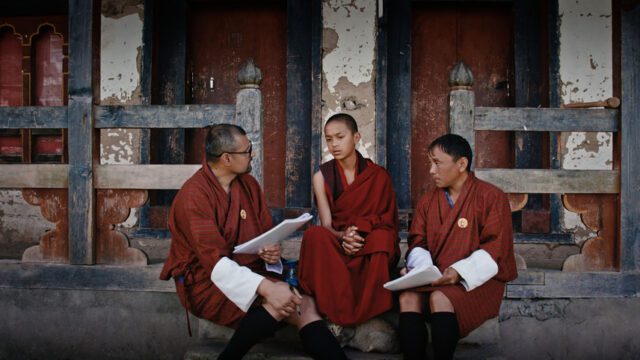
Some of the most successful projects tutored by dok.incubator include Arun Bhattarai and Dorottya Zurbo’s upcoming Sundance-bound Agent of Happiness (“the very first doc feature shot in Bhutan” and “a humorous film tackling the serious topic of the Bhutanese king’s national project on the measurement of happiness”), Tünde Skovrán’s intersex-focused Who I Am Not (which world-premiered at Thessaloniki and screened at CPH:DOX and SXSW), Vlad Petri’s epistolary doc Between Revolutions (which premiered at Berlinale 2023 and screened at Sarajevo), Alexander Mihalkovich and Hanna Badziaka’s 2023 CPH:DOX winner Motherlandand Efthymia Zymvragaki’s Spanish-Greek co-production Light Falls Vertical.
Towards the end of our conversation, Prenghyová zoomed in on Zymvragaki’s Light Falls Vertical to explain how decisive can be the creative impact of dok.incubator on a project still in the making. “Light Falls Vertical is the story of a perpetrator who’s been arrested and committed violence on women. [..] He wrote to 300 production companies asking them if they could make a film based on his autobiography. Only one person answered [director Zymvragaki], and she started making a film with him, re-enacting some scenes from his life. The book also shows how perpetrators are damaged by the situation they’ve put themselves in and can’t find a way out.”
“When the shooting was still ongoing, the director took part in our workshop. She didn’t have a producer and had some raw footage, which was quite interesting. We selected her for the workshop, but then we realised that watching such a violent main character wouldn’t be acceptable for the audience. The audience wouldn’t understand his position, so we started to discuss with her why she was making this film and why she was the only one who replied to this person.”
“She told us that it was because she had been victim of an abusive father herself and, when she had her first boyfriend, he locked her in their house and didn’t let her out for two weeks. So she wanted to find out what was wrong. That’s why she accepted to tell this story. She wanted to understand better hers.”
“So we convinced her to add this layer to the film. We convinced her that this person shouldn’t be the main character, but we suggested her to enter the film and tell us her story. [For us] she and her healing process should have been the main characters of the film, and not the perpetrator.”
After following dok.incubator’s input, the director completely changed her point of view and fully reshaped her project, finding finance and gaining a selection (and a Special Mention) in the main competition at IDFA 2023. “This is a clear case of how you can completely turn over the way you look into your film, if you get good ‘impulses’ and [are asked good] questions,” Prenghyová sums up.