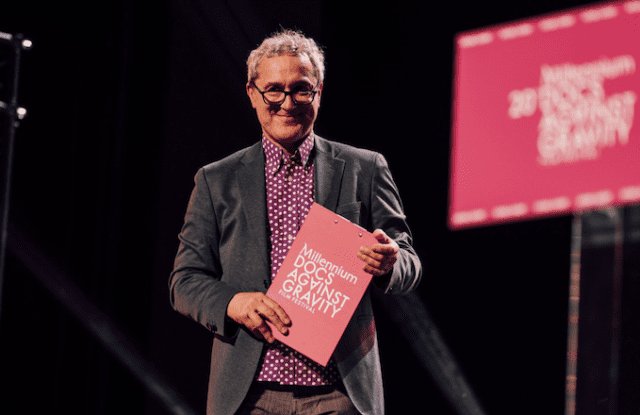
The 21st Millennium Docs Against Gravity, which plays across 7 Polish cities, kicks off May 10, running to May 19 before going online from May 21 to June 6.
The event offers up a slew of awards across numerous competitive (and non-competitive) thematic sections, catering for international and Polish films alike, and is driven by a particular rationale – “to promote documentary film art and its directors well beyond the doc audience [and] to seek new audiences using a wide coalition of media titles and opinion-making experts,” CEO and Festival Director Artur Liebhart explains to Business Doc Europe.
For Liebhart it was important first to establish the festival “as the most popular film event in a 40-million country,” before he looked to target professionals back in 2020 with his MDAG Industry programme. “Now, we can widen it [the festival] from both ends,” he says.
This year, high profile docs such as the Sundance-awarded Porcelain War and Sugarcane will have their international premieres at MDAG. “At the same time we promote avant-garde and experimental films, both new productions as well as older films via retrospectives curated by experts,” says Liebhart.
“Our activities don’t stop there. The festival has run academic faculties on avant-garde films and on various aspects of contemporary documentary films at three Polish Universities since 2012. Our festival runs for 10 days in 7 cities at the same time, with directors travelling to other cities than Warsaw. Besides Q&A sessions at each of the festival cities the local teams organize special events: debates, workshops, music concerts, photo exhibitions. We plan 220 such events for the 21st MDAG, and that’s excluding the Q&A and Industry events. The scale of the festival and the influence it exerts count for a lot – and this differentiates MDAG.”
Liebhart further explains his selection rationale. “Choosing the cinematographic concept is proposing the aesthetic,” he says. “We hunt for an original combination of theme and aesthetic. An interesting, engaging story presented in an original way. The cinematographic concept fitting to the story is at the core of the selection criteria. And our selection is mostly made by the curator’s [vision] rather than waiting for submissions.”
The main competition of the festival in Warsaw constitutes the competition sections in the other cities of Wroclaw, Katowice, Poznan, Gdynia and Bydgoszcz, where local juries decide on their own cash awards sponsored by local authorities. The Big Screen (Audience) Award is chosen by the audiences from all festival cities across Poland.
MDAG also presents a series of thematic competition sections, such as the Amnesty International Award, the Chopin Nose Competition dedicated to films on the arts, the Green Warsaw Award for films on climate change and the Newsweek Psychology competitive section for films tackling psychological issues.
“There is an Ethnographic Film Competition under the patronage of the Ethnographic Museum in Gdynia, being an example of a local initiative incorporated into the body of the festival,” Liebhart adds. “So we select thematic films too. Nevertheless the high level of film art is what always decides.” The Cinematography Competition, Debut Film Competition and Short Film Competition in Warsaw wrap up the MDAG competition sections. For the 2024 online festival, a special film section dedicated to Palestine will present old and new films “from various perspectives,” the MDAG CEO adds.
Unsurprisingly, Polish filmmakers are much in evidence across all sections of the festival. How does Liebhart assess the current health of the local doc industry? “A new attitude and a different point of view, and bravery in pursuing the subject and protagonists who mark the new times,” he answers, before giving examples.
“Lidia Duda follows a middle-class family leaving the city life and moving out to a house in the forest in her new film Forest, already awarded in Thessaloniki. In Life and Deaths of Max Linder, Edward Porembny rediscovers the legendary Max Linder, the first European actor who made a career in Hollywood, superstar and a role model for Charlie Chaplin, and constructs the story of his protagonist in the style of 1920s cinema. In Just Hear Me Out Malgorzata Imielska turns her camera on 18-year-old Margareth who openly speaks about her schizophrenia and a need to be understood and loved. In Well of Dreams Pawel Tarasiewicz follows the transgender Reema, who works at a carnival sideshow in Pakistan, dancing to attract spectators. These are the examples of a variety of styles and interests of the fast-developing Polish documentary industry.”
Liebhart returns to the subject of MDAG Industry, whose emphasis is in large part placed on the presentation of local projects. “It is a 4-day event with pitches of feature-length projects, shorts, films for the young audience, masterclass sessions and lectures. I don’t believe in success by the size of the event with so many well-established markets and pitching forums in the documentary world. We aim to gather key-decision makers who can help a small, carefully selected number of projects. For the time being, we focus on Polish co-productions as far as it goes for feature-length film projects. All key players of the Polish market – producers, TV channels commissioning documentary films, co-financing institutions – will be present.”
“Our selection is focused on the potential of the projects for the international market. Shortcomings in the business plans can be mended along the way,” he says, adding how he is “very proud” that Alisa Kovalenko (We Will Not Fade Away, 2023) will be pitching her new project Frontline at MDAG before moving on to Cannes Docs.
Other features of MDAG Industry 2024 are a Thom Powers keynote and masterclasses given by Esther van Messel of First Hand Films, Eric Hynes (curator of Film at Museum of the Moving Image) and revered Danish editor Niels Pag Andersen.
“Thom Powers’ keynote (titled ‘The Power is in Our Hands’) will open MDAG Industry and will focus on current opportunities and obstacles within the documentary industry. Esther van Messel will share her immense experience from the start of the project through to its distribution within an ever-changing market. Eric Hynes will present the current state of American documentary market and will focus on ‘how to get there’ with the project. Niels Pag Andersen will give a masterclass on the art of editing and will spend one full day with 4 projects selected from film schools across Poland. This is one of the Festival’s dedicated tasks, to grant access to masters at the beginning of the young filmmakers’ carers.”
In terms of what will constitute a successful festival, Liebhart hopes to exceed 150 international guest filmmakers in Poland. Already, the number of screenings stands at 1390. “I expect to break the record of tickets sold and to have super happy festival guests who will remember MDAG as a unique experience,” he ends.