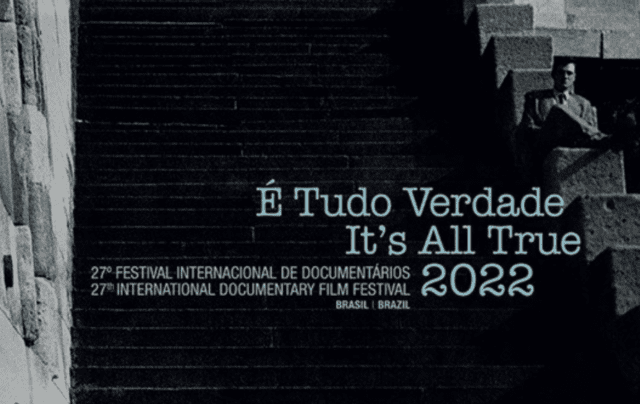
It’s All True 2022 will take place in hybrid form from March 31 to April 10 at 4 venues across São Paulo, and from April 1 to April 10 at 2 Theaters in Rio de Janeiro. The online version, playing across the same dates, will be hosted by the It’s All True, Itaú Cultural Play and Sesc Digital platforms. In total, the festival will screen 77 productions from 34 countries.
Winning films (jury) in Brazilian, International Feature, Medium-length and Short Film Competitions will automatically qualify for next year’s Oscar® long-list. The awards ceremony takes place Saturday April 9 in São Paulo.
Mark Cousins’ The Story of Looking and The Story of Film: A New Generation will open the festival in São Paulo and Rio de Janeiro, while Alex Pritz’s The Territory will close the event. The festival will also honour the documentary work of Ana Carolina and Ugo Giorgetti.
“It’s a privilege to see the festival’s gradual return to movie theatres, in full compliance with the prevailing health and sanitary protocols urged by the ongoing pandemic, including the presentation of a vaccination pass, obligatory mask-wearing and limits on maximum capacity”, says Amir Labaki, the festival’s director. “For an event with a traditional level of excellence like It’s All True, prioritizing the health and safety of all concerned, from the audiences to the film casts and crews, representatives of our partners, and festival personnel, spoke to the adoption of a transitional hybrid format.”
Brazilian Feature/Medium-Length Competition
- Goodbye, Captain by Vincent Carelli and Tita. Before he passed in 2016, “Captain” Krohokrenhum, leader of the Gavião ethnicity of Pará, told his daughters and granddaughters about the civil war that waged among factions of his people prior to the survivors’ transfer to the Mãe Maria Glebe. World premiere.
- Belchior – Just a Wild Heart by Camilo Cavalcanti and Natália Dias. Antonio Carlos Belchior Fontenelle Fernandes (1946-2017) is revealed in a portrait that delves into the wild heart of this poet and singer-songwriter from Sobral, Ceará. World premiere.
- Eneida by Heloisa Passos. With the help of her filmmaker daughter Heloisa Passos, Eneida, 83, sets out in search of her estranged eldest daughter, whom she has not seen in over two decades. World premiere.
- Skin by Marcos Pimentel. Graffiti, tagging, indecipherable symbols, slogans and declarations of love reveal desires, fears, fantasies and reveries. World premiere.
- Out of Breath by Ana Petta, Helena Petta. The documentary looks at the pandemic from the perspective of the care-giver, revealing the human face behind the collective struggle against Covid-19. World premiere.
- Rubens Gerchman: The King of Kitsch by Pedro Rossi. The documentary offers up a portrait of Rubens Gerchman (1942-2008), whose art strove to make a virtue of Brazil’s precarity through scenes of the cityscape and everyday urban life. World premiere
- Symphony for a Common Man by José Joffily. This documentary looks at the career of José Bustani, the first director-general of the Organization for the Prohibition of Chemical Weapons. In the wake of the September 11 terrorist attacks, the US began to pressure Bustani to resign from the post. World premiere.
International Feature/Medium-length Competition
- Getting Away With Murder(s) by David Nicholas Wilkinson. Under the London Charter of 1945, the Allies agreed to prosecute all those responsible for the Holocaust. However, after the end of the 40s, those same Allies did little or nothing to further that end. Why?
- Batata by Noura Kevorkian. An unusual film that spans ten years in the life of a determined Syrian Muslin woman, detained at a refugee camp in Lebanon, and forbidden to return home.
- The Strait Guys by Rick Minnich. A cantankerous Czech mining engineer and his motormouth pupil join forces with Russian visionaries to attempt the impossible: join the United States to Russia via a hundred-kilometer tunnel under the Bering Strait. World premiere.
- Cesária Évora by Ana Sofia Fonseca. Unseen footage, insights, struggles and successes from the life of the Cape-Verde singer Cesária Évora (1941- 2011).
- The Balcony Movie by Pawel Lozinski. Built upon conversations the director held with passers-by from the balcony of his apartment in Warsaw, the unique stories the film tells look at the different ways we go about our lives as individuals.
- Kurt Vonnegut: Unstuck in Time by Robert B. Weide, Don Argott. The film recounts the extraordinary life of the author Kurt Vonnegut and his 25-year friendship with the filmmaker who set out to document it.
- The Trial – Prague 1952 by Ruth Zylberman. In 2018, footage was found of a sham trial held in 1952 at which fourteen high-ranking Czech communists facing trumped-up charges were forced to make a public confession of guilt.
- Portraits of the future by Virna Molina. When the pandemic struck, the filmmaker Virna Molina was making a film about the equal rights struggle of women workers on the Buenos Aires subway system. However, the Covid-19 outbreak would quickly transform the present into the dystopian future the film was depicting.
- Riotsville, U.S.A. by Sierra Pettengill. Using only archival footage, the film explores the militarization of the North-American police force, and creates a counter-narrative to the nation’s reaction to the civil unrest of the late 1960s.
- Tantura by Alon Schwarz. In the late 1990s, Teddy Katz researched the mass massacre that took place at the Palestinian village of Tantura in 1948. His work on the subject was later contested and Katz’s reputation ruined.
- Ultraviolette and the Blood-Spitters Gang by Robin Hunzinger. A teenage girl challenges her school, illness, doctors and death itself, and embraces the world around her by founding a gang of kindred spirits, “The Blood Spitters”.
- Navalny by Daniel Roher. A documentary “thriller” about how a leading opponent of Vladimir Putin’s authoritarian regime survived an attempted assassination by poisoning in 2020, identified those responsible for the attack, and, despite it all, returned to Russia to continue his democratic militancy.
Brazilian Short Film Competition
- Alágbedé by Safira Moreira. From the scrapyard to the Afro-Brazilian cult, Zé Diabo follows in the footsteps of Ogum, and forges gods in his workshop.
- Searching Heleny by Esther Vital. This stop-motion animated documentary revisits the life of Heleny Guariba, philosopher, teacher and theater director who disappeared in 1971, during the Brazilian military dictatorship.
- Chants from a Holy Book by Cesar Gananian, Cassiana Der Haroutiounian. Set against the so-called Velvet Revolution in Armenia in 2018, the film uses five chants to recreate the synergy that generates revolutions.
- Letter for Glauber by Gregory Baltz. In 1964, days after the military coup installed a dictatorship in Brazil, Gustavo Dahl, Brazilian filmmaker and film thinker, wrote a letter to his friend Glauber Rocha, who was away at Cannes presenting his film Deus e o Diabo na Terra do Sol (Black God, White Devil).
- Half A Light-Year by Leonardo Mouramateus. A youth sits on the side of a busy Lisbon street to draw the passersby. Not far from there, a couple discusses the origin of a wallet found months before.
- The Rightful by Ana Galizia. The grassroots landless movement stakes a claim to a territory in Guapiaçu Valley, Cachoeiras de Macacu (Rio de Janeiro). Recent disputes concerning a planned dam on the river means they will have to fight for water too.
- Order Prevails by Fernanda Pessoa. An internationalist voyage (in time) through seven countries that have experienced revolutionary turmoil in the 20th Century, accompanied by the voice of a woman reciting Rosa Luxemburgo’s last-ever text.
- Solmatalua by Rodrigo Ribeiro-Andrade. With a constellation of Black voices and presences, Solmatalua plots a vertiginous course through ancestral and contemporary territories.
- Tekoha by Carlos Adriano. On September 6, 2021, private security guards burned down a Guarani Kaiowá house at the Ava’te Tekoha (“place for living the culture”) in the Dourados Indigenous Reserve in Mato Grosso do Sul. The act was captured on video by the Guarani Kaiowá.
International Short Film Competition
- Ali and his Miracle Sheep by Maythem Ridha. Ali, a nine year-old mute, takes his favorite sheep, Kirmeta, to be sacrificed. On their long journey, they witness the beauties and unveil the ills of Iraq. But can those be cured with a sacrifice?
- How Do You Measure A Year? by Jay Rosenblatt. A father films his daughter on her birthday every year, and always asks her the same questions. In only 29 minutes, we watch the girl transform into a young woman.
- Outtakes (Descartes) by Concha Barquero, Alejandro Alvarado. In 2016, at the Spanish Cinematheque, a group of filmmakers discovered 260 rolls of 16mm negatives cut from the documentary Rocío, which was censored in the early 80s.
- Fruit of Thy Womb by Fábio Silva. A filmmaker returns to his family home in a bid to understand his trauma.
- Heroines by Marina Herrera. A mockumentary about the cult of a group of women who venerate the skull of Tomasa Ttito Condemay, who fought in the Peruvian war of independence.
- Handbook by Pavel Mozhar
- Numerous protests broke out across Belarus in the days following the country’s presidential elections. The special police spared no brutality in quashing the unrest. In interviews, hundreds of victims recount their experiences.
- Party Poster by Rishi Chandna. In suburban Mumbai, science, religion and politics clash comically amidst a raging pandemic when a group of laundrymen decides to design a poster to celebrate a popular annual festival.
- The Stillness Syndrome by León Siminiani. In 2018, a group of filmmakers calling themselves The Still Ones embarks on an essayistic film about a hypothetical stillness syndrome in the Republic of Colombia.
- Virtual Voice by Suzannah Mirghani. The doll Suzi is an ego warrior. The director’s avatar, she marches to the rhythm of social media algorithms.