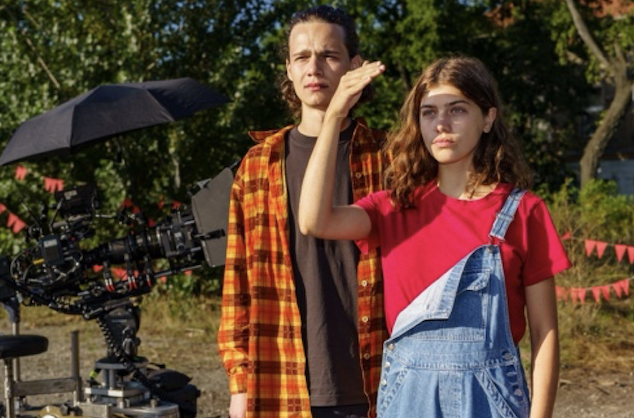
At Ji.hlava 2024, writer-producer-director Maté Konkol and producer Balász Zachar pitched their timely new project, a documentary titled Books Are Our Weapons. Set in Hungary, the feature delves into a socially committed student commune that gathers in an annual camp to welcome new members, discuss feminism, cultural critique, and direct democracy, as well as sit by the fire and sing songs of the movement.
Konkol’s debut feature closely follows Noémi, a first-generation university student from a working-class background who has just moved to the big city, and Péter, an eager, hedonistic young man from a middle-class family, as the newest members of FÉSZEK—a community of university students dedicated to exploring critical social theory and advocating for change as activists.
The two participate in debates, reading circles, forums, choir sessions, and social activities, realising how challenging it can be to fit in. The film uses extended takes and a wealth of cultural references to intertwine form and meaning, illustrating how the personal is inherently political.
Prior to embarking on this documentary, Konkol worked as an assistant to Crystal Globe-winning director Szabolcs Hajdu on It’s Not the Time of My Life (2016) and Oscar-winner László Nemes on Sunset (2018). He regularly writes on the film industry and cultural politics, while his two latest short films, Budapest, Closed City (2021) and Reap What You Sow (2023), are coming-of-age stories about sexual and political identity viewed through the lens of gender and class consciousness. Zachar, an EAVE 2018 graduate, has worked on numerous projects, including films premiered at Karlovy Vary, Locarno, and other major events.
Konkol described Books Are Our Weapons as “something more than a film—rather, a democratic experiment.” He elaborated: “Today, we all feel that young adults are aware of living in a society ruled by patriarchy and capitalism. They want to change things and their ways of life. We follow a community of young activists learning how to change themselves before changing the world.
“Initially, we thought of making a fiction film, but we ended up creating a documentary with fictional elements, meaning that all the protagonists act as themselves. It’s a participatory project where the director and protagonists all contribute to the making of the film. That’s why we also defined it as a ‘democratic project.’ Once finished, we hope to spark many conversations across Europe.”