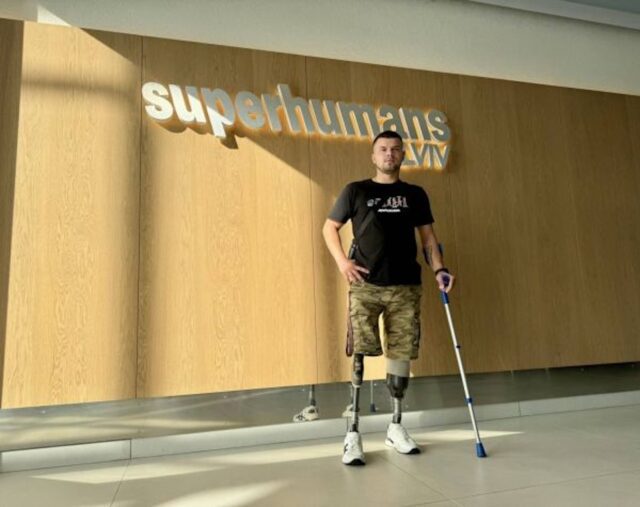
In Lviv’s Superhumans Center, war survivors confront a new kind of battlefield: their own bodies, reads the synopsis of Superhumans, Ukrainian Inna Shevchenko’s urgent and dynamic work-in-progress, pitched at Ji.hlava IDFF. Through intimate, sensory fragments — metal against skin, phantom pains, quiet laughter — the film explores how identity is reconstructed beyond trauma. A war film without explosions. No heroes, no victims; only fragile, fierce humans, each step an act of resistance.
“The body has been my personal frontline in protest, in speech, in writing and now in filmmaking,” Shevchenko reminded the professional audience of her activism of the past 13 years. “Because the body is where violence is truly enacted, and the body is also where defiance truly begins. So with Superhumans I turned the camera to the body at war.”
“Not the heroic body, not the mythical body at war, but the real body, the wounded body, the shattered in pieces body, the reconstructed body,” she continued. “The amputated leg, the scarred skin and a new titanium arm, with electronic fingers. And I ask how do you remake a self, not just survive, how do you remake a self in dignity when your physical form has been shattered by war, when your body itself became a front line?”
She finds an answer to her question in the Superhumans centre, its staff and its residents. Here we meet the defiant survivors of the war waged by Russia – limbless, scarred, wheelchair-bound or on crutches, but all defiant, and none afraid to deploy the darkest of humour to reflect on their condition, and many preparing to rejoin the fight for their country.
“This absolutely futuristic rehabilitation clinic for war injuries rising from the ruins of an archaic mediaeval war,” Shevchenko describes the centre. “Here Ukrainians who lost their limbs, who rebuild themselves, they learn to walk again, to move again, to dance, to laugh, to sing again.”
The 80-minute film is produced by Arash T. Riahi of Golden Girls in Austria, who is looking to deliver the completed work by February 2026.
“To work with Inna is a challenging privilege,” he told Ji.hlava audience. “We worked together on Girls & Gods, a film that she wrote and premiered in CPH:DOX [2025]. The film is now in Germany, in Austrian cinemas and soon in Switzerland.”
“Superhumans is for me a very dear film…This is not a film you like to do, it’s a film that you must do…That’s the feeling that I have,” he continued. “We’re trying to get the funding….Maybe you can help us here in the room to fill that gap…[but] we will make this film. With or without any external support,” he underlined the sense of imperative he feels around the project.
“In this place [the Superhumans centre] I’ve seen this radical demand, this radical claim for the future,” director Shevchenko continued. “People rebuilding their bodies part by part, rebuilding themselves part by part, they rebuild the very idea of Ukraine – and they are rebuilding the country and the nation itself.”
“Cinematically, Superhumans is very intimate and sensory. And I tend to think about it not as a film only, but as an archive of sensuality within this war.”
It’s a war film, but one without trenches, without explosions, without blood, she added. “It’s fragmented and intimate, just like trauma is, and it’s a film about despair and hope that we all find within, inside the war. So Superhumans is a war film, but it’s not another report on war, because it’s about what happens after. After the missile exploded in silence and beyond the headlines of the media. It is a story about what will happen after the war.”
“It is already a film about the future Ukraine, she signed off. ““It is about what happens when humanity refuses to disappear, when a nation and a person, an individual, refuses to collapse in pieces.”