

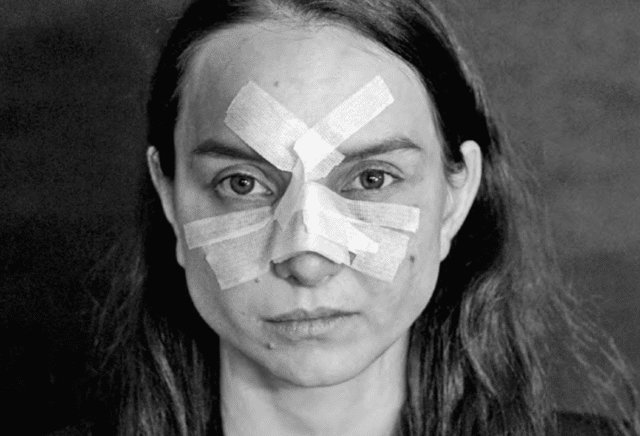
Faces of Agata by Małgorzata Kozera
During KFF Industry, eight new Polish documentary projects approaching completion were presented to the great and the good from the international finance, sales, distribution and festival sectors. The subject matters are diverse, entertaining and dramatic in equal measure, ranging from the life of a transgender woman in Pakistan, to a Rocky-style tale of boxing prowess and dedication, to a Polish graphic designer whose Communist era logos are now considered as significant artworks from the period.
Read on for reports on the eight upcoming projects, together with producer/director comments and annotations.
Faces of Agata tells the story of a woman who should have died a long time ago, but was instead born again. A woman who loves life while struggling with a deadly disease, who creates art and never stops asking questions, say the project notes.
“When she was 16 years old, Agata was diagnosed with a severe cancer-like disease that caused bleedings from her nose and mouth and eyes,” explained director Małgorzata Kozera of the 72-minute Poland/UK production. “But Agata didn’t give up…Today she’s 37, she has been through severe pain. She experienced extreme loneliness, has been closed in hospitals for months. She was very close to death but in all this darkness there is also light because in this borderline situation. Agata discovered something that she truly loves. She discovered her passion [for art].”
Shooting on Faces of Agata completed in April 2022 and the film is at advanced edit stage with a first rough cut available. The Plesnar & Krauss project is co-financed by the Polish Film Institute and UK co-producer Premier Productions, which is work on getting a major UK broadcaster on board, confirmed producer Maria Krauss. Later this month Faces of Agata will be presented at Sheffield Meetmarket, where Krauss will continue to shore up festival interest, attract a sales agent and distribution deals. Delivery on the €150k (approx) project is expected February 2023.
Director Kozera tells how she was at first reticent to tell Agata’s story. “I said, no, thank you, it’s not a story for me. It’s too heavy. It’s too dark. I can’t deal with such a burden, but when I first talked to Agata on the phone, I totally fell in love with her [during] the first two minutes of our conversation, because she’s really amazing, full of joy, full of energy and peace… Agata is inspiring me a lot, giving me energy and I’m sure she will also inspire and uplift the audience of the film.”
In Fear Out Of Head, produced by Natalia Grzegorzek of Koskino, director Grzegorz Brzozowski uses the computer screen as a window to the world, and to people who teach him that every fear can be overcome as long as we stay together. In these dark and troubled times, it can be a place to find hope.
“Maybe the pandemic, despite all the suffering, also gave us some opportunity to reflect and reinvent ourselves, like never before. I recall my spring time, two years ago, as a time of radical helplessness, I was missing human connection and a camera. So I decided to turn my computer into the camera, a meeting room and my window to the world,” said Brzozowski of what became a “polyphonic construction.”
“But the computer screen has something peculiar to it. It transmits the information, but no human touch. So what kind of emotions does it actually transmit? A few months later, I found myself having completed more than 16 interviews with people of very diverse backgrounds, diverse ages, professions, life philosophies, religions, artists, extroverts, introverts. Some of them I was meeting, getting to know while talking to them. Others I was reconnecting with after many, many years, like my crush from high school […and…] we narrowed down into six main characters and six supplementary ones.”
The €120k project is in post-production ahead of a March 2023 delivery. Confirmed partners are the Polish Film Institute, and just before Krakow FF they secured a co-production partner in Canal+, producer Grzegorzek confirmed. At Krakow she was looking for further co-pro partners, sales, distribution and festival support.
“I’m a kind of lone wolf having spent most of my adult life on my own,” added director Brzozowski. “Some of my friends refer to me, actually, as a kind of expert in loneliness, which I’m a bit fed up with. But the pandemic imposed the state of loneliness on most of us. So through this project, I want to learn how people are dealing with this experience.”
In The Coal Daughter, directed by Aneta Nowicka, 25-year old Olivia has followed the family [and female] tradition of working in the coalmine, applying herself to one of the most laborious and exhausting tasks of sorting and clearing industrial waste. The phrase ‘you’ll get used to it,’ is one she strongly reacts to as she assesses her future life options.
“I was supposed to work in my parents’ shop – that was the family pressure, so I had to run away,” explains Nowicka of her own upbringing. “But I did come back to that small town in south Poland where I was born, full of coal mines. Because I fell in love with the topic I want to present you. I found the women working physically in the most heavy department in the coal mine. And [when] I found Olivia my character…I immediately knew she’s the one that’s the main story in my movie.”
Produced by Jacek Kucharski (Trafik), the €126,000 52-minute Polish-language project is set for a December 2022 delivery. With confirmed partners in the form of the Polish Film Institute and Polish National TV, Kucharski is looking for post-production partners and a sales agent.
“She [Olivia] has to also face the men’s environment because the world there is like [it has] stopped in the seventies. She also has to face her feminine boss who tells her that if she hasn’t got a rich boyfriend, there’s no other choice than the coal mine,” says Nowicka. She receives comfort from her family, but only via the oft-repeated mantra that “she will get used to it.”
Hope and defiance are found in the shape of her Olivia’s sister Isa who runs a successful hairdressing salon, but another younger sister is also contemplating life down the mine.
“So you may see at the end the movie of a girl who is continuing the family tradition. So it’ll be a universal movie about family heritage,” commented Nowicka. “In many families there is this [parental] need that the child becomes someone, but sometimes someone that they [the parents] want. It may be a movie about not fulfilling your dreams, but how many of us have fulfilled our dreams?”
Support (working title) tells the story of adolescent Łukasz Perkowski’s three-year path to boxing success. As a teenager, he attempts to win the Polish Junior Championship, which can give him independence and triumph.
The 70-minute film is directed by former sports journalist Adam Roszkowski (Okay Films) who produces together with Anna Różalska (Match&Spark) and Tarik Hachoud.
“We all love Rocky Balboa,” says Roszkowski. “I met this kind of hero in real life [a few] years ago when he was just 15 years old. I started to follow him when he was living with the other six members of his family in a very small flat. His dream was to become a Polish junior champion in boxing. He only had two opportunities to achieve this goal – when he was 16 and 17 years old. Winning at this competition would allowed him not only making him dreams come through, but also being financially independent.”
“I have followed this story also from perspective on his mum,” he adds of a very personal aspect to the story. “It was fascinating for me because at his age I also trained [in] boxing. I was raised by my father without my mum. So I noticed something in relationship between Łukasz and his mom, something which I have never experienced myself. I have also been a parent since 2017. So I understand this relation perfectly.”
The project is at edit stage ahead of a December 2022 delivery. With the Polish Film Institute in board, the producers are half way to reaching their €100,000 budget, and are looking for sales, finance, broadcaster and festival support.
Producer Różalska underlined director Roszkowski sports journalist credentials as to why he is the perfect fit for this project. “That gives him a very deep understanding of how athletes operate both in their professional and private life.”
The One I Love, directed by Paweł Hejbudzki and produced by Filip Luft and Justyna Przybylska of Airy Movies, tells a searingly poignant and tragic tale of self-discovery after Daria comes from Mexico to Poland to find the biological siblings her mother gave up for adoption.
“It was about two years ago when a friend of mine from high school called me and said, ‘guess what, after 40 years of my life, I find out that I was adopted, but this is nothing, man. I’ve got a biological sister in Mexico. She found me on Facebook,’” Hejbudzki explains of how he first heard of the story. “And I said, where is she now? ‘She’s in Mexico. She’s got a family there. And, and she wants to reveal everything because there are more of us. There are more brothers and sisters.’”
And so the project began. But what started out as an exploration into a family’s genealogy soon turned into an altogether darker tale of violence and death. As the film summary stresses, Daria’s mother starts to reveal some secrets, at which point the daughter slowly realizes that her mother’s alcohol addiction and seemingly inexplicable life choices may have resulted from a very deep trauma. The relationship between mother and daughter has always been full of pain and mutual regret, but now Daria tries to build it all anew. But the burden of the past drives one of the women to the extreme…
Producer Filip Luft confirmed a delivery date of August 2022 for the Polish/Spanish/Dutch-language film, for which he is looking for broadcasters, financiers, festivals, co‐producers and a sales agent. “To complete this film, we need partners because till now we were filming it with our own resources. The story was happening in front of our eyes. So we just had to take the cameras and act. Now, we need funding to cover our expenses, but also to finish post production.”
Director/producer Paweł Tarasiewicz’s absorbing Well of Dreams tells a tale of love and dreams at the centre of which is Reema, a transgender woman in Pakistan.
Tarasiewicz, also a serious cineaste and owner of cinemas, set out his stall early in his pitch. “I believe every movie should be about love,” he said. “This movie is also about love, the love of Reema. But it’s really hard to find love, especially when you’re a transgender woman.”
“My little hobby is to visit cinemas around the world. So being in Pakistan I visited one of the cinemas in Lahore and a fixer friend of mine I met there told me, ‘don’t go there. It’s a very dark cinema, almost a porn cinema.’ But when I ended up there, I saw that it’s a place where men can see women dancing,” he explains of the project’s inception.
Tarasiewicz was looking for a subject to photograph and asked if there was a festival circuit in Pakistan, he continued.. When he arrived at one, he saw the same women dancing as on the screen in the cinema, but they were transgender women. “I was amazed by this image, by this place, and it was in front of the Well of Death.”
The well of death of the film’s title is what is otherwise known as a wall of death, a precipitously-sided circular construction around which motorcyclists ride at breakneck pace. The dancers perform before the shows.
When Tarasiewicz met Reema something clicked, he explained. “We sometimes say that when you don’t like someone, it means that you love this person. I mean, there’s a friendship that is born. And that was the case of Reema who was covering my camera. She didn’t want to be in front of the camera, but she became my main character of my documentary [that] I’ve been shooting already four years now.”
In the film, budgeted at €120,000, at advanced edit stage and set for an October 2022 delivery, everything seems perfect until Reema, also a sex worker, loses her boyfriend Asif who finds it difficult maintaining their relationship. Heartbroken Reema travels back to the cinema of her childhood, looking for love.
Tarasiewicz explained that Reema’s is a “world different from anything you’ve seen before,” and one “not discovered in cinema from my experience.”
Hasan’s Joy, co-directed by Natalia Pietsch and Grzegorz Piekarski, asks how one can remain calm in the face of impending cataclysm? The answer is ‘keyf’ – the Middle Eastern art of taking pleasure in the ‘here and now.’
“I have a question for you,” said director Pietsch at the beginning of her presentation. “Could you still sit here and quietly watch our pitching if you knew next day your house would be destroyed. Burak the barber…found out that next day his place would be demolished, but he’s still cleaning it. Why? Because maybe one more customer will come. Our film is about enjoying the moment when the catastrophe is coming, about everyday habits and small pleasures. Keyf can be drinking tea or simply walking – this four letter word is the basis of a local philosophy.”
In the film, produced by Katarzyna Kostecka of production company Larmo, we see how the entire Turkish city of Hasankeyf was submerged due to the construction of a dam on the Tigris River, ending the 10,000‐year history of settlement. The most important monuments were moved and New Hasankeyf, an estate of identical houses, was built two kilometres away. The flooded city becomes an attraction for underwater sightseeing, and the castle protruding above the surface becomes a destination for noisy tourist ships. The scale of the changes could overwhelm Westerners, but the people of Hasankeyf managed to maintain their dignity and peace. How? Keyf.
“We found out that a topic that felt so distant is surprisingly universal, without religious, geographical or linguistic bias,” explained Kostecka of the €140,000 project which is still in production. The mooted delivery date is September 2023. Partners onboard are the Polish Film Institute and TVP. The producer is looking for co‐producers, financing, post‐production partners, a sales agent, festivals and broadcasters.
The final Docs to Go final was for Signs of Mr. Plum, directed by Urszula Morga and Bartosz Mikołajczyk and produced by Stanisław Zaborowski and Jan Borowiec of Silver Frame. The story concerns a very talented one-eyed boy who became a graphic designer and whose corporate logos came to define Communist era Poland. Many of the designs are still in use to this day, but no one knows that Mr. Plum created them. Mr. Plum’s real name was Karol Śliwka. Śliwka is the Polish word for ‘plum.’
“Those times when he was creating, trademarks weren’t considered as art,” explained director Monga. “I think that this guy was present in our lives more than any other artist, because the streets and ordinary products were his gallery.”
“His life was very fascinating, and full of drama,” she continued. “As a kid he lost his eye [but with] one eye he graduated from the sculpture and painting department against the will of his parents who wanted him to be a farmer. He broke down after he lost his beloved wife, but despite not having a very happy life, he kept sense of humor and stayed creative to the end.”
The 72-minute film, budgeted at €190,000 and still shooting ahead of a February 2023 delivery, will be based on archival footage, mostly from his private video and photo archive, “but of course on this project, we will also use animation to build the rhythm of the movie and to show you his creative process.”
As Morga writes in the project notes, we will “look at [the history of] Poland through his only eye.”





