DOK Leipzig and Thessaloniki International Documentary Festival announced March 12 the joint launch of Doc Together, a new initiative dedicated to supporting displaced or exiled filmmakers and those working under perilous conditions in their home countries.
Doc Together aims “to explore how these professionals can access funding, resources and industry support in their current locations or in their countries of origin if they are excluded from national funding opportunities or unable to receive support.”
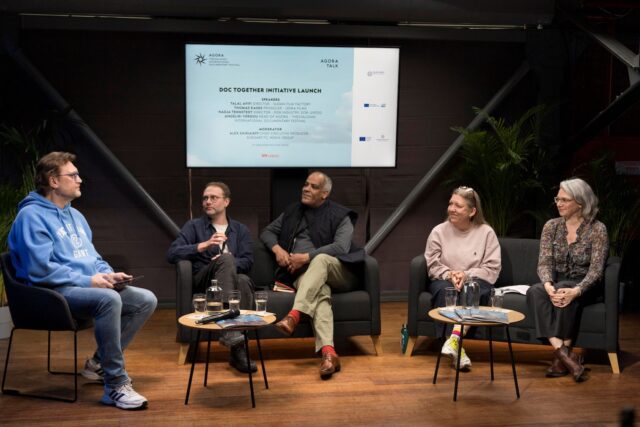
The initiative was officially presented at the Thessaloniki International Documentary Festival by Nadja Tennstedt (Director of DOK Industry, DOK Leipzig) and Angeliki Vergou (Head of Agora, Thessaloniki International Documentary Festival) together with Talal Afifi (filmmaker, producer and founder of Sudan Film Factory) and producer Thomas Kaske (Seera Films). The event was moderated by Alex Shiriaieff(co-founder of B2B Doc and Chief Executive Producer of Euro Arctic Media Group).
In a joint statement, initiators Vergou and Tennstedt said: “Documentary filmmakers often face significant challenges in their home countries, compelling many to relocate for a variety of reasons. Some are persecuted due to their political views or aspects of their identity, including ethnicity, gender, or sexual orientation, as oppressive regimes or religious establishments impose restrictions on freedom of expression. Others are forced to flee as wars devastate their homelands, while some struggle with the lack of necessary infrastructure to sustain a filmmaking career. At the same time, there are also filmmakers who choose to remain in their countries, navigating hardships while finding ways to continue creating under difficult circumstances. On countless occasions, documentary filmmakers have had to re-establish their careers in foreign countries.”
As part of this initiative, the Leipzig and Thessaloniki festivals will host events that foster critical discussions on these issues. These events will also provide a platform for selected filmmakers to present their works and share their stories, ensuring that their voices are heard and their creative endeavors are supported.
“With Doc Together, DOK Leipzig and the Thessaloniki International Documentary Festival reaffirm their commitment to fostering inclusivity and resilience in the documentary film industry, advocating for filmmakers whose creative expression is at risk,” the festivals jointly underline.
During the launch, B2B Doc’s Alex Shiriaieffcommented: “Daily, we encounter filmmakers from countries where the conditions are unfavorable. Such cases are for example Ukraine, or Belarus. In these countries, there is a plethora of filmmakers with important stories to tell, yet they are often marginalized by the industry itself. Today, we are living in a climate where we are confronted with dictatorships, democracies in ruin, states in occupation, wars, censorship, corruption, nepotism. There are filmmakers facing exile, or seeking asylum. We observe the radical right gaining momentum. There are limitations on freedom of expression, but also a significant violation of the rights of minorities. What is the common denominator in all these issues? They are all political in nature, and spreading from Europe to the other side of the Atlantic.”
Sudanese producer Talal Afifi spoke about the situation in his home country: “In reality, a creator from Sudan must deal with the traditions of the local community, the government, as well as the embargo imposed on the country by Europe, America, and the United Nations. It is very difficult to find funding. We have been at war for two years now. Filmmakers often need to relocate, and many of them are seeking asylum. I don’t know how the situation will unfold. It is a new condition of dispersion, one that we don’t even know how to deal with.”
Thessaloniki Doc Fest’s Vergou further added: “We decided to launch this initiative here, in Thessaloniki, and call upon whoever is interested in joining their voice with ours. Each filmmaker in exile, in danger, or in their homeland lacking access to state funding, can find the support they need through our network. Our objective is to aid creators in reaching the market, from covering their accommodation to helping them promote their idea.”
Summed up DOK Leipzig’s Tennstedt: “We wanted to share our experience regarding what works at a national level. For example, for some filmmakers, the process of securing a visa is extremely difficult. We have to examine how this can be facilitated. This year, we are trying to identify creators, talk to them, and consider their needs. We often assume we know people’s needs but this can be far from the truth. We are still exploring the idea of creating think tanks, gathering different members, institutions, markets, investors and individuals so as to investigate how this initiative can work even more effectively.”
“It was both a desire and a priority for us to contribute,” Tennstedt underlined.