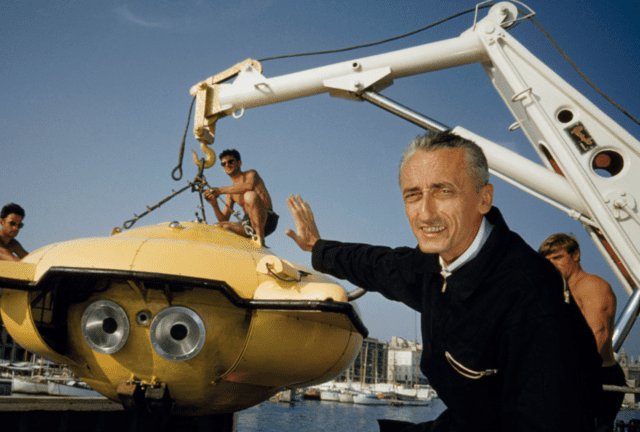
Long before nature programming became a staple of television and even before saving the planet became an imperative, French inventor/conservationist/explorer/filmmaker Jacques Cousteau and his iconic red beanie took audiences deep into the world’s oceans to reveal a beautiful, dangerous, mesmerising and threatened underwater world.
His films and television programmes are rarely seen these days, though his film The Silent World won a Palme d’or at the 1956 Cannes Film Festival and he, of course, served as an inspiration for Wes Anderson’s 2004 comedy The Life Aquatic with Steve Zissou. But his influence remains profound, whether it be introducing audiences to the living world of the oceans or discussing the dangers of climate change and the human dangers to the oceans.
The title of Liz Garbus’s enthralling and engaging film may well serve to emphasise the story of how he both found his love for the sea and became such an iconic and even celebrity figure, but the rest of the story is of his life as an oceanographer who managed to use that celebrity status to try and do good.
To an extent, Garbus takes a linear documentary route as she tells the story of this remarkable life, though an early scene right at the start of Becoming Cousteau explaining the wonder of the undersea world to a group of enthralled schoolchildren also sets the tone. The first half details his early years and how later a car accident that almost killed him set him thinking about the nature of life, helping his find peace and a sense of calling in the underwater world.
A French naval officer and explorer, he also co-developed the Aqualung, was drawn to the world of freediving and in the 1930s shot a remarkable series of underwater sequences. His life is also punctuated with tragedies – whether it be as part of his plans to create an underwater city or the death his son Phillipe – but to an extent the film remains driven by a sense of wonder for the beauties of the undersea world despite the complexities and dangers that come with it. Vincent Cassel’s striking narration helps to foster that tone of wonder both for the watery world and the complicated Cousteau.
He admits his failings – both as a father and husband – in one interview, with the lure of the sea proving too demanding at times, and it is rather plaintive to hear about both his son’s death and his first wife Simone’s death from cancer, and then see him spend time with the two young children he had with second wife, Francine.
What is most striking is seeing him make the journey from enthusiastic adventurer and recorder of the natural world (rather like David Attenborough) to activist keen to explain the impact of climate change and how mankind itself was polluting and destroying the oceans.
The film by its nature is archive driven, but it is wonderfully structured and edited, with Garbus allowing the late Cousteau’s innate passion, enthusiasm and even optimism be the driving force rather than take a downbeat tone. He remains a remarkable figure and Becoming Cousteau is an impressive account of his life…and it also simply makes you want to go out and track down all of his films.
US, 2021, 93mins
Director Liz Garbus
Production National Geographic Documentary Films, Story Syndicate, ACE Content
Producers Mridu Chandra, Dan Cogan, Liz Garbus, Evan Hayes
Screenplay Mark Monroe, Pax Wassermann
Editor Pax Wassermann
Music Danny Bensi, Saunder Jurriaans
With Jaqcques-Yves Cousteau