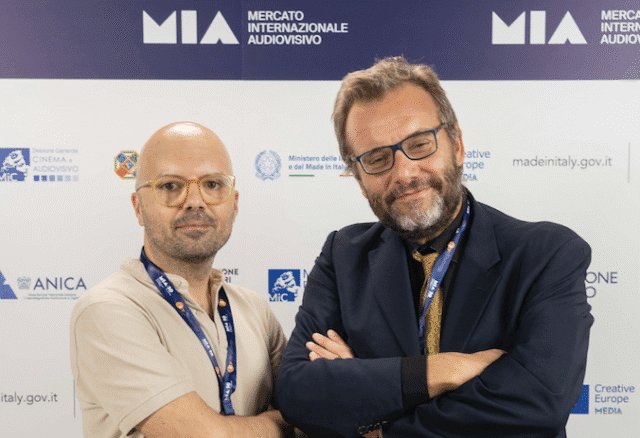
The upcoming edition of Rome’s MIA (6–10 October) is set to reinforce its role as a key meeting point for the non-fiction industry. Speaking to Business Doc Europe, MIA’s Head of Doc & Factual and Deputy Director, Marco Spagnoli, and Head of the Doc Co-Production Market, Ben Pace, outlined an event focused on coproduction and internationalisation, fostering connections that bring documentary and factual stories to global audiences.
Spagnoli first highlighted the rigorous selection process for the Doc Co-production Market & Pitching Forum. “We’re very pleased because this year all the projects are world premieres. Last year, this was still just a preferential criterion,” he explained. Out of more than 170 applications, 15 projects were selected, underlining MIA’s evolution into an international reference market. Spagnoli admitted that achieving this milestone had been uncertain at the outset, but described it as “the result of a gradual process.”
Pace added that the selection was intentionally diverse, spanning multiple formats – feature documentaries, docuseries, and one-off TV specials – and a wide range of themes. “We cover everything from sports in challenging contexts to civil rights, the fight for transgender women’s rights, crime, femicide stories, art, architecture, and science. We don’t focus on a single theme. The selection committee chooses the best projects based on value and narrative quality,” he explained.
Spagnoli emphasised that the market’s broad editorial approach reflects its philosophy. “Specialisation would contradict the line of MIA and our Doc section. The strength and interests of projects must find space for everyone. Besides, we don’t want to offer an outdated notion of Italian documentary, often shot in black-and-white and telling ‘uncool’ stories. That no longer works.”
When asked about the presence of six Italian projects out of 15, he stressed that they were selected for their intrinsic value, not national quotas, highlighting the strength of the local documentary scene.
Spagnoli also highlighted the significance of the Italians Doc it Better showcase. “It’s fundamental. It’s an idea inspired by international experiences. Italy lacks a large, Oscar-qualifying documentary festival. This showcase allows us to present Italian titles with international potential. These are advanced projects with diverse stories and an international outlook.” Producers are asked to present their projects in English, using trailers or clips, creating opportunities for international financing and visibility.
A long-term partnership with GEDI, one of Italy’s largest media and publishing groups, is essential for addressing a persistent challenge for documentaries: communication and audience reach. “If projects don’t have major players or broadcasters behind them, they risk being unknown. We create opportunities to make their work visible,” Spagnoli explained.
PANELS, TALKS, AND INDUSTRY INSIGHTS
The 2025 programme will feature a series of notable panels and talks. Among the confirmed guests is Thom Zimny, docmaker and Bruce Springsteen’s biographer, who will host a special keynote on October 9. Spagnoli also noted that high-profile guests such as Odessa Rae and Brian Fogel attend to share their experiences navigating complex production challenges, rather than to pitch projects.
Key panels include discussions on financing in Italy, organised with APA and leading broadcasters such as Rai and Sky, and What’s the Future of History?, examining the enduring relevance of historical documentaries. Panellists will explore global audiences for contemporary and ancient history, the role of AI, and new formats and platforms shaping storytelling. Speakers include Caroline Haidacher (ORF, Austria), Elisabeth Hagstedt (Histoire TV, France), Mikael Österby (SVT International, Sweden), Laurent Filliung (ARTE GEIE, France), and Sergiy Nedzelskyy (Suspilne, Ukraine), moderated by Krishan Arora (UK).
The increasingly important issue of theatrical distribution will also be addressed in Getting Docs to Theaters: Strategies and Opportunities. The panel will examine how streaming has transformed viewing habits while identifying opportunities for documentaries on the big screen. Speakers include Enrico Bufalini (Cinecittà S.p.A.), Franco Di Sarro (Nexo Digital), Artur Liebhart (Millennium Docs Against Gravity), Augustina Lumi (Usheru), Gregorio Paonessa (Vivo Film), and Anastasia Plazzotta (Wanted Distribution), with Giorgio Bigoni (Cinetel) moderating.
A specialized session, The (Second) Italian Job: Stolen, Heist of the Century, will explore the production of the Netflix/Amblin documentary Stolen. Spagnoli recalled: “We had previously met Chiara Messineo and director Mark Lewis for Vatican Girl, before its distribution. Stolen revolves around a group of Italian thieves. With the help of the Piemonte Film Commission, they could recreate locations in Turin instead of Antwerp or South Africa, achieving remarkable accuracy. A project like this shows that Italian and European stories can have significant international reach.”
Later, Pace and Spagnoli highlighted the growing thematic diversity of documentaries today. “There is great vitality in the field, different from twenty years ago. There isn’t a single dominant idea; instead, there’s a diversified offer, with audiences following documentaries on both television and in cinemas.” The pandemic, Spagnoli noted, has further expanded viewership in Italy, which has finally caught up with international standards: “Audiences have discovered stories beyond traditional narratives, including music, art, and politics. Platforms have made a wide variety of content accessible, and RAI Play, our public broadcaster’s VoD platform, now has over 25 million registered users, reflecting the growing public interest in documentaries.”
The 2025 edition of MIA Doc & Factual demonstrates that documentary storytelling thrives on collaboration, diversity, and international outreach. Through a rich programme for industry professionals attending on site and virtually, MIA promises to “solidify its role as a catalyst for innovation while creating opportunities for projects to reach audiences worldwide.”
MIA | Mercato Internazionale Audiovisivo is promoted by ANICA (Italian Association of Film, Audiovisual and Digital Industries) chaired by Francesco Rutelli, and APA (Italian Audiovisual Producers Association) chaired by Chiara Sbarigia, and directed for the fourth year by Gaia Tridente.