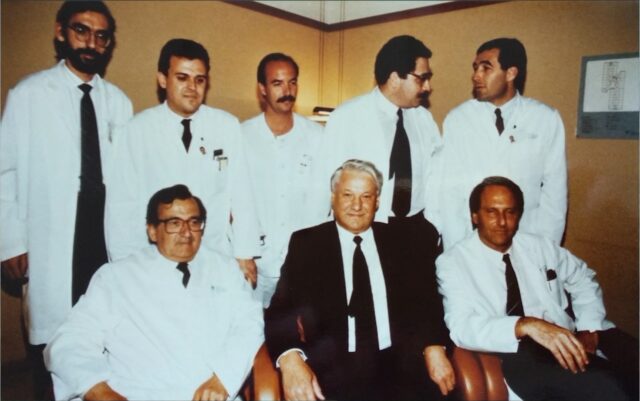
Barcelona’s most improbable Russian connection has landed at Rome’s MIA market. Boris Yeltsin, Forever Friends, a new doc project directed by Manuel Rodríguez, will explore the extraordinary relationship between the former Russian president and the Catalan doctors who saved him, drawing on previously unseen archives and first-hand testimonies. The film will revisit how emergency surgery brought Yeltsin to Barcelona and how that unlikely bond endured through some of the most turbulent years of post-Soviet politics.
Selected for MIA’s Doc Connect: One-on-One programme, the project is budgeted at €590,000, seeking international co-production, broadcasting and sales partners.
The story begins in April 1990, when Yeltsin, an outspoken challenger to the Soviet establishment, travelled to Barcelona at the invitation of Catalan broadcaster TV3 to participate in a televised debate about communism’s future. Instead, a severe herniated disc left him in acute pain and with partial paralysis in one foot. He underwent urgent surgery at Barcelona Hospital on 30 April, missing the debate. Within days he was back on his feet. Little more than a year later, the politician appeared atop a tank in Moscow during the failed August 1991 coup.
The Catalan connection did not end with his recovery. In September 1993, with Yeltsin now president of Russia and suffering renewed back problems, members of the Barcelona medical team travelled to Moscow to examine him. According to the production dossier, they stayed in Mikhail Gorbachev’s former dacha and joined Yeltsin for a Kremlin banquet.
Within weeks, the president’s confrontation with parliament turned violent, culminating in tanks firing on the parliamentary building on 4 October. When he returned to Barcelona in 1994, Yeltsin met his former doctors once again.
Rather than assemble another conventional political biography, director Rodríguez plans to tell this history through the testimonies of people who knew Yeltsin as a patient. The film’s chapters will be organised as sections of a clinical record: admission, history, diagnosis, treatment and prognosis – allowing his political trajectory to be examined through the practical, unsentimental perspective of the medical staff.
“I first heard this story as an anecdote; too many coincidences, too perfectly assembled. A Soviet politician operated on in Barcelona; Catalan doctors singing inside the Kremlin. What made me commit was not the geopolitics, it was the doctors,” says Rodríguez, a Barcelona-based filmmaker whose background combines fine arts, political science, television and documentary work.
That perspective promises a tension between personal intimacy and public responsibility. The doctors encountered a patient whose charisma, physical vulnerability and resistance to medical advice could coexist with decisions that shaped millions of lives. The September 1993 reunion is particularly charged: convivial scenes in the Kremlin are set against the constitutional crisis unfolding almost immediately afterwards. The film will ultimately follow Yeltsin’s path to his resignation on New Year’s Eve 1999, when he handed power to Vladimir Putin.
The filmmakers say they have access to members of the Catalan team whose accounts have not previously been recorded on film, including doctors Carles Humet, Josep Granados and Robert Soler, alongside Mercè Puig and nurse Glòria Rosell. Proposed archive material includes TV3 footage of Yeltsin speaking from his Barcelona hospital bed in 1990, local coverage of his 1994 visit and a previously unpublished letter in which he thanked Spanish prime minister Felipe González and Catalan president Jordi Pujol for the medical assistance he received.
“For thirty-five years this story lived in a few archive boxes and in the memories of a handful of doctors. Our job is to get it on camera while the people who were in that operating theatre can still tell it,” says producer Jaume Vilalta.
Vilalta is producing with Paolo Maria Spina of Italy’s Revolver. Catalonia’s 3Cat/TV3 is being lined up as the anchor broadcaster, with licence terms still under negotiation and access to its 1990–1994 archive forming an important part of the proposed arrangement. No international sales agent has yet been appointed. The project is being developed in both a 90-minute feature version and a 52-minute television cut, with Catalan, Russian and Spanish dialogue and English subtitles.
At MIA, the team hopes to secure a minority co-producer from France or Germany, ideally one with relationships at ARTE or ZDF, as well as to advance pre-sale discussions with broadcasters in the UK, Nordic countries, Benelux, Central and Eastern Europe and Italy. Producers are also looking to build a shortlist of international sales agents with documentary festival experience and North American broadcasting contacts.
Filming is currently planned for summer or autumn 2027, with a festival premiere targeted for spring 2028. If it comes together, Boris Yeltsin, Forever Friends will connect a little-known episode of Catalan television history with the larger question of how political power and private loyalty can coexist, without asking its doctors to pass judgement on their most famous patient.