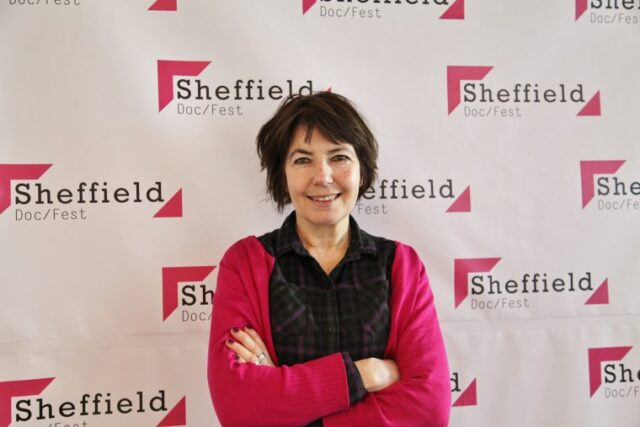
For British docmaker Kim Longinotto, the camera is far from an impartial observer. It can shift power dynamics, encourage unexpected conversations and even change the lives of those standing behind it. Speaking during a ‘fireside chat’ moderated by MIA’s Head of Doc Content Marco Spagnoli on 20 October in Rome, the director reflected on nearly five decades of filmmaking, explaining why she rejects conventional interviews, avoids imposing explanations on audiences and considers emotional involvement essential to her work.
“I’m not at all objective,” Longinotto declared when asked how she approaches cultures different from her own. “I know I was supposed to be,” she acknowledged, before making her position even clearer: “I wouldn’t want to be objective.”
The conversation, accompanied by excerpts from several of her documentaries, began with Divorce Iranian Style (1998), co-directed with Iranian legal anthropologist Ziba Mir-Hosseini. Filmed inside a Tehran divorce court, the documentary follows women navigating a legal system heavily weighted against them.
Longinotto recalled how the production itself altered the atmosphere inside the courtroom. “When Ziba said to the women in the corridor, ‘Can we film your story?’, not one woman said no. They were delighted, because we changed the balance of power in the room.”
Her camera was positioned to capture both the judge and the women appearing before him, while allowing the latter to address the filmmakers directly. Longinotto remembered wearing an ill-fitting chador borrowed from Mir-Hosseini’s aunt, an unintentionally comic detail that helped make the crew seem less intimidating.
The contrast became apparent when another Iranian crew arrived with lights and a tripod but struggled to persuade anyone to speak. Longinotto insisted that her own approach depended on allowing people to behave naturally. “We didn’t ask them to do anything. It was very much their space, and we were just there for them, really, and with them.”
The collaboration also transformed Mir-Hosseini, who had experienced two divorces as a teenager but initially felt ashamed of her past. As filming progressed, she began sharing her experiences with the women she encountered, using her knowledge of Islamic family law to establish trust.
For Longinotto, the relationship illustrated the reciprocal nature of documentary filmmaking. “I think making films changes you, because you learn more about yourself,” she observed, adding that she discovered how much she shared with Mir-Hosseini despite their different backgrounds.
Humour emerged as another important element of the film. Longinotto recalled an early university screening during which women in the audience laughed repeatedly at the exchanges between the divorce petitioners and the judge.
“There was angry laughter, because they were recognising things. There was mocking laughter,” she explained. One woman, after enduring 30 years of an unhappy marriage, repeatedly insisted she no longer wanted her husband, while the judge suggested that she should make herself more attractive to win him back.
When a male spectator subsequently complained that people were laughing at a supposedly serious documentary, Longinotto defended the response. “I think laughter is very liberating. It’s a very freeing thing.” Ridiculing oppressive figures, she argued, could make them appear less powerful.
The MIA discussion also provided insights into the practical challenges of producing observational documentaries, particularly when financiers demand clearly defined stories before filming begins.
Longinotto explained that Divorce Iranian Style was developed partly from the case histories collected in Mir-Hosseini’s book Marriage on Trial. To secure a commission, she presented prospective characters and scenarios to the broadcaster, effectively dramatising situations she hoped to encounter. “Commissioning editors don’t like it if you can’t tell them what,” she said, recalling their expectations of a shooting schedule and identifiable protagonists.
Although the team could not predict who would enter the courtroom, four of the five principal types of cases they had anticipated eventually materialised, albeit involving different people. The woman featured in the opening sequence, however, arrived unexpectedly and effectively invited the filmmakers to record her confrontation with the judge.
This tension between the need to plan and the unpredictability of real life remains central to Longinotto’s filmmaking philosophy.
Another formal decision concerned the use of narration. Longinotto recalled that Channel 4 had insisted on a voice-over for Divorce Iranian Style, although she believed audiences could have understood the material without it.
Her subsequent work increasingly embraced the experience of fiction, where viewers discover locations, characters and relationships through the unfolding action rather than explanatory commentary.
Discussing Sisters in Law (2005), co-directed with Florence Ayisi and set in Cameroon, she described constructing the opening around a journey into the courthouse, allowing the audience to become immersed in the setting before meeting the principal characters.
“I remember saying to Audrey, the editor, it would be really nice to make this as if it’s fiction. Even though nothing’s set up, it’s not fiction at all,” she recalled. Her aim was to avoid the “dead hand” of informational voice-over and instead “just let the audience feel their way”.
The same philosophy shaped Hidden Faces (1990), filmed in Egypt with Claire Hunt. Longinotto described an intimate sequence involving her Egyptian collaborator Safaa Fathay and her mother, who unexpectedly began discussing her marriage and personal history after waking for morning prayers.
Rather than organise a formal interview, Longinotto knelt on the floor and quietly filmed their conversation. “I think that’s what’s so interesting about filming, is that you create a sort of neutral space where things can happen that wouldn’t normally happen.”
She explained that the camera could temporarily transform family relationships, enabling subjects to ask questions or share feelings that might otherwise remain unspoken. To preserve that intimacy, she preferred communicating with collaborators through gestures, eye contact or touch rather than interrupting scenes with instructions in English.
Yet such closeness also creates ethical complications. Reflecting on Gaea Girls (2000), her documentary about Japanese female wrestlers, Longinotto admitted that she had been unprepared for the brutality of their training.
One sequence showed wrestler Meiko Satomura repeatedly striking a young trainee during a gruelling test. “At one point, I thought, ‘I’ve got to stop this. Chibi’s going to be killed.’ It just felt so painful,” she recalled.
At a recent London screening, Satomura reportedly acknowledged how uncomfortable she now felt watching her younger self. Having subsequently established her own dojo, she told the audience that her approach to training had changed and that she cared for the young women under her supervision.
Longinotto further recalled Satomura saying: “I look at that now, and I don’t recognise that girl as me. I can’t believe I did that.”
The episode raised questions about the filmmaker’s responsibility when documenting violence or abusive behaviour. Longinotto acknowledged that her own perspective had evolved, particularly regarding people she initially regarded as antagonists.
She referred to Dreamcatcher (2015), which examines the experiences of women involved in prostitution in Chicago, and Salma (2013), about an Indian poet whose creative ambitions were constrained by her family and marriage.
In both cases, Longinotto gradually became more interested in understanding how perpetrators of oppression had themselves been shaped by violence, shame or restrictive social expectations. “For the last years, I’ve been trying to be much more even-handed. I’ve tried to understand the people, the baddies,” she explained.
Her admiration for Iranian filmmaker Jafar Panahi reflected a related interest in storytelling that reveals different perspectives without explicitly instructing audiences what to think. Longinotto singled out It Was Just an Accident as an “absolute masterpiece”, praising its combination of humour, political urgency and inventive filmmaking under restrictive conditions.
The MIA conversation moved on to Shinjuku Boys (1995), co-directed with Jano Williams, which explores the lives and relationships of three gender-nonconforming hosts working in Tokyo.
Longinotto described how one of the protagonists, Gaish, invited the crew to accompany him on a date because he feared his girlfriend was preparing to end their relationship. Initially hoping that the presence of a film crew would impress her, he found himself in an unexpectedly revealing conversation.
Although Longinotto could not understand every word exchanged in Japanese, she explained that she could follow the emotional shifts through gestures, expressions and changes in behaviour. “The girlfriend starts taking control, and I find that fascinating,” she observed, describing the encounter as something the couple appeared never to have experienced before.
The anecdote encapsulated the central argument of the discussion: observational filmmaking is not simply about recording events without interference. A filmmaker’s presence can create circumstances in which people discover new ways of expressing themselves.
For Longinotto, that possibility depends less on technical sophistication or claims of neutrality, more on patience, personal conviction and the willingness to become emotionally invested in other people’s lives.
“I care passionately about the people I’m filming with,” she signed off, reaffirming an approach in which the documentary camera is both a witness to reality and an active participant in the relationships it records.