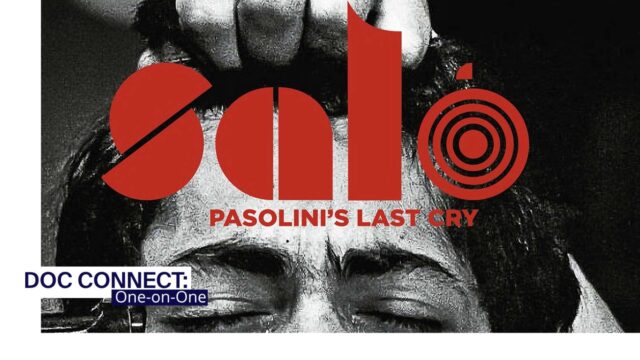
French filmmaker Sophie Bassaler is developing Salò, Pasolini’s Last Cry, a 90-minute feature documentary revisiting Pier Paolo Pasolini’s final film, Salò, or the 120 Days of Sodom (1975), not simply as a landmark of cinematic provocation but as a warning about the mechanisms of power that, she argues, still shape contemporary society. The France–Italy co-production, produced by Philippe Touzery of Wendigo Films alongside Matteo Tortone of Malfé Film, will be presented at the MIA market in Rome, running October 19–23, 2026, as part of its Doc Connect: One-on-One programme.
Currently at the development stage, the project is being positioned as a historically grounded investigation into the making and reception of Pasolini’s most controversial work, as well as an examination of its relevance in an era of resurgent authoritarianism, commodified bodies and violence consumed as spectacle. French firm The Party Film Sales is attached to handle its international sales, whilst shooting is planned for 2027 ahead of expected delivery in 2028.
“In the dark recesses of film history lies Salò by Pier Paolo Pasolini. Like the books confined to the ‘Inferno’ section of libraries, Salò long stood as my personal Everest,” Bassaler says. “Once I dared to confront it, it never left me. What stayed with me was not so much the disturbing monument, more often invoked than seen, but what it embodies and denounces: the mechanisms of power in the hands of a few men, and the atrocious violence they inflict upon the rest of humankind.”
Rather than constructing a conventional film-history portrait, Bassaler has devised a narrative inspired by Dante’s Inferno and the structure of Pasolini’s adaptation of the Marquis de Sade. The documentary begins with an Antinferno centred on the film’s tumultuous Paris premiere on November 22, 1975, three weeks after Pasolini’s murder, before travelling through the Circle of Passions, the Circle of Shit and the Circle of Blood. A concluding chapter, The Prophecy, connects the political climate of 1970s Italy with the present day.
The feature will explore the rupture between Pasolini’s earlier Trilogy of Life, which celebrated bodily freedom, and his subsequent rejection of that vision as consumer culture absorbed and commercialised sexuality. It will place Salò within the Years of Lead, drawing on the filmmaker’s political writings, including Io so (I Know), and the turbulence surrounding the production and its posthumous release. The proposed reconstruction also covers the theft of film reels in 1975 and Pasolini’s final days, although the documentary’s broader focus is on his artistic and political arguments rather than attempting to settle the circumstances of his death.
Bassaler explicitly links this political rupture to the present. “I had never truly understood what Pasolini meant when he described Salò as ‘his first film about modernity’ until the current geopolitical context revealed its full meaning,” she writes in her director’s statement. The closing section will extend this analysis to algorithmic surveillance, emotional capitalism and contemporary forms of social control.
Bassaler’s treatment combines archive material, including footage from the set, interviews and television appearances by Pasolini, press coverage and production photographs, with new filming in Italy, France and Germany. Discussions with archive holders and prospective contributors are under way, but the producers stress that access agreements and interview participation have yet to be finalised. The film’s visual language will contrast the chilly, controlled geometry associated with Salò with the warmth and grain of historical material and footage of Rome’s working-class outskirts. A recurring black circle will punctuate its descent from one chapter to the next.
“The heart of the film is one question: why was Salò so impossible to understand, even for some of the finest minds of its time?” Bassaler explains. “Like Salò itself, the documentary descends through Dante’s circles.” For the filmmaker, the last movement is as important as the historical excavation: “In November 1975, people looked at the screen and saw a scandal. Half a century later, I want us to look again and see ourselves in a mirror.”
Bassaler previously directed New York Cinéma, featuring Martin Scorsese, Spike Lee and Harvey Keitel, and Cinema Through the Eye of Magnum, which screened at Telluride and Hot Docs and was distributed internationally through broadcasters including Arte, the BBC and HBO Europe. She has also worked on the editorial and visual identity of Turner Classic Movies. The new project promises to extend her interest in the relationship between cinema, cultural memory and political history.
On the financing side, Salò, Pasolini’s Last Cry has secured development support from Procirep-Angoa, alongside its established French–Italian production structure. The team is in discussions with a French broadcaster and has made initial approaches to other European broadcasters following its selection for MEDIMED 2026. The budget has not yet been finalised.
At MIA, Touzery and Tortone will seek additional European co-producers, broadcast pre-buys, private finance, Italian archival partnerships and theatrical distribution opportunities. The producers identify Rome as particularly important for strengthening the Italian component of the project, securing institutional backing and advancing access negotiations. Festival and television launches are envisaged, although no premiere has been slated.