French director Mathilde Damoisel is examining more than a century of Italian emigration in Ciao Italia!, a 90-minute documentary that challenges the familiar narrative of successful integration by looking at the discrimination, labour struggles and changing racial identities experienced by Italian communities abroad. Produced by Paris-based Hauteville Productions in co-production with Arte France, the film is currently in production and will be presented at the Doc Pitching Forum during Rome’s MIA, running October 19–23, 2026.
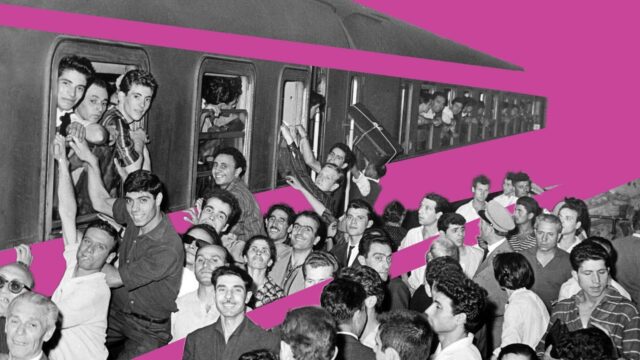
Tracing the departure of an estimated 26 million Italians between the country’s unification in the 1860s and the early 1970s, the documentary follows migrants who crossed the Atlantic or the Alps in search of what they called pane e lavoro (“bread and work”). Their experiences stretched from industrial France and the United States to Argentina, Brazil, Belgium and Switzerland. Rather than treating the diaspora as a straightforward story of upward mobility, Damoisel examines how migrants once regarded as outsiders gradually came to be presented as exemplars of the “good immigrant”, sometimes at the expense of later arrivals.
The doc is organised into two broad historical movements. The first part, titled Pane e lavoro! (1860–1929), explores the mass departures prompted by poverty and political instability, and the often hostile reception awaiting Italian workers. It revisits the 1893 massacre of Italian labourers at Aigues-Mortes in France, the lynching of 11 Italians in New Orleans in 1891 and the struggles of Italian-American radicals, including Nicola Sacco and Bartolomeo Vanzetti, whose trial and execution became an international cause célèbre.
The project also considers how perceptions of Italians differed across borders. In the United States, migrants were subjected to racial discrimination and excluded from established notions of whiteness. In Argentina and Brazil, by contrast, European migration was promoted within racialised nation-building projects, an unsettling counterpoint to the familiar image of Italians solely as victims of prejudice. Labour activism, anarchist movements and the emergence of organised Italian communities form another strand of the narrative.
The second part, titled The ‘Good Immigrants’? (1930–1973), charts the changing status of the diaspora, from the political divisions created by Fascism and the resistance of Italian exiles to post-war labour recruitment. The documentary will address the 1946 arrangement that brought Italian miners to Belgium, as well as the experiences of guest workers in Germany and Switzerland. Particular attention is given to the so-called ‘children in the closet,’ the sons and daughters of Italian workers who were hidden from the Swiss authorities because of restrictions on family reunification.
Across both periods, the treatment casts migrants in a succession of often contradictory roles: foreigner, worker, threat, settler, essential and, finally, good immigrant. In detail, this thematic approach examines how perceptions changed according to the political and economic needs of host societies. It also asks whether communities that achieved acceptance could themselves become complicit in the exclusion of newer arrivals.
For Damoisel, the story also unfolds through the descendants who shaped the cultural identities of their adopted countries. Figures explored in the project include footballer Michel Platini, singer Salvatore Adamo, actor Dominic Chianese and Rino Della Negra, the French footballer of Italian descent who joined the Resistance. Their stories sit alongside those of lesser-known families, workers and political activists, linking personal memories to the broader history of migration.
The documentary will combine contemporary interviews with historians and descendants, filming at significant migration sites and material drawn from more than 30 photographic and audiovisual collections. Planned locations include Little Italy of New York, the Paris suburbs, Belgian mining towns, Buenos Aires’ La Boca neighbourhood and the Italian settlements around Caxias do Sul in southern Brazil.
The filmmakers also cite extracts from works such as The Godfather, The Sopranos and Bread and Chocolate to explore how popular culture has shaped representations of Italianess. Traditional emigrant songs, reinterpreted in a contemporary pop-rock idiom, are intended to form the basis of an original soundtrack.
Damoisel previously worked with Hauteville on Blood, Sweat and Sugar, a documentary examining the history of labour and exploitation in sugar production. The producers describe Ciao Italia! as a continuation of her interest in discrimination and the lasting consequences of historical inequalities, with individual testimonies giving emotional weight to an expansive political and social narrative.
The stated ambition, according to the production team, is “to recount, with power and emotion, a pivotal human saga in our contemporary history, and to encourage discussion about the history of migration and what our societies owe to it.”
The film has a budget of €775,000, of which 75% has been already secured. Alongside Arte France, it has received development and production backing from Procirep-Angoa and backing from the Île-de-France region. At MIA, Hauteville is seeking an Italian co-producer to contribute local expertise, as well as international broadcasters, pre-sales and an international distributor. Delivery is slated for mid-September 2027.