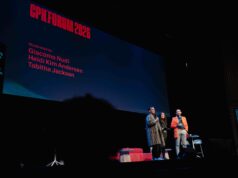
On 17 October, Rome’s MIA hosted a keynote titled ‘Unveiling Truth and Inspiring Change,’ delivered by the Oscar-winning producer Odessa Rae of US-based Raefilm Studios. Rae spoke about two of her most acclaimed works: Daniel Roher’s Navalny, an Academy Award, Sundance and BAFTA winner, and Ibrahim Nash’at’s Hollywoodgate which premiered at Venice last year and is set to be a frontrunner during the upcoming awards season.
First, MIA Head Gaia Tridente and MIA Head of Doc & Factual Marco Spagnoli invited Rae on stage. After showing a clip from Navalny, Rae admitted that the infamous scene where the Russian opposition leader phones his hitmen would never have happened if she hadn’t been there to shoot the documentary.
“The night we met Navalny and his wife, Julija, Daniel [Roher] and I pitched the idea of making a documentary. We ended up spending three and a half months together with them in the Black Forest,” Rae revealed. At first, the documentary had no budget and no broadcaster on board, so everything was charged to the credit cards of Rae and Christo Grozev, Bulgarian investigative journalist and Rae’s close collaborator on the film. “We had the DoP on board, and the sound guy in Stuttgart agreed to work on deferred pay.”
“That night, we told Navalny how important it was to capture the moment. We didn’t know he was planning to go back to Russia. Trust was built day by day. On the first day, he wanted to make sure we weren’t spies and checked our bank accounts. We said, ‘why don’t you just let us film? If you don’t like what you see, you can have the footage, no strings attached.’ We started slowly. In the first scene, he and his wife are walking in the forest picking apples. He teases her and says, ‘do you think this is like Russia, where everything in open space is yours?’”
Rae and her team quickly realised they needed to film Navalny and [wife] Julija in action, “not just seeing them working with their laptops.” That’s when the idea to call Navalny’s hitmen came about.
“The phone call took place in the B&B in Fribourg where Daniel and I were staying. We invited Navalny to use it as his basecamp. We got the suspect [on] board and everything he [Navalny] needed. And then we kept the cameras rolling… That phone call lasted almost an hour, even though you only see seven minutes in the film. During the call, one of these FSB guys confesses there was a plot to kill him [Navalny]. Next, Putin held a press conference and said: ‘If we wanted to kill Navalny, he’d already be dead.’ But the release of that phone call created huge ripples in Russia. Finally, there was an insider confirming what the opposition had been saying for a long time…That was one of the first big wake-up calls.”
Rae added that the second wake-up call was the unveiling of the riches of Putin’s palace alongside Navalny’s release of his own documentary on YouTube. “The ‘employee of the people’ [showed] absurd wealth… That sparked some of the largest protests ever seen.” Rae added that ultimately the protests failed and Russia is now a closed country with little hope in sight.
Next, Rae discussed the making of Hollywoodgate. The project details the dreadful fall-out following the US withdrawal from Afghanistan in 2021. Through the Doha Film Institute, director Ibrahim Nash’at managed “to gain some valuable connections and to board a couple of Qatari military planes.”
“He had to make new inroads. He stayed for weeks and weeks trying to find access. Eventually, it was a sort of stroke of God. He used to rent an apartment in Kabul, and he bumped into one of the heads of communication for the Taliban,” Rae said.
“This guy asked: ‘What are you still doing here? You’re a Western journalist.’ Nash’at said: ‘I’m a documentary filmmaker, but if you don’t like my proposal, I’ll leave tomorrow.’ So, he felt sort of obliged to let him into his apartment, and they spoke for seven hours. ‘I’m not here to make a propaganda film, [Nash’at added]. ‘But I want to film you so that people themselves can decide and make a decision […] I hope this documentary can make a difference in how we act and how our government can act differently from now on.’”
Thus, the director managed to spend over a year in Afghanistan. “We realised how hard it is for women to live there – they can’t speak outside, they can’t read or sing aloud inside, they need to be completely covered everywhere they go, and even if they need to buy groceries, they need to be accompanied and act dumb to say which ones they need. […] So, you get this intimate view of what’s happening there.”
Rae highlighted how all of this is the result of a twenty-year war backed by four different US administrations – two Democrat, two Republican. “It started off as a war to find Bin Laden; it turned into a mission to bring democracy, something that never worked.”
Rae also disclosed that Laura Poitras’ My Country, My Country has been a great inspiration for her in her of non-fiction filmmaking. “Documentaries like these make us feel responsible for the US war machine, which is important to question. Our film [Hollywoodgate] got strong distribution in Europe and the UK this summer, but we’re still struggling to distribute it in the US. I don’t think I have to say much about that… It’s really hard to get the film out. Hopefully, we’re doing a strong Impact campaign that can supplement our struggles.”
The film has been shown to various governmental organisations, including the EU Parliament in Brussels and the UK’s Ministry of Defence. “Basically, we showed it to the people who decided to send weapons. We left [Afghanistan] completely armed with billions and billions of dollars of US weapons. I don’t specifically blame Biden – the [pullback] agreement was made by Trump, but it’s all of the four administrations’ responsibility. I hope all of this will create something that can change our foreign policy, and how we make decisions around that.”