

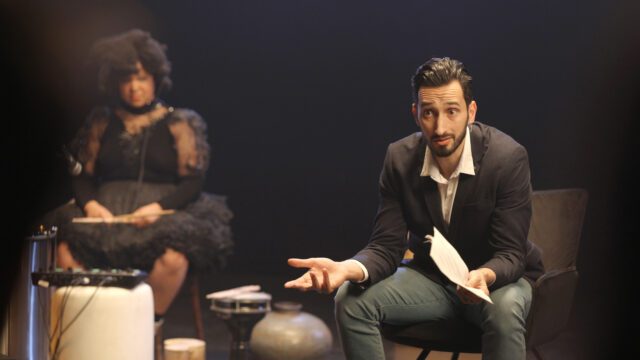
Actor/author Rashif El Kaoui was born of a loving Flemish mother (Christine) and a Moroccan father (Ahmed) who showed little inclination to be the dad that his son wanted him to be. Rashif was, as he says in the film, “born in the interval, the space between polarities, the space where hate takes shape, love is stirring and the axis is shifted.”
Ahmed was a “week-end” father who never wanted to take his wife and son back home on his frequent trips to Morocco. So at the age of 11, Rashif called time on the father/son relationship, in the film admitting to “going the full Freudian…killing the father means killing your inner child.”
He subsequently grew up in Belgium with his mum and grandparents. He had no desire either to learn Moroccan or visit the land of his father. Nor did Rashif want to visit the spot off the coast of France, in the Mediterranean between Collioure and Port-Vendres, where his father drowned.
But such is the enduring power of family and legacy that Rashif eventually takes the first tentative steps towards discovering his paternal roots, starting with contacting his uncle in Belgium. He then embarks on an odyssey back to Casablanca to meet his maternal grandmother, and to the tiny village of Tingliane in the Atlas Mountains where his father was raised. A final emotional visit to his father’s last resting place in France enables Rashif better to understand what shaped Ahmed’s personality and determined his actions.
Produced by Corine Meijers of Studio Biarritz, I am a Bastard received a Special Mention from the Dutch Movies Matter jury this week. The film is a co-production with Dutch broadcaster NTR for its Het Uur van de Wolf creative documentary strand, and will premiere on the small screen Wednesday April 20.
Meijers explains how, when director Ahmet Polat discovered that Rashif had never been to Morocco he vowed to his friend that if “if you go one day, then I’m gonna make a film about it.” As this was Meijers’ first documentary since launching her new company Biarritz, she was equally all-in.
“We really did this adventure together, all of us, director Ahmet, Rashif and me, and the sound guy Alex Booy. We were all there all the time supporting Rashif. Everything you see in the film really happened in front of us as well,” says Meijers of the doc’s sense of immediacy and integrity, citing as an example the first time her protagonist meets his grandmother. “It’s not that we went to see her first. It was really the first time Rashif met her [on-screen]. Also in the village, we really wanted Rashif to tell his story as it happened. It was not us producing everything in advance, and then bringing him in afterwards.”
Shot during a time of lockdown uncertainty, the original plan was to drive to Spain, take the ferry to Morocco and then continue by car to Casablanca and on to the mountains south of Marrakech. But this was continually scuppered due to the travel restrictions among all the countries in question. In the end the production flew to Morocco as soon as a narrow window opened up in Summer 2021.
The film’s lyrical script, which articulates Rashif’s thoughts and feelings, was co-written by Fabie Hulsebos and director Polat, in association with Rashif himself.
There is an associated theatre play called ‘The Bastard,’ and an interactive dimension titled ‘We Are Bastards’ was launched at Movies That Matter, designed to engage wider debate on the issues raised in the film.
In terms of international ambitions for the film, Meijers is confident that it can travel beyond Dutch borders. “I think that the thematic of the film is very universal,” she says. “So for sure we’re going to make some noise and I will bring it to other countries as well over the next couple of months and years.”





